Hippocrates of Cos was a dreamer among realists. His visions were grounded not among the stars, but in the tangible world of the human body.
Beyond Divine Retribution
In ancient Greece, the explanations for illness were often shrouded in the mystical. It was a realm where divine punishment, wrathful gods, and capricious spirits dictated the lines between health and sickness. Traditional healing practice was intertwined with ritualistic offerings and prayers at the temple. Here, on the serene island of Cos, nestled in the Aegean Sea, a revolution in thought was brewing. A single figure dared to challenge the supernatural narrative—Hippocrates, a physician who would come to be known as the father of Western medicine.
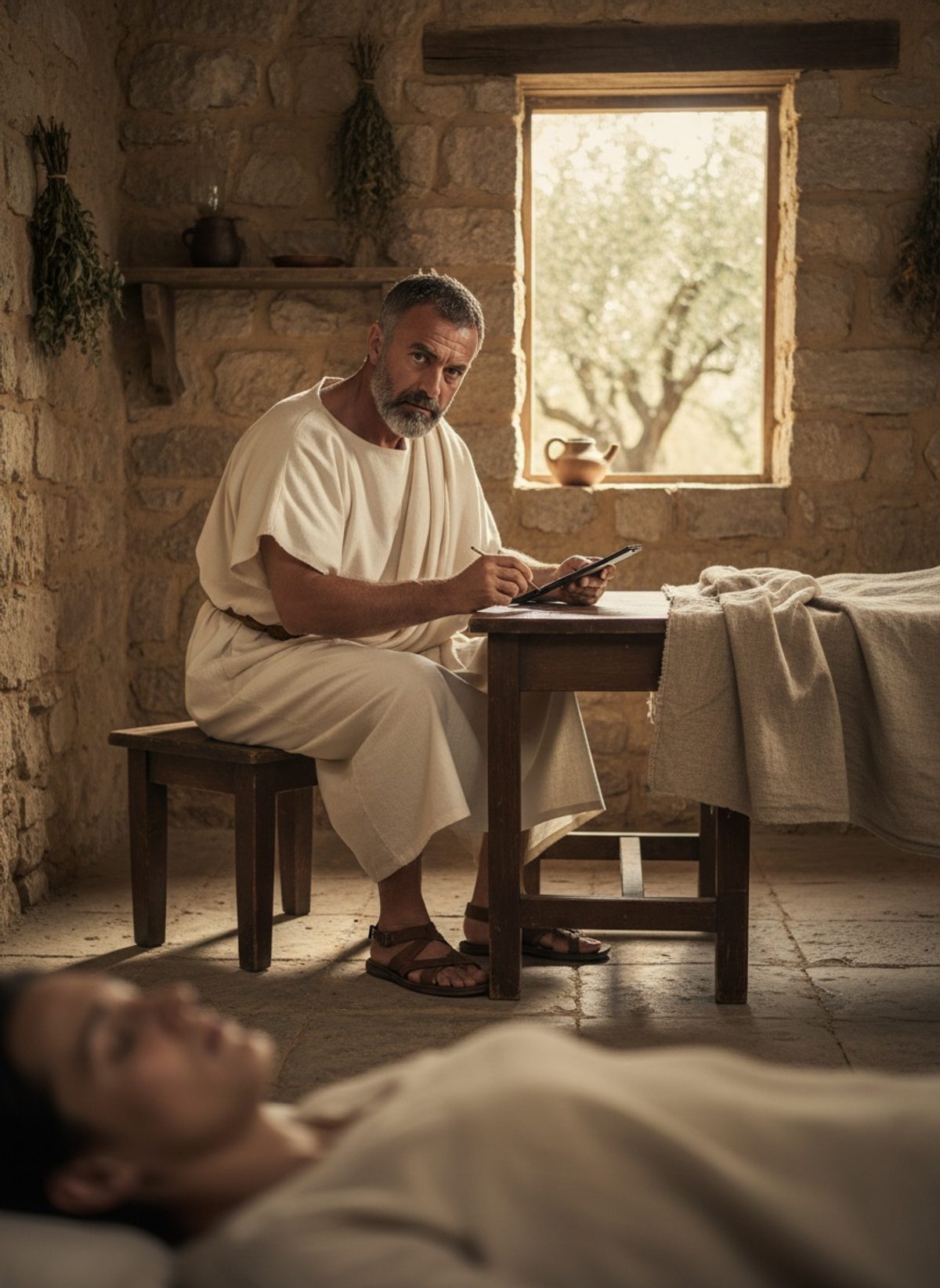
As the sun cast its golden glow over the whitewashed walls of the island, Hippocrates moved through the humble abodes of the sick. He was not searching for signs of divine intervention but for signs of nature’s disturbances. He was one of the earliest to propose that illness resulted from environmental factors, diet, and living habits—concepts revolutionary for his time.
Imagine him standing, eyes keenly observing the feverish patient before him, not praying for a god's favor, but rather, attentively listening to the rhythm of labored breaths. Hippocrates meticulously recorded these observations, marking the rise and fall of fevers and charting the course of diseases. This methodical documentation was as much about understanding humanity as it was about treating its suffering.
Read next: Democritus Said the World Was Made of Nothing. Greece Laughed.
The Dawn of Empirical Medicine
Hippocrates' work laid the groundwork for a crucial shift—from divine causality to naturalistic explanations. This, in turn, led to the formation of what would become known as the Hippocratic Corpus—a collection of texts attributed to his teachings and those of his followers. These writings became the cornerstone of medical practice for centuries to come. They articulated theories and methods focused on the systemic approach toward diagnostics and treatments.
His observations underscored the importance of prognosis—the ability to predict the course of a disease—transforming medical practice. By focusing on empirical evidence and the consistent patterns of symptoms, Hippocrates empowered future doctors to anticipate outcomes, thus better preparing themselves for more effective interventions. Ailments ranging from epilepsy to consumption (now known as tuberculosis) were scrutinized under this new lens, prompting researchers to understand disease as a series of bodily reactions to external stimuli rather than mere whims of the divine.
In Hippocrates’ world, the first tentative steps towards modern medicine were taken not through a telescope pointed heavenward but through an earnest gaze directed at human suffering. He set a precedent for generations to follow—a scientific approach to medicine grounded in observation and logic over superstition and conjecture. His emphasis on environmental factors influencing health resonates through millennia, echoing in modern discussions surrounding public health and preventative care.
Read next: Cliff Young Had No Coach. He Just Kept Moving.
A Legacy Beyond the Horizon
Hippocrates' rejection of supernatural causation in favor of observations and rationality was as transformative as it was risky. To suggest that gods were not behind plague and pestilence might have sounded heretical. Yet, his resilience carved a new path forward, one that emphasized a holistic understanding of humanity and health. His teachings granted dignity to the human condition by shifting the narrative from divine wrath to natural law.
He taught that a doctor must first "do no harm"—a principle still echoed in the Hippocratic Oath, an ethical code that even today guides the medical profession. This oath, steeped in vows of ethical medical conduct, underscores the enduring spirit of his revolution. Inherent within it is the recognition that every patient's life held intrinsic value, a stark divergence from the whims of fate decreed by ancient gods.
Why does Hippocrates' story resonate so profoundly in a modern world awash with advancements his contemporaries could scarcely dream of? Because his approach underscores a fundamental truth—medicine's essence lies not in abstract divination but in compassionate care, rigorous observation, and the relentless quest for empirical understanding. Hippocrates’ journey from the mythical to the empirical spearheaded an enduring search for truths hidden within the human body—a quest as relevant in today’s medical laboratories as it was in the humble homes of ancient Cos. That is the essence of his legacy: a testament to the power of human inquiry, one that dared to read the stars and discover medicine instead.