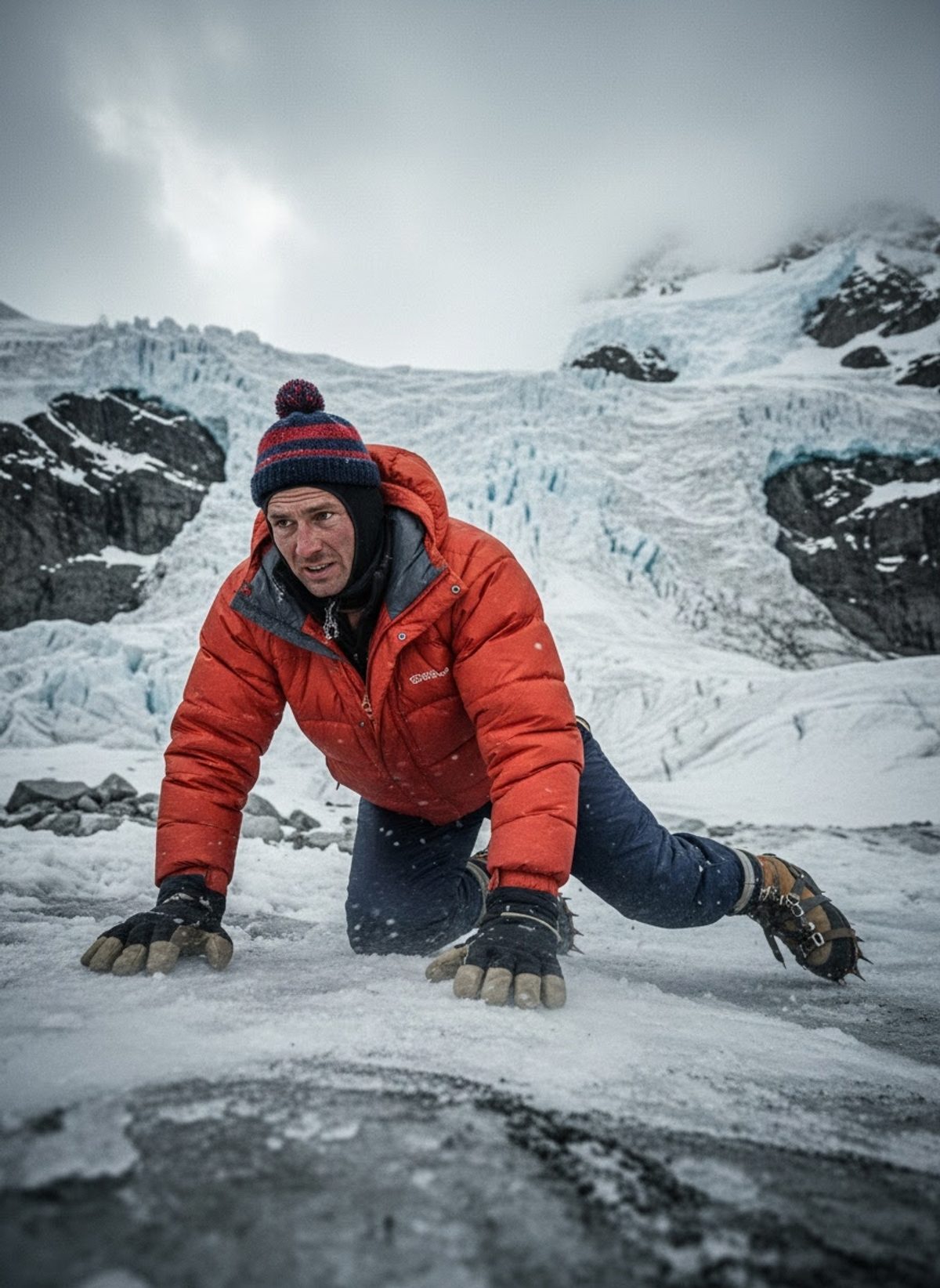
The screech of tearing snow echoed through the crevasse as Joe Simpson landed heavily onto the ice ledge. Darkness surrounded him, the air cold and unforgiving. Pain exploded through his right leg as he took stock of his situation: alone, injured, 20,000 feet high on Siula Grande, a treacherous peak in the Peruvian Andes.
Descent into Darkness
June 1985 marked the harrowing climb of Joe Simpson and Simon Yates, who sought to conquer the West face of Siula Grande. As the first to navigate this route to the summit, they were pioneers in a chilling, ice-bound world. However, the descent proved fraught with challenges.
Severe weather battered them, visibility reduced to mere feet as snow swirled around them. As they turned to the North Ridge, attempting to trace the path of Siula Grande's first ascent in 1936 by Arnold Awerzger and Erwin Schneider, disaster struck.
Simpson slipped on an ice face, and in a cruel twist of fate, a fall shattered his leg, turning a calculated adventure into a desperate struggle for survival. His partner, Yates, faced a dilemma no climber ever wishes to encounter.
Read next: Charles XII Was Shot Dead at Fredriksten, Aged 36
With the weather worsening and Simpson dangling over a crevasse, held only by his rope, Yates made a heart-wrenching decision: he cut the rope to save himself. For Simpson, it seemed a death sentence, but instead, it marked the beginning of an incredible defiance of destiny.
A Choice in the Abyss
In the silent belly of the crevasse, Simpson lay injured and alone. The decision came with clarity: to wait for death or to climb deeper into the abyss. Simpson chose life. Summoning a strength unknown even to himself, he began to lower himself further into the void. Trusting his instincts, he moved away from what could have been his icy grave.
The crevasse, an icy labyrinth, held no mercy. Each movement was a torment, the shattered leg a constant reminder of his fragile mortality. Yet, a miracle of nature offered hope: a small shaft of light piercing through the dark ice. It guided him upward out of the crevasse, pushing Simpson toward the perilous freedom of the glacier above.
His body screamed against the pain, his mind a battleground of desperation and determination. As exhaustion set in, he broke the gnawing despair into manageable goals: reach the next rock, cross another boulder. These micro-missions became his lifeline, his reason to move when every sinew urged him to surrender.
An Epic Trek of Endurance
Emerging from the crevasse was merely the opening act of an excruciating journey. From there, a panorama of icefields and treacherous terrain awaited, a landscape of obstacles for a man who could barely crawl. Three days spanned the odyssey back to base camp, each moment etched in endurance.
Simpson navigated snowfields and talus, transitioning from slipping down ice to dragging his broken body over jagged rocks. Hallucinations danced before his eyes, a cruel mockery from a mind and body pushed to its limits. Yet, he continued, driven by a primal urge to survive.
Food was scarce, shelter nonexistent, and hope a fleeting whisper in the brutal wind. Nightfall offered no respite, only the encroaching cold and the creeping dread of the Andean wilderness. Simpson's only solace was the small flame of determination, flickering against the storm.
Read next: Jalal al-Din Rode Off a Cliff and Genghis Khan Held His Archers
The Final Push to Camp
Crawling mile after relentless mile, Simpson neared base camp. His world shrunk to a single focus, each movement a battle. The once well-laid plans of an ambitious climb had crumbled, replaced by a moment-to-moment fight for life.
The reunion with Simon Yates was bittersweet, a mix of joy and the unspoken acknowledgement of the gamble they each had taken with life. Yates, who had believed his friend lost to the mountain, watched in awe as Simpson returned from the brink.
The event became a testament to human resilience, underscoring the fierce determination embedded in the climber's spirit. Simpson's ordeal was later immortalized in his book, Touching the Void, and the account reverberated through mountaineering circles. Siula Grande remained, its icy face etched with the indelible story of survival against all odds.
Joe Simpson's incredible ordeal on Siula Grande is much more than a tale of survival. It's a profound reminder of the extraordinary lengths one can go when faced with oblivion. In defying the mountain, the elements, and his own frail body, Simpson demonstrated an unyielding spirit. His story reframed the essence of endurance, a vivid illustration of the human capacity to withstand, persevere, and ultimately, endure beyond all expectations.