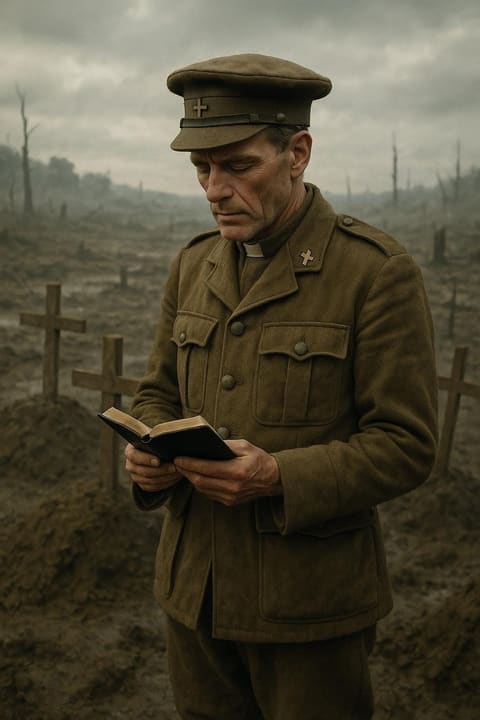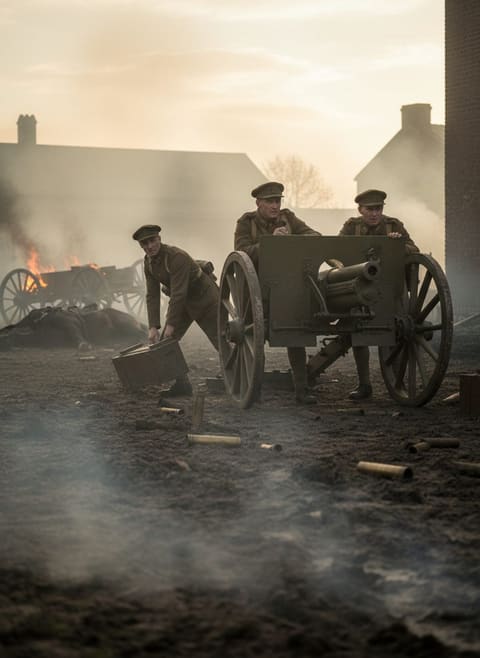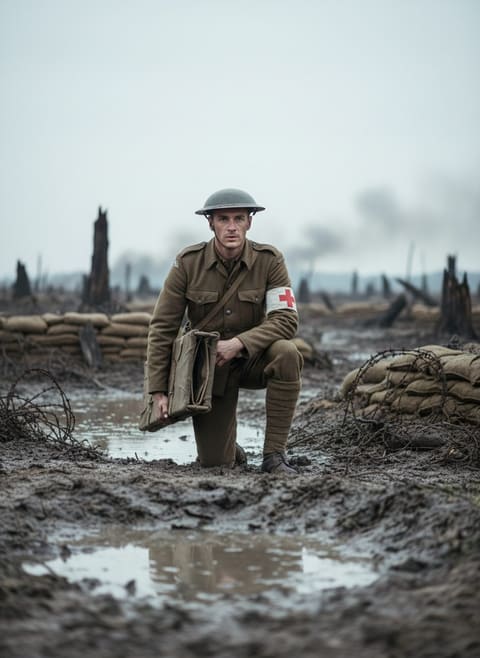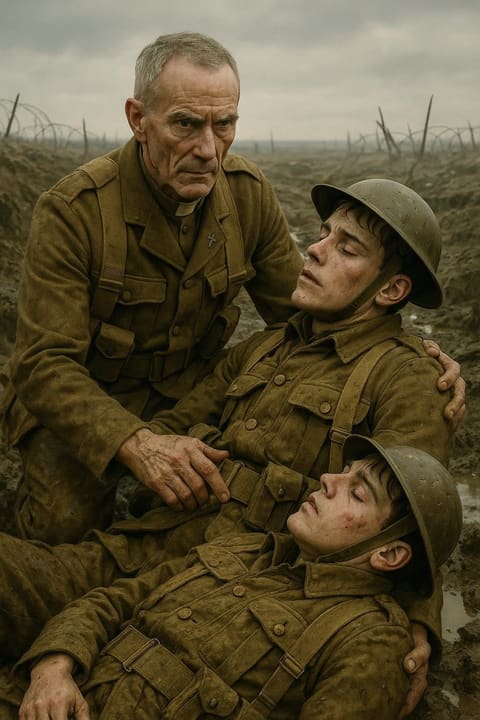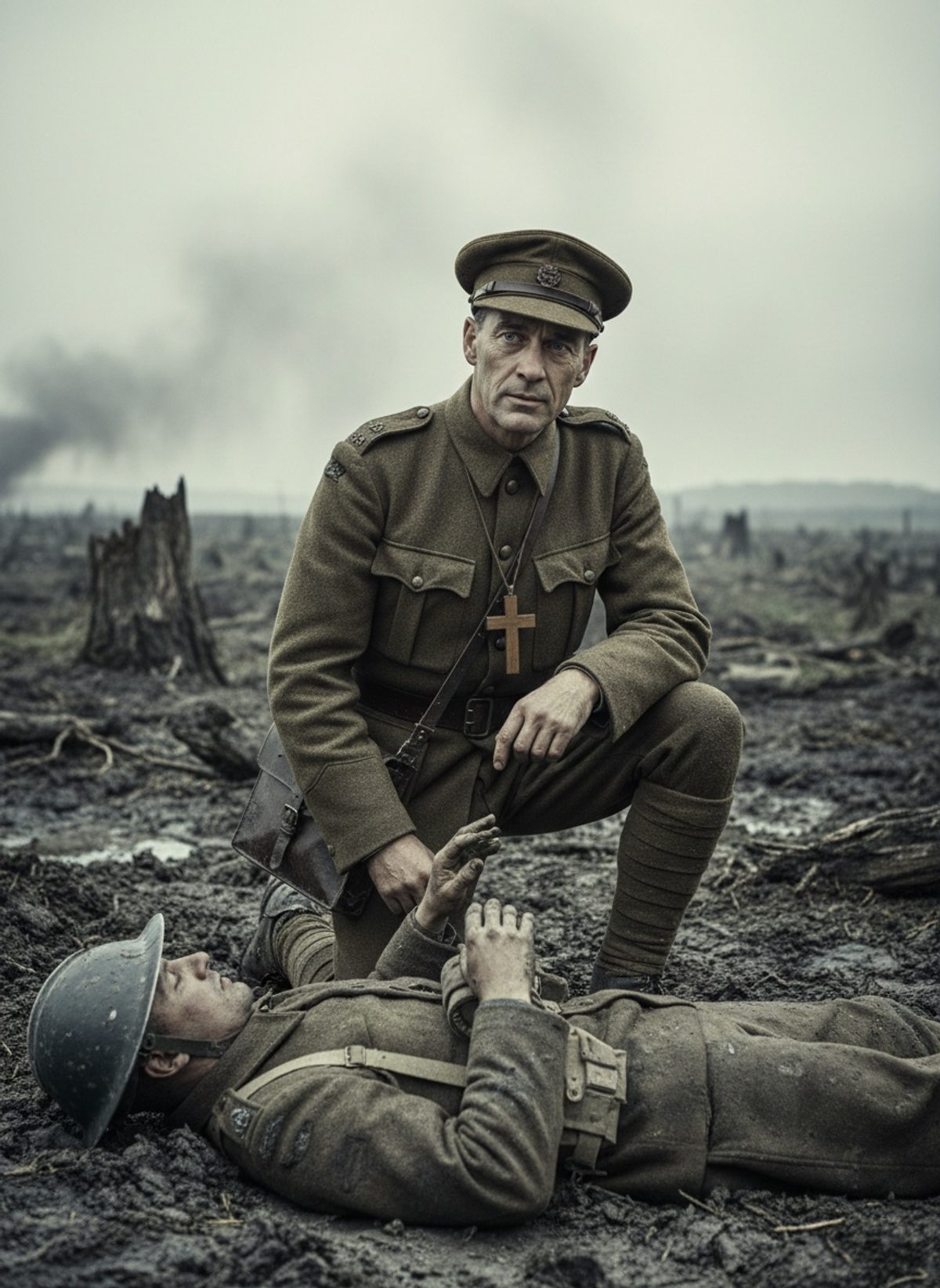
Through the pungent smell of churned earth and lingering gunpowder, the air in no man’s land was almost still, haunted by the anguished cries of the wounded. Padre William Doyle moved with a silent determination, his boots sinking into the unforgiving Flanders mud with each deliberate step. The battle had ebbed, leaving behind a deadly mosaic of barbed wire and scattered bodies. He was unarmed, save for the cross dangling quietly from his neck, a beacon of hope amid the despair that swelled around him.
Doyle was not a stranger to the dangers of no man’s land. The desolate stretch between the German and Allied frontlines was a morbid theater where the courage of some burned fiercely against the bleak backdrop of war. It was August 1917, a few months into the grueling Battle of Passchendaele—an ordeal where traditional soldiering gave way to a grim war of attrition. Troops called it a living hell, yet here was Doyle, a Jesuit priest from a humble parish in Ireland, refusing to heed orders that dictated he stay behind. His mission was his own, dictated not by military command but by an unyielding moral compass.
The calls from the wounded punctuated his thoughts, directing his route like a dark symphony. There were men who believed the padre possessed divine protection, an almost mythic figure clothed in clerical black amid the encircling hues of mud and blood. But it was his humanity, not miracles, they would remember—the way he cradled hands in the throes of death, whispered the final comforts of home, or simply existed as a presence unafraid to cross an invisible line when others dared not.
Doyle had an instinct for this work. Stories from those who had encountered him spoke of a man who bridged differences, willingly attending both Catholic and Protestant troops as if the battlefield itself had leveled all distinctions of faith. His calm demeanor in the face of overwhelming odds lent soldiers a sense of peace, a rare commodity in the chaos of war. This peace often came at great personal risk. To both enemies and allies alike, he was an unmistakable figure: the padre who walked fearlessly through the fray.
Read next: The Day a British Stretcher-Bearer Refused an Order to Save Lives
Back at camp, Doyle’s name was a whispered talisman. Soldiers passed stories of his acts of bravery, tales that grew in the cloudy spaces between fact and legend as they shared them around flickering fires. Yet, it was not bravado or glory that drove him; Doyle's acts were deeply entwined with his devotion to faith and fellowship. Amidst a landscape disfigured by conflict, he brought news from loved ones, borne on handwritten letters plucked from his cloak, read aloud in gentle, familiar tones.
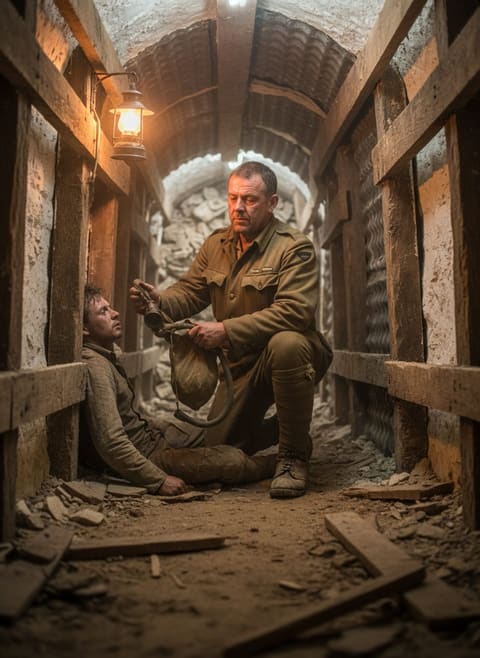
The trenches themselves were an eerie abstraction—a claustrophobic maze of twisted timber and sodden earth. Here, these dugouts shouldered the responsibility for the living and the dead alike, the two often indistinguishable in the endless loops of warfare that turned hour by hour, day into night. Doyle, though, could always be found in the midst of the fray—tending to the dying with sacraments, uplifting the weary with confessions, or just being a voice of reason and reassurance that rivaled the sharp percussion of distant artillery.
For many, he was the last person they would see, Doyle’s shadow lingering as eyesight dimmed into that eternal embrace. In the annals of conflict that constituted World War One, perhaps few could have imagined such a presence—a guardian angel who dressed not in armor but the simple garb of a priest, whose arsenal was not fired by gunpowder but the deepest convictions of his soul.
Read next: The Day a Army Chaplain Gave His Coat to a Dying Stranger
On that fateful August day, as the cries subsided one by one, Doyle became increasingly vulnerable to the perils of his environment. The quagmire of Passchendaele would claim more than 275,000 Allied casualties—a number that soon included Doyle himself, on that lonely stretch of contested earth. He did not return from this journey, and his lasting presence was realized in absence—a life extinguished as quietly as it showed courage. Yet, Doyle’s story continued, a flickering light passed between those who survived.
His valor defied the grim calculus of war. While many conflicted stories claim him as canonized in memory, his name, for those who returned, signified a different kind of heroism—the kind sculpted not in the embers of gunfire but in the quiet moments shared in mutual humanity. Through the lens of history, William Doyle aligns with countless others whose tales of bravery weave into the fabric of the First World War, a testament to the small acts that challenge the overwhelm of such vast destruction.
In the aftermath, as nations sought to redefine themselves in the shadow of loss, the courage of individuals like Padre Doyle offered a poignant reflection. In acknowledging his sacrifice, we recognize the silent men and women throughout history who chose to act when others turned away, daring to make a difference in the simplest, most essential ways. Doyle's lasting legacy suggests that courage need not be loud or commanded, but quietly persistent, illuminating the darkest chapters of humanity with the enduring power of compassion.