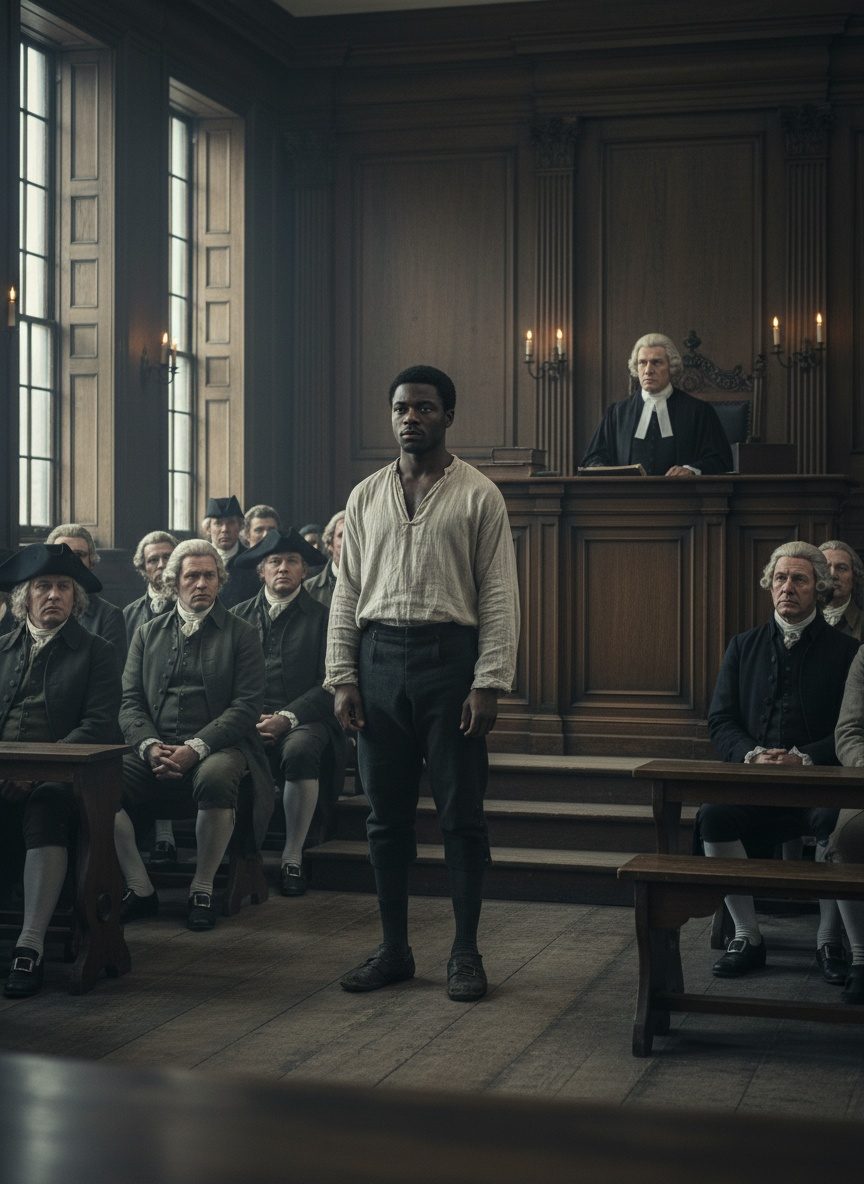
The courtroom was thick with anticipation, the air heavy and damp from the unrelenting London rain hammering against narrow windows. A somber stillness enveloped the gallery as the flickering candlelight cast long shadows across the ornate wood paneling. Across the room’s stone floor echoed the shuffle of anxious feet and the murmur of hushed voices. It was an ordinary day in 1772, but the gravity of the decision before the court that morning was anything but ordinary. On this day, Jonathan Strong stood before Lord Mansfield, the most powerful judge in the land, ready to redefine what it meant to be free on English soil.
A Day in Court
The proceedings unfolded in the esteemed Westminster Hall, where echoes of gavel strikes seemed to resonate eternally within its medieval immensities. Jonathan Strong, the son of a Cornish miner, had once tread his own path beneath the weight of England’s indifference to human freedom. That morning, he stood in a courtroom where justice was to be tempered by a man who had agonized over the implications of his ruling. For Lord Mansfield, this wasn’t just a matter of law; it was a moral crucible.
The case, initially centered around Strong's status, soon expanded its perimeter, challenging legal precedents of human servitude. Fear and hope mixed uneasily in the hearts of those gathered — a collection of legal minds, curious onlookers, and the enslaved souls who dared to dream of freedom. The central question was clear yet profound: Could a person be claimed as property within the sanctified borders of England?
From Darkness to Light
Jonathan Strong's journey to the pale grandeur of Westminster Hall began in the deepest shadows. Beaten by his so-called master, blinded, and discarded onto the unforgiving streets, Strong’s life seemed destined to conclude in obscurity. But fate took an unexpected turn when he was discovered by a compassionate apothecary, who provided him succor and treatment. With time, the lattice of his injured eyes gradually began to part, drawing him back to the borders of sight and understanding.
Read next: The Day a London Printer Stood Trial and Freed the Press
As a testament to the human spirit, Strong found allies who recognized his inherent dignity and worth. His fight became their fight, a shared resolution to challenge the unyielding structures of bonded servitude. These advocates understood that emerging victorious from this case could indeed unveil a new era, one predicated on principles of equality and liberty.
Law and Conscience
Lord Mansfield’s chamber bore witness to countless matters, from mundane disputes to landmark decisions. Yet this case possessed a particular torment. Known for his keen legal intellect and cautious restraint, Mansfield grappled more with his conscience than any point of precedent. The rumbling debate swirled around notions of property and personal rights, encapsulating the broader struggle of the British Empire wrestling with its own iniquities.
Mansfield’s hesitation was no act of cowardice; rather, it was the pause of a man measuring the weight of history. His discernment joined principle and pragmatism in a delicate counterbalance, as he confronted the institution of slavery on British ground. The deeper issue laid bare by the case was one of justice intertwined with human compassion, of recognizing a shared humanity beneath the legal claims of possession.
The Judgement
When the hour came, the courtroom fell into a breathless silence. The esteemed judge at his lofty bench inhaled deeply, a prelude to words that would ripple far beyond that day. His ruling would not be just a statement, but a declaration that no person, once having set foot upon English earth, could be compelled to return to the subjugation of slavery. By refusing any legal recognition of bondage within his dominion, Mansfield shifted the landscape of human freedom forevermore.
His verdict echoed through the hallowed halls and out into the restless world beyond. To Jonathan Strong and those who banded with him, the ruling was an unshackling, both profound and bittersweet. It was a testament not only to a brave individual’s struggle but to the unwavering power of human empathy and justice unbridled.
A Boundary Reimagined
Though narrowly binding in its legal scope, the decision carried extraordinary symbolic weight. It emboldened the growing abolitionist movement, providing a foundation from which to challenge deeply entrenched systems that deemed humans as chattel. This evolved into a gradual swell towards the emancipation and dismantling of the slave trade within the British Empire itself. To deny bondage within England was a step; to abolish it completely still lay far ahead, threading the vast quilt of history with its bold stitch.
Jonathan Strong perhaps remained a figure blurred by the passage of time, yet his resolve lit a path from shadows into eventual daylight. English courtrooms would rarely see a more poignant testament to the idea that justice may falter, delay, and stumble, but it had not — would not — surrender the future. In our continued quest for justice, let us remember this son of Cornwall, his quiet defense of liberty, and the autumn rain that sang outside an ancient court on a day freedom found its voice.