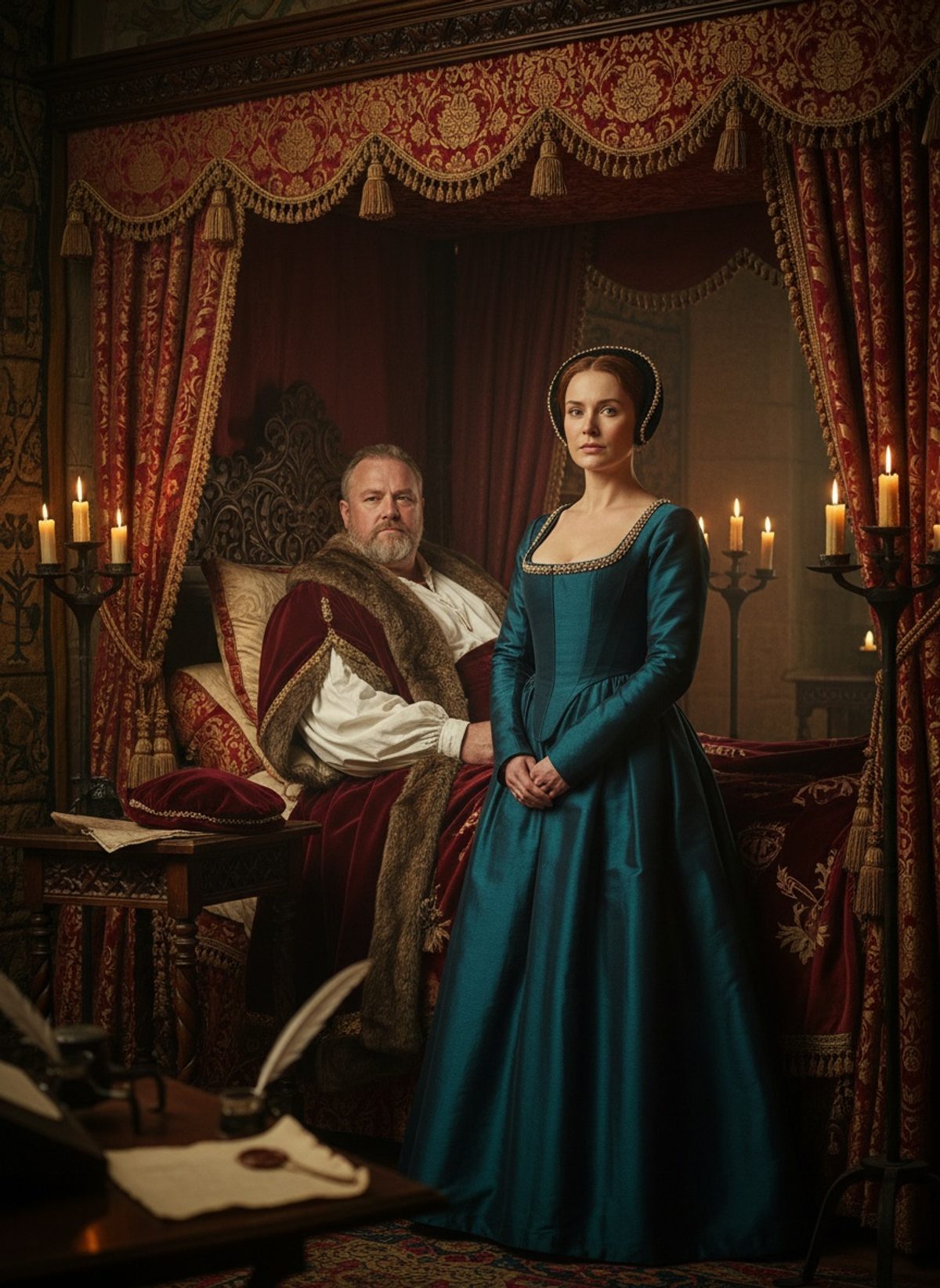
The wind sliced through Whitehall with the chill of finality, each gust whispering through the stone corridors, as if echoing the very breath that was escaping from the chest of a once-mighty king. Inside, the room was dim, candles flickering hesitantly in the draft, their light pooling into almond-shaped shadows on the cold, bare floor. Yet, beneath these wavering shadows lay a reality of unspeakable tension. It was January 1547, and King Henry VIII, the most infamous monarch in English history, lay dying amidst his palatial surrounds. Around him huddled an anxious court, watching for any sign that the tyrant king would either carry one last act of wrath or show mercy unheard of in his long and turbulent reign.
No one could have predicted the act of grace that was to come. Henry had buried two wives, discarded another, and severed the heads of two more whose names were forever stained in history. Catherine Parr, the sixth and final wife, lay perched at destiny's edge like each who came before her. She, too, could have been easily swept aside by the king's famous temper that alternated so swiftly between favoritism and fury. Yet, against expectations, Catherine Parr was written into his will with not just survival, but favor. What occurred in those final days and hours of Henry's life, as illness tightened its grip, was a scene not witnessed by many but reported in hushed tones after.
Outside, London's cobbled streets murmured with their own life, unaware of the machinations behind palace walls. The belief was that Catherine Parr, like Anne Boleyn before her, might be subjected to an end as brutal as their beginnings had been jubilant. A king who had survived a jousting accident that many claimed altered his temperament permanently—a king who wielded his power with little empathy, little grace. The very notion that such a man would show clemency in his last decision seemed as fantastical as the myths of Merlin's magic. Yet Catherine's intellect and patience had seen her through when even the sharpest minds, like that of Thomas Cromwell, fell afoul.
Catherine Parr was no mere surviving queen; she was an orchestrator of her destiny. With a soothing hand, she took on a stepmother’s role to Henry's children, advocating for the education of Elizabeth and ensuring young Edward was well-prepared for the kingship he would assume far too young. It was her stoicism, perhaps, her ability to quell the king's legendary rages with her gentle yet firm demeanor, that earned her a place alongside the looming shadow of death as Henry took his final rattled breaths.
Read next: The Day a Dying King Placed the Crown on His Son's Head
But what of her is most subtle yet profound was her influence on the king himself. Catherine Parr was a staunch supporter of the Protestant Reformation—an advocate of religious reforms that were both progressive and perilous at the time. In a world where opposing views were enough to seal one’s doom, Catherine walked a tremulous line, navigating Henry’s court with the deftness of a political tightrope walker. She managed this not through passive obedience but through open discussions on matters of faith and governance, risking not only her status but her life each time she dared to challenge established norms.
Even those outside the Tudor court could sense the change she brought about. Her intellectual salons became well-known in reformist circles, attracting thinkers, scholars, and radicals who craved change as she did. And it was in these salons that the whispers about female rule and intellectual equality were allowed an ear. Though cautious, Catherine’s influence nudged England closer toward the ideological shifts that would later characterize Elizabeth’s own reign.
As the winter sun cast long shadows across the palace garden on that fateful day, one might have paused to contemplate the ironies that define human history. For a king who desired a legacy as enduring and unshakable as stone walls, it was ultimately thoughts of those who’d follow him—his children and his wife—that dictated his final acts. With a quill guided by foreign hand, Henry's dying wish inked its way into permanence. Catherine's name intertwined with his legacy ensured that she could continue her role as a guardian and an intellectual force in Europe. She was a queen who had not only outlived a tyrant but who had been handed the keys to her future rather than be shackled by his past grievances.
It is this act, this dying wish of a king notorious for his ruthless finalities, that reveals the unpredictability woven through history's fabric. As England braced itself for yet another child king, it did so under the guidance of a queen who had not only navigated the treacherous waters of royal marriage but who had cultivated seeds of change for the future. Catherine Parr had been named an executioner, not of life, but of the burdens that tethered the future to an unforgiven past.
And therein lies the enduring intrigue of this moment—a reminder that in the sombre quiet of a fading life, choices can echo longer than any decree, testament more to what one leaves behind than what was wrought during reign's tumultuous years. When we peer through the mist of time into the life of such a conflicted figure as Henry VIII, we find that his final act of grace illuminates more about the man and his final days than any history book might dare claim. Catherine Parr’s triumph stands as a reminder and question: whether history's real power belongs not to those who wield it, but to those who quietly shape it. Through Catherine, Henry VIII secured a legacy that whispered rather than thundered—a stirring testament to grace in the face of tyranny's end.