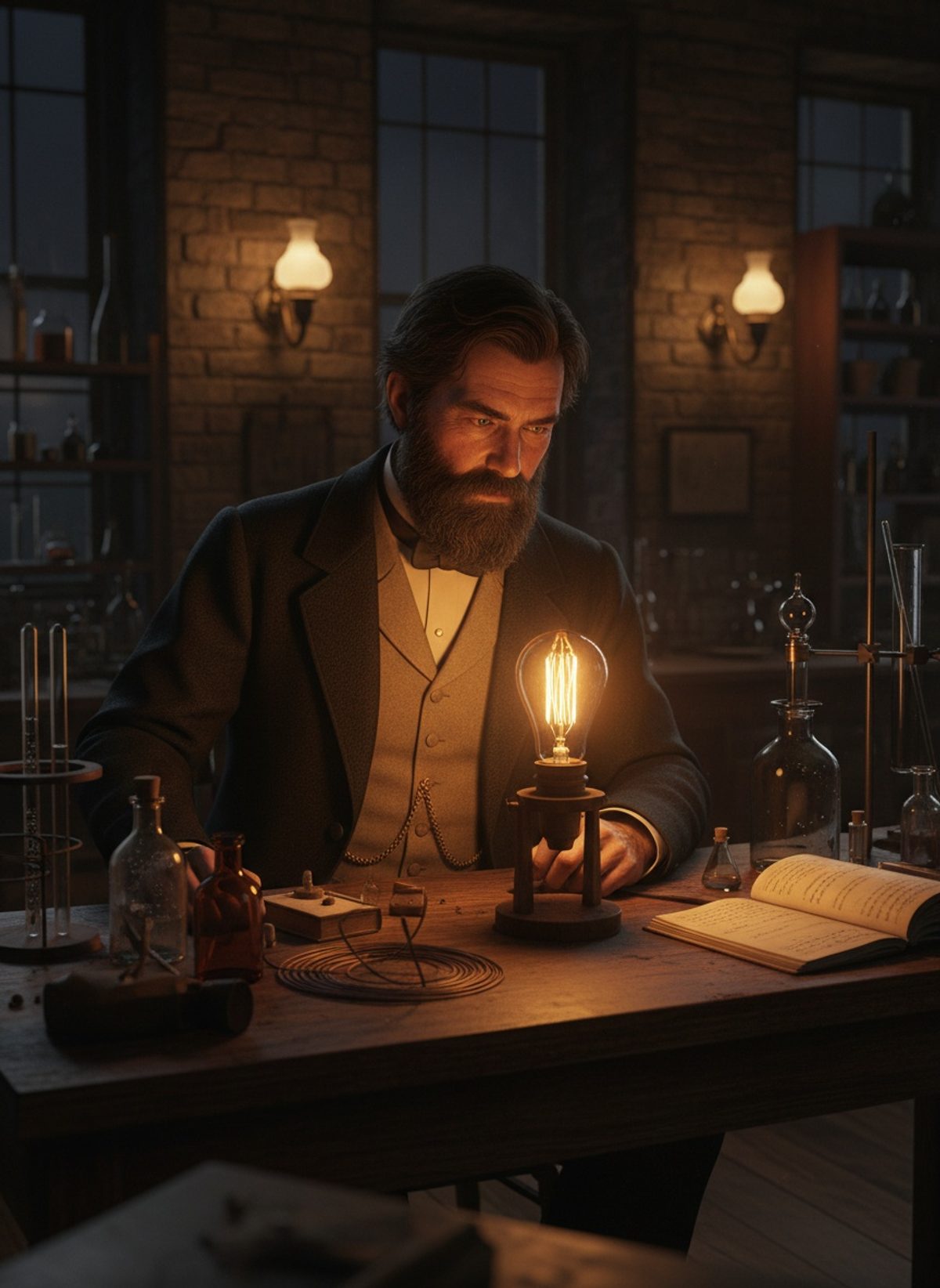
The room was cloaked in darkness save for the single flicker of light that danced like a spirit in the night. A bead of sweat trickled down Joseph Swan's brow as he leaned closer, the luminosity reflecting in his eyes as though myriad tiny stars had descended upon him. For a moment, the world outside ceased to exist for the chemist and physicist who had sacrificed his leisure and peace in the relentless pursuit of his dream. That night, inside his nondescript laboratory in Gateshead, he had transformed a flicker into a steady, glowing promise—a new kind of light that would illuminate the future of humanity.
Joseph Swan, the son of a humble joiner from Bishopwearmouth, had long revered the word written by the flame of lamps that flickered endlessly with soot and hazard. Yet the yearnings of ambitious men are seldom quenched by the convenience of the present. For thirty years, Swan had battled against the ridicule of those who deemed the incandescent lamp an impossibility. His Sunderland birthplace bred a pragmatism that wedded determination to ingenuity. What many failed to understand was that the obstacles to creating a stable electric light—maintaining vacuum seals, discovering a reliable filament, limiting electrical resistance—were puzzles to a mind that relished complexity.
This quiet chemist, without the backing of prominent laboratories or financial benefactors, pulled from his own pocket to chase what others dubbed a fool's errand. A myriad of experiments, with carbon and vacuum tubes, littered Swan's dingy hideaway. Each failure was a lesson in disguise. By 1878, the sun had set countless times over visions littered with flickers and failed filaments. But the spark that lit that fateful evening was unlike any other. It was resilient. It was bright. It was bound to change the world.
Swan calibrated his methods meticulously, understanding that the secrets of a successful incandescent bulb lay inside not just the wire's constitution, but its nature—carbonized thread. A single piece of thread plucked from the commonness of everyday life was his unassuming choice. Transforming it through an arduous process of carbonization was a task both painstakingly slow and admirably simple. The material simmered within the vacuum of a glass bulb, alight with radiance undisturbed by the greedy consumption of fuel or hazardous flame.
Read next: The Day a Clockmaker's Son Tamed the Tides of Time
Before Thomas Edison, a name that would eventually dominate the narrative, Joseph Swan had achieved the unthinkable. The incandescent lamp inside his home was as steady as the resolve of the chemist whose persistent spirit pushed beyond the perceived boundaries of the age. This revelation had not only sent a modest tremor through his household but also challenged the annals of science. The invention, much like light itself, could not be contained—capturing the awe of visitors who would become the first witnesses to a miracle born of determination and silence.
In the heart of the Victorian era, the implications were profound. London streets, forever marred by the sooty residue of gas lamps, beckoned a revolution that whispered of cleaner cities, safer nights, and a society less constrained by the inevitability of nightfall. The strength of this new light lay not in its intensity, but in its reliability. Swan, for his part, was not merely content with invention. Recognition found its roots in practicality, and the chemist saw a horizon where homes and streets alike could shimmer under the glow of electric light with a consistency that had once seemed an unattainable dream.
Read next: The Day a Tanner's Son Mapped the Human Body From Inside
Throughout these developments, the broader impact lingered beyond the immediate delight. The narrative of Joseph Swan—and his incandescent triumph—raises questions critical to the nature of invention itself. What drives a man to labor in obscurity for decades, battling against the expectations of a world entrenched in its traditions? For Swan, it was the intoxicating belief that light could be different, that a flicker in the dark confines of one man's laboratory could transform society, ignite imaginations, and elevate the mundane.
Although history sung of Edison’s advancements and his light bulbs would eventually beam throughout America and beyond, it is important to acknowledge those solitary moments in Gateshead when a joiner's son lit a fire that refused to go out. The light that shone from Swan’s incandescent bulb illuminated not only a room but a path for others who would build the highways of electric innovation upon the foundation of his life's work.
In contemplating the varied landscapes of Britain’s past, the allure of Swan’s legacy lies in its quiet defiance. For in a nation on the brink of the electric century, what better symbol exists of progress than that most human quality: the determination to light the world when shadows threaten to prevail? In those brief moments between darkness and revelation, Joseph Swan granted humanity more than illumination; he offered a lesson in persistence that refracts through every filament of modern society. His tale remains a bridge between the simple and the spectacular, a reminder of the light born from the dark craft of refusal to accept the impossible.