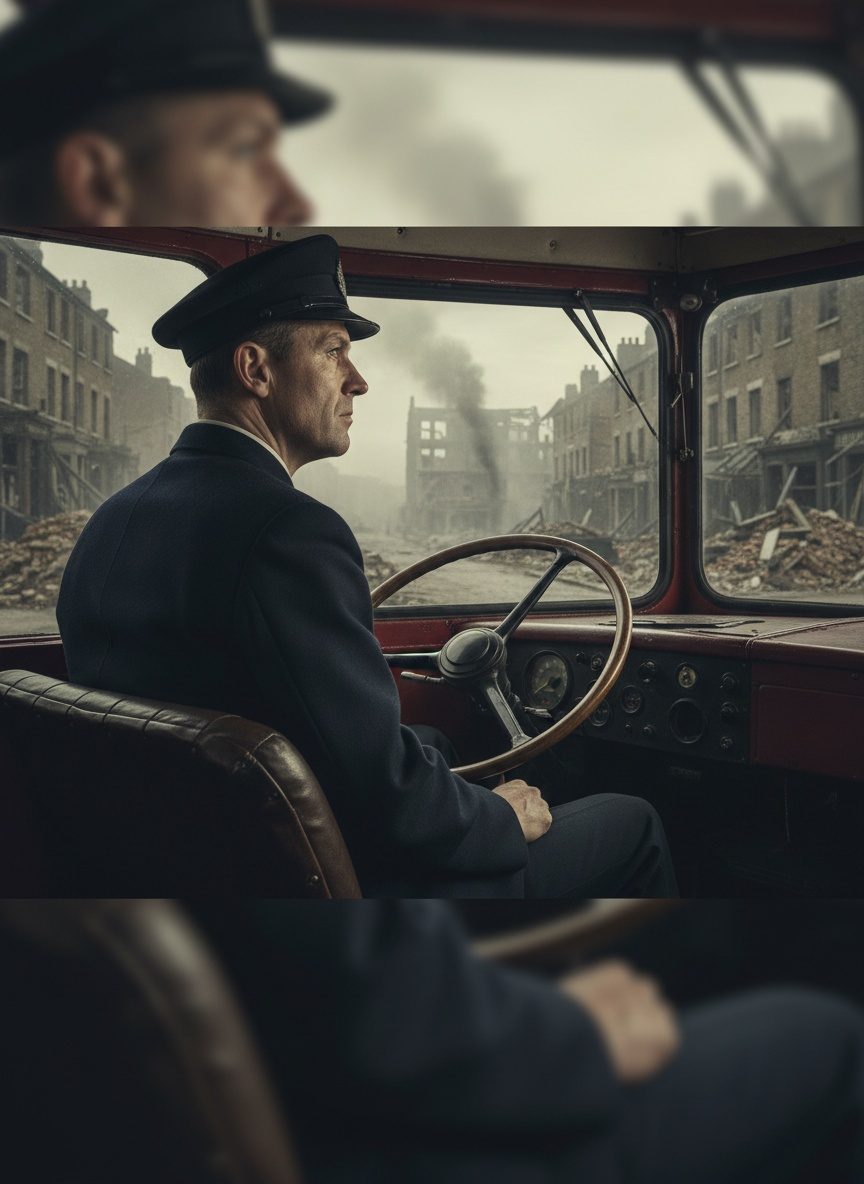
The shrill whistle of falling bombs sliced through the thick London night. In a matter of heartbeats, the familiar rumble echoed like thunder over Westminster. But as dawn broke over the city cloaked in smoke and dust, the throaty growl of diesel engines answered back. A double-decker bus, battle-worn yet unbowed, trundled along its route, its red-painted flank smeared with ash. This morning ritual, a defiant continuity in the face of chaos, was an ordinary miracle playing out daily on the streets of war-torn London.
Under the Cloak of Darkness
In September 1940, the Blitz began its merciless assault on London, transforming the city's skyline into a silhouette of devastation. Night after night, families sought refuge in makeshift shelters, shuddering with the earth as bombs carved their merciless holes. Yet, in the thickest hours of darkness, when hope was hard to cling to, there was a silent army preparing for the morrow. Among them were London’s bus drivers, waking to the muffled roars that struck fear into the heart yet spurred them into motion.
The London they knew had morphed into a labyrinth of rubble and craters, yet the crack of dawn called them to their posts. It was more than a duty; it was a declaration that life would not grind to a halt beneath the Luftwaffe’s pounding fists. Despite the nightmarish landscape, they reported unscheduled to depot managers. Without waiting for official post boards to command them, they understood that their role was vital—a lifeline linking scattered remnants of their city. Their resolve was hardened by the knowledge that every turn of the wheel was an act of resistance.
Navigating the Wounded City
Morning light brought no comfort, only the stark reality of a city shattered. Bus drivers maneuvered through scenes that looked as though ripped from the pages of Dante. Buildings burned stubbornly against the hollow blue of the sky, streets vanished under the debris, and still they drove. Like sentinels patrolling familiar yet twisted battlegrounds, their vehicles advanced with practised precision, transforming paths freshly torn apart by the night’s havoc.
Read next: The Day a British Stretcher-Bearer Refused an Order to Save Lives
The crackling radio updates—filled with dry, official statistics—were no match for the first-hand scenes these men and women witnessed every day. The challenge of adhering to known routes was a strategic puzzle, a test of memory and nerve. Passengers waiting at familiar stops, their faces pale with exhaustion, were as much in need of the respite these buses offered as the familiar reliability they stood for. Every stopped bus was an island of normality in a city starving for it.
Silent Guardians of Routine
For passengers, a ride on these buses became acts of faith as much as necessity. Londoners clutched shopping bags or huddled children close as they clambered aboard, greeting familiar faces with worn smiles. The drivers and conductors, never heralded as heroes, were the quiet custodians of morale, ushering all aboard into moments where a shared journey bound them together as survivors rather than victims.
Amid their silent duty, each driver carried personal tales—a lost home, a loved one seen only in the flickering of candle-dim shelters. They exchanged stoic nods, knowing that their quiet commitment meant safety for the familiar faces stepping onto their buses. This mutual acknowledgment was the real currency of those days, each exchange affirming that even if plans lay in ruins, courage remained unbroken.
Read next: The Day a Army Chaplain Gave His Coat to a Dying Stranger
Defiance Wrapped in Routine
Some say wartime heroes wear uniforms adorned with medals. But the real bastions of resilience often bear ordinary faces and names forgotten by history. London's bus drivers offered neither speeches nor battle cries; they delivered something infinitely more precious—a semblance of normalcy during a time when certainties were shattered. Each driver stood for daily battles fought with engines and steadfastness, acts of everyday rebellion against a future threatening to pull them under.
With each dawn, as bombs crescendoed into daylight, their unnoticed orchestrations of steadfastness wove defiance into the very fabric of London’s rhythm. They made every stop a testament that humanity’s most relentless force is its will to endure, to find order amidst chaos.
In this mechanized ballet of wheels and fortitude, these drivers showed that history turns not only on grand gestures but also on the relentless thread of consistency that holds it all together. The echoes of those engines across a bruised city remind us: sometimes, revolutions ride on simple acts—like a bus running its route through an air raid—proving that not all heroes are hailed, but every quiet act of defiance leaves its mark far beyond the textbook pages.