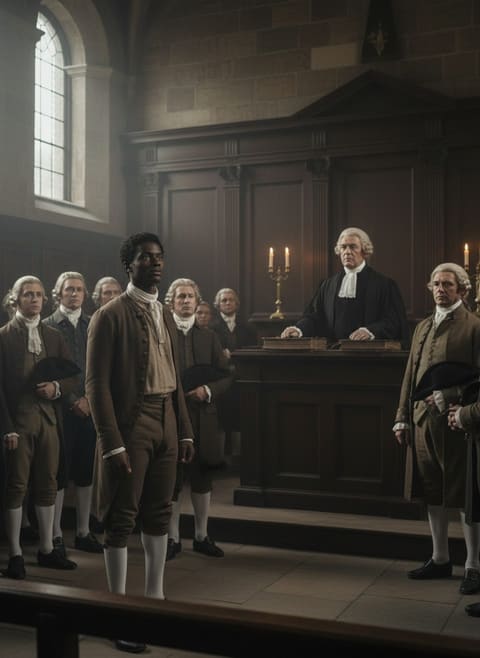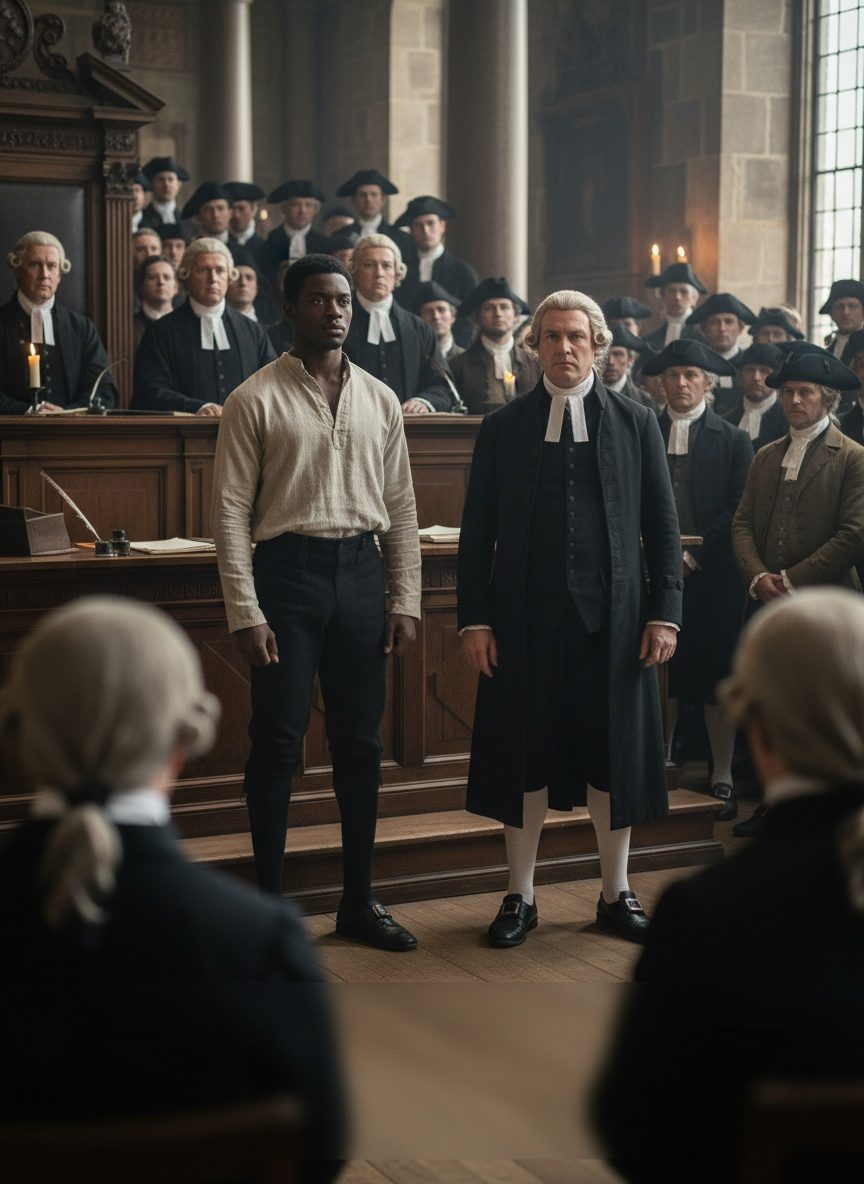
The grey clouds swirl ominously over Edinburgh, their melancholic embrace casting long, wavering shadows on the cobbled streets below. Rain patters against the windows of a stately courtroom, each droplet a reminder of the tension pooling inside. The still air of anticipation fills the room, as inside those walls, an argument is about to unfold that could alter the course of history. It is the year 1778, and Joseph Knight, a man far removed from the land of his birth, stands at the center of a seismic legal battle over his freedom.
A Journey from Bondage
Joseph Knight's story begins far from the windswept streets of Edinburgh. Born in Africa, he was brought to Jamaica as a child, where he came under the ownership of John Wedderburn, a wealthy plantation owner. Wedderburn eventually brought Knight to Scotland, a land stark and foreign yet tantalizing with the promise of something Knight had only dreamt of: freedom.
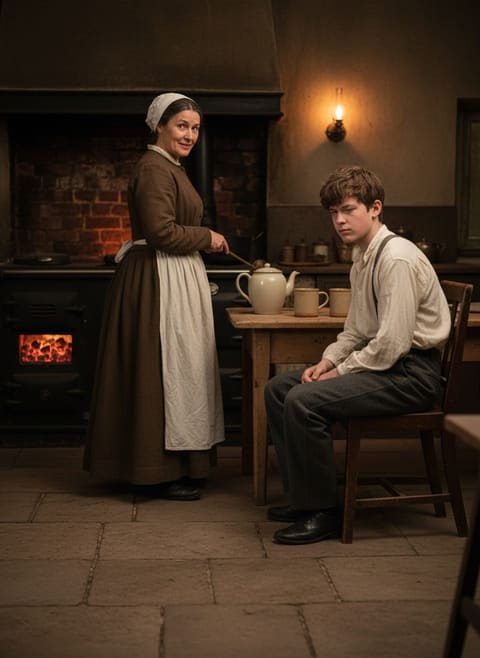
In Scotland, unlike the vast plantations of Jamaica, the land was covered in rolling hills and quaint towns. Yet, despite the change in landscape, the chains of servitude clung tightly to Knight. He served in the Wedderburn household, cooking and performing various tasks. Wedderburn, citing the purchase of Knight as property, was determined to keep him in lifelong servitude.
However, in the cold northern air, the stirring words of abolition were beginning to take root. For Knight, inspired by tales of freedom taken by others, the promise of Scotland was too great a temptation to resist. He refused to serve any longer, prompting a courtroom battle that would draw the attention of the entire nation.
Read next: The Day a Scots Weaver's Son Freed the Kirk From a King
The Courtroom Drama Begins
The courtroom, dimly lit with the flickering light of oil lamps, buzzed with hushed conversations. On one side sat John Wedderburn, resolute, armed with his belief that property was a right to be protected at all costs. On the other stood Knight, a calm determination emanating from his eyes, with the support of those who dared envision a future without the chains of human ownership.
The case had reached the Court of Session, Scotland's supreme civil court. This was no ordinary legal discussion; this was a moral battle, with the fate of slavery on Scottish soil hanging in the balance. Into this fraught atmosphere stepped one of the most unlikely of champions: a Scottish minister named the Rev. Robert Alison.
Alison, an impassioned man of the cloth, possessed more than just a knowledge of scripture and moral philosophy. He harbored a deeply ingrained belief that all men were entitled to their God-given liberty. In the echoing halls of the courtroom, he built his case on this premise, challenging the very foundation upon which slavery stood.
The Ministers' Argument
Alison's arguments resonated through the room like a clarion call, clear and unwavering. He implored the judges to recognize the fundamental injustice of slavery, asserting that it contradicted Scotland’s moral and legal principles. His words carried a weight that silenced the murmurs of the gallery, drawing focus on a singular truth: in a land that prided itself on justice, was it just to condone slavery?
He brought to light the 1775 Somersett's Case in England, which had famously freed an African slave, James Somerset, questioning the legality of enslavement. Alison connected those dots in the minds of the judges before him, highlighting the inconsistency of allowing slavery in a country that claimed to honor liberty and justice.
As he argued, the faces of those presiding softened with contemplation. Each word of testimony hung in the air, challenged by nothing more than its undeniable veracity. By the end of his discourse, the courtroom had transformed from a place of indifference to a chamber of possibilities.
Read next: The Day a Highland Clan Turned a Massacre Into a Legend
The Verdict That Echoed
On that overcast day, the gavel came down with a decision that would send ripples through Britain and beyond: the judges ruled in favor of Joseph Knight. They declared that slavery was not recognized by the law of Scotland, and therefore, Knight could not be rendered property under Scots law. The wind outside seemed to whisper of a great change, its fingers plucking leaves from trees, carrying them into an uncertain but hopeful future.
The significance of this verdict transcended the immediate freedom of one man. It undermined the legal standing of slavery in Scotland, setting a precedent that questioned the very ethos of slave holding throughout the British Isles. Though it was but a single ruling in a relatively small jurisdiction, it emboldened the abolitionist movement gaining momentum across the Atlantic, sparking debates that would eventually lead to broader reforms.
The Ripple of Freedom's Bell
Joseph Knight's perseverance, supported by those who believed in a just cause, was a reminder etched into the annals of history: that the smallest voices can carry the mightiest truths. His case, though born of personal struggle, grew into an emblem of change, a herald of a world beginning to understand the value of freedom.
The story finds relevance in today’s global landscape, where the fight against injustice and inequality continues. It suggests with clarion certainty that change is always possible, always near, and that justice, much like the relentless rain that had pattered down as Knight walked free, has a way of washing over the world in its own relentless, unstoppable course.