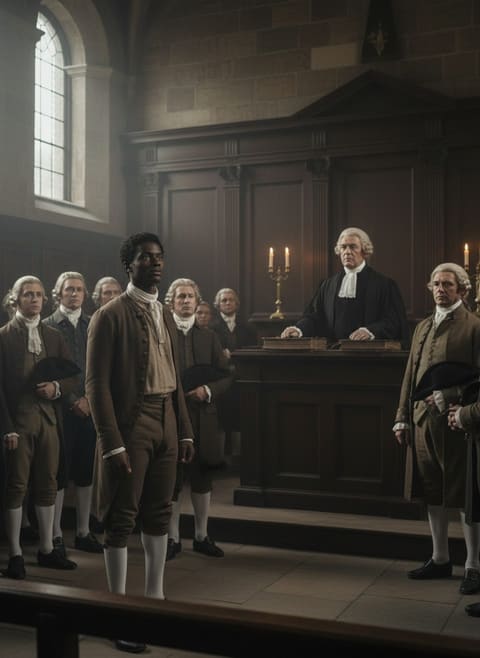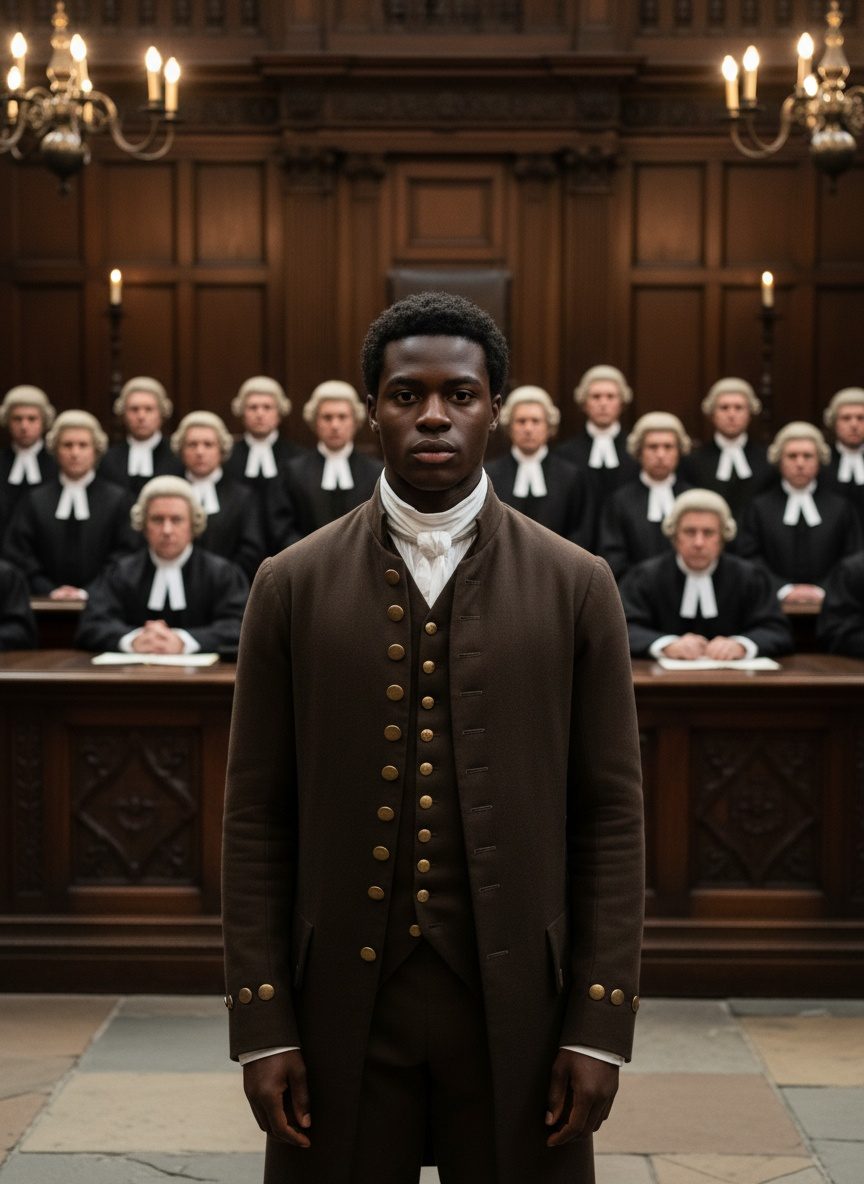
July 22, 1778. A gust of wind swept through the narrow alleys of Edinburgh, carrying with it the scent of peat smoke and damp stone. Amidst this bustling yet muted Georgian city, a crowd gathered around the grand sandstone façade of the Court of Session. Inside, an extraordinary scene unfolded that would resonate far beyond the high windows and carved wood panels of the courtroom.
Joseph Knight, a name not yet emblazoned in history, stood alone. A young man swept from the sun-drenched but shackled environs of Jamaica to the grimly majestic edifices of Scotland’s capital. His was an improbable journey and an even more improbable quest—an appeal not just for his own freedom, but for the very notion of humanity under Scottish law. With no legal representation, Knight had walked into this courtroom armed only with his conviction and belief in a principle untested on this soil.
The year 1778 placed Britain on the cusp of change, its empire sprawling and its philosophers wrestling with ideas that would ignite revolutions. While the concept of freedom was fervently discussed in drawing rooms and pamphlets, it had yet to be tested under the nuanced grey skies of Edinburgh. Previously, the echoes of chains worn in the colonies rarely troubled the corridors of Georgian society. Knight, however, demanded that the court grapple with the uncomfortable truth of slavery, pushing these abstract discussions into the stark reality of legal precedent.
Knight's journey to this legal showdown began years earlier. He was purchased in Jamaica by John Wedderburn, a prominent Scottish plantation owner. Brought to Scotland, Joseph had been a part of Wedderburn’s household, thrust from fields to polished salons, his worth reduced to property on a ledger. Yet, in the chill of Edinburgh, striving for warmth seemed synonymous with striving for freedom.
Read next: The Day a Scots Weaver's Son Freed the Kirk From a King
At the heart of Knight’s argument lay the principles enshrined in the Air of Freedom, rumored to apply to all who walked upon Scottish soil. He contended that slavery had no place in a land famed for its assertion that "slavery had never been known to the law of Scotland and could not be recognised there." Knight argued before the court that by simply being in Scotland, he was entitled to the freedom others took for granted. His claim resonated with those sitting in judgment—men well-versed in philosophy and law, yet faced with an issue neither parchment nor precedent had adequately addressed.
Witnesses were called, each adding layers of complexity and human testimony to the case. Wedderburn maintained his claim over Knight as rightful property, an assertion supported by the accepted norms of colonial holdings. Defense for Wedderburn leaned heavily on the economic fabric of the empire, one entwined with the very institution Knight now contested. Observers noted how the tension within the courtroom mirrored the broader debate on British engagement with slavery.
As the proceedings unfolded, within the chambers and in the streets, the air thickened with anticipation and uncertainty. Edinburgh’s proximity to the broader Enlightenment movement underscored the trial. Concepts such as liberty and rights, long bandied in halls of learning, suddenly acquired flesh-and-blood urgency. Crucially, for Joseph Knight, this court was not just an arena; it was a crucible where ideals were to be smelted into reality.
With each testimony, each legal interpretation, Knight’s audacity shone not just as a challenge to established norms but as a beacon for reform. The air, rippling with murmurs and exchanged glances, was charged with the realization that the decision would hold implications beyond one man's fate. In choosing to navigate these uncharted waters, the judges unwittingly etched their names alongside his in a narrative yet unwritten.
Read next: The Day a Highland Clan Turned a Massacre Into a Legend
The deliberation was arduous, with the echoes of law and morality clashing against economic interest and tradition. The weight of potential precedent pressed heavily upon the judges. When the final ruling came, it was a quiet yet seismic shift. The Court of Session determined that slavery, as it existed in the colonies, held no standing in Scotland. It was a pronouncement that rippled through the foundations of legal thought and crossed the borders of the British Isles.
The verdict, both simple and profound, affirmed Knight’s freedom. A proclamation that in Scotland, every person was considered free by virtue of having set foot upon its land. In a single decision, the court refused to cast Scottish soil as complicit in shackling human spirit. Joseph Knight, once a subject and now a symbol, walked out of the courthouse no longer as property but as a person, touched by law’s capacity for justice.
In the years that followed, this ruling would reverberate through the legal systems of other lands, contributing to the rising tide against the obliteration of human dignity. Knight’s case injected a new urgency into ongoing discourses regarding the abolition of slavery throughout Britain’s far-flung domains.
Today, the tale of Joseph Knight is a testament to the transformative power of individuals challenging conventions. He stands as a reminder that the struggle for freedom and recognition can transcend the bounds of time and place, demanding the re-examination of our collective duty to justice. Knight’s story, drawn from the shadows of Scottish history, illuminates the profound fact that history’s great tides of change sometimes begin with the courage of a single voice echoing in a courtroom.