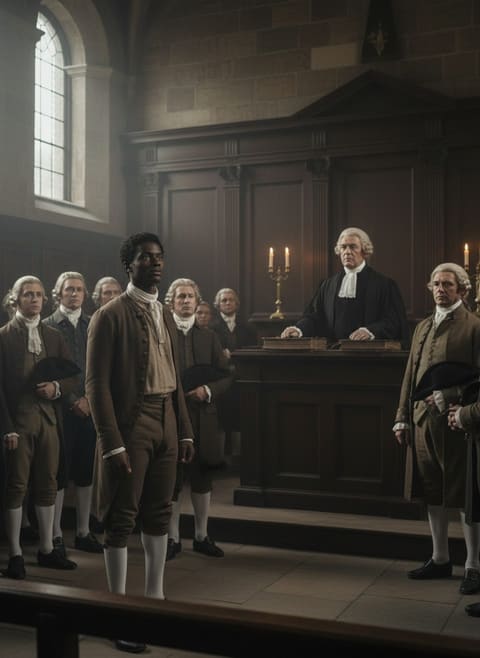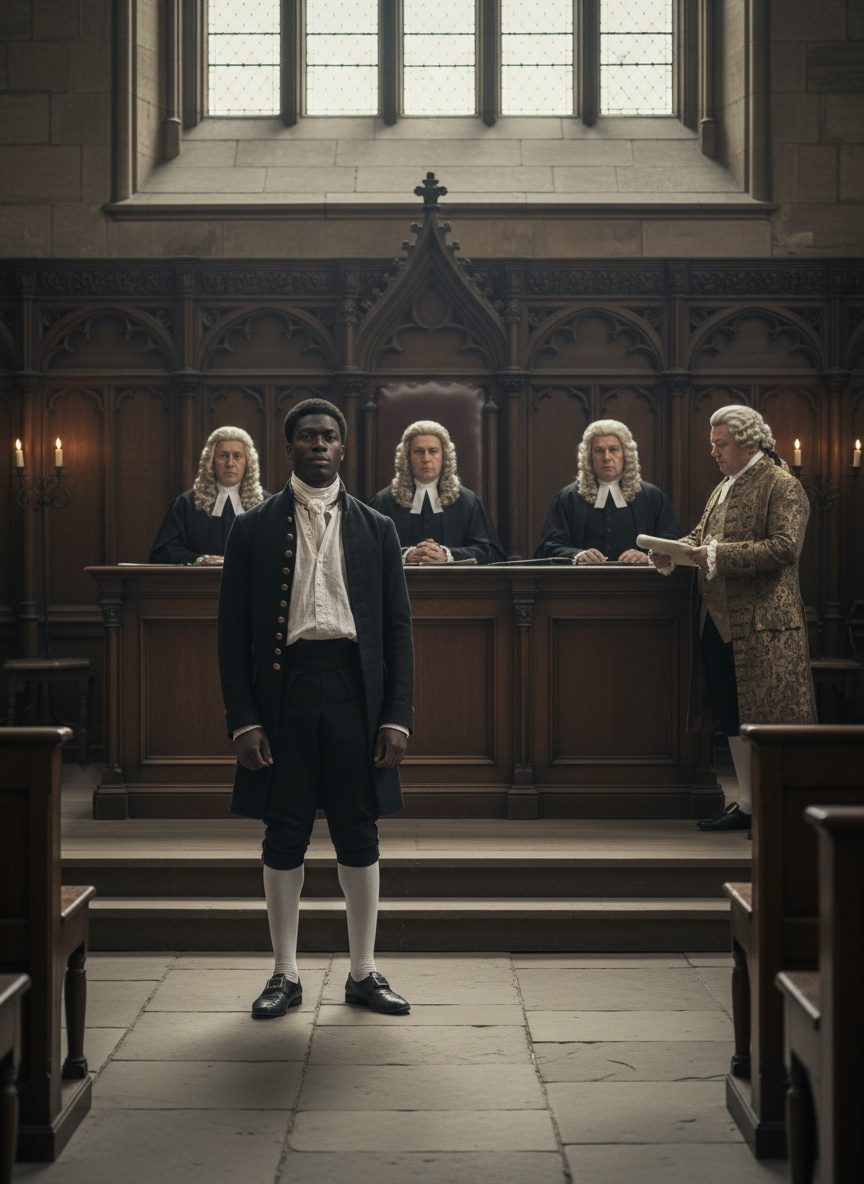
The heavy oak door creaked as Joseph Knight walked into the courtroom, his heart pounding like a drum. The grand chamber was filled with whispers and the rustling of long woolen robes, echoing the audacious stakes of this day. His dark eyes swept across an audience that seemed as rigid as the sandstone walls of the Parliament House of Edinburgh, where he stood alone, a man resolved to reclaim his freedom—a freedom that was both promised and denied by the very land beneath his feet.
The Unyielding Chains of the Past
Joseph Knight’s journey to that Edinburgh courtroom had begun many years earlier in Jamaica, thousands of miles and a world apart. Captured and enslaved, Knight was shipped across vast, tumultuous seas, landing not in the home of his birth but in the unfamiliar clime of Scotland. His master, John Wedderburn, brought him to Dundee, claiming ownership not of a person but a piece of property—a practice as common in the Caribbean as the sugar plantations where Knight had once toiled.
Yet, to label Joseph Knight merely as a ‘captive’ would be to overlook the spirit that animated the man whose very name was imposed upon him. Knight was not resigned; he was resolute. He had learned that on Scottish soil, the inklings of enlightenment had begun to murmur that no man could call another his property. These whispers reached Knight’s ears and sparked a defiant hope that would see him challenge the very laws which bound him.
Voices of Justice and Freedom
In 1778, the societal dialogues surrounding slavery were nascent but growing in Scotland. The idea that a land’s customs and conditions might implicitly reject the legality of slavery was still fringe but germinating in intellectual circles. Joseph Knight seized these notions, daring to challenge John Wedderburn’s claims before the Scottish Court of Session, Scotland’s supreme civil court.
Read next: The Day a Scots Weaver's Son Freed the Kirk From a King
There he stood, a lone figure, against the weight of entrenched power. Knight’s case presented more than a challenge to his own servitude; it questioned the very ethical bedrock of an emerging modern Scotland. The case was not merely a legal contest—it became a philosophical crucible. Scottish soil posed a question: could it support the weight of chains?
The Courtroom Drama
The crisp air of the courtroom served as the backdrop for a profound confrontation between the principles of human rights and the remnants of imperial might. Joseph Knight’s words cut through the room, delivering his own eloquent testament to liberty with a clarity that resonated deeper than the legal arguments of even the finest barristers.
Judges seated on high listened intently, their wigs bobbing slightly with each shift in their seats. Among them, a shared awareness unfolded, a stirring notion that they were not simply arbiters of law but indeed participants in a historic junction. As Joseph Knight voiced the claims of his natural rights, the courtroom became a vessel of transformation, rocked by the tumult of this moral gale.
The Verdict that Defied Expectation
As whispered rumors circulated through Edinburgh’s cobblestone streets, the decision approached, harbored with anticipation by those both within and outside the courtroom. And then, it came — a moment as stark and profound as the pages of history itself.
Read next: The Day a Highland Clan Turned a Massacre Into a Legend
The Court of Session declared that Scotland, in its sovereignty, rendered no place for slavery; upon its soil, chains were but illusions. The court affirmed Knight’s freedom, stating, "The state of slavery is not recognized by the laws of this country, and there is no right of foreign masters to make slaves of persons here." The words broke like thunder, not only freeing Joseph Knight but also marking a pivotal episode in British legal history.
A Scar on Brilliance
Though Knight's struggle is but one story within the greater tapestry of Georgian Scotland, it illuminates a profound moment. This legal moment foreshadowed an embryonic understanding of human equality. On that day in 1778, Joseph Knight did more than win his freedom; he struck against the very institution of slavery in a land teetering on the cusp of modernity.
And so, the courtroom became more than a mere chamber of law; it was a bastion where moral resolve confronted societal inertia. Knight's voice, once a ripple challenging the tides of tradition, transformed into a wave of change—undeniable and irreversible. His courage catalyzed a wider reflection on human rights, echoing through the corridors of history and reminding us of the power one individual holds in shifting the conscience of a nation.