Thomas Cranmer saved himself. Then he chose to perish.
The Rise of a Reluctant Reformer
Thomas Cranmer’s path to martyrdom didn't begin in the flames; it evolved on the cobblestones of Tudor England, a kingdom rife with religious turbulence. Born far from the political epicenter, Cranmer’s ascent to the Archbishopric of Canterbury was marked by scholarship rather than ambition. A Cambridge scholar at heart, his tendrils of influence extended not through power, but through intellect and engagement with reformist ideas sweeping Europe. Yet, he was a man caught between monarchs, whose shifting allegiances required not just faith, but flexibility.
During the reign of Henry VIII, Cranmer became instrumental in the annulment of the king's marriage to Catherine of Aragon, a decision rooting more in royal favor than divine inspiration. But as the rudder turned toward Protestant reform, Cranmer became not just an agent of change but its embodiment. His fingerprints were upon the very fabric of the Church of England’s evolution—a reformation that would endure long after the ashes of his own fate were scattered.
A Time of Tumultuous Trials
The ecclesiastical landscape during Cranmer’s time was a perilous one, shifting like the delicate patterns of the Tudor tapestries. The oscillation between the firm Catholicism of Mary I and the revolutionary Protestant reforms under Edward VI framed Cranmer’s vocation with precariousness. It was in this interim of traditions and transformations that Cranmer's ultimate test unfolded—a test not just of faith, but of memory, loyalty, and conscience.
Read next: The Day a Tudor Chancellor Chose Death Over a Royal Lie
Mary I's ascent to the throne cast a shadow of dread across Protestant reformers, a bloody specter signifying the restoration of Roman Catholicism. Cranmer, a staunch supporter of Protestantism, was thrust into the harsh spotlight of a heretic prosecution. Incarcerated in Oxford, his circumstances became increasingly dire, as the fires of Queen Mary’s religious eliminations burned brightly across England. Faced with the scaffold, the steadfast Archbishop faltered, signing several recantations under immense pressure.
The Spectacle of Repentance and Resolve
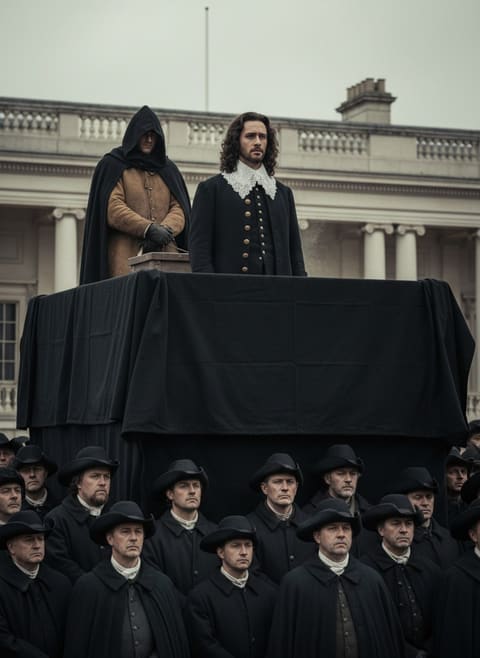
March 1556 unfurled with the dull dread of inevitability. In Oxford, onlookers gathered, expectant and eager for the public penitence of a fallen primate. Yet, the stage on which Cranmer’s redemption was to play out offered a twist that would imprint itself upon history’s fabric. In a final sermon delivered before his execution, an unexpected resolve took shape. With clarity, Cranmer renounced his prior recantations, stunning those gathered with a declaration of Protestant faith.
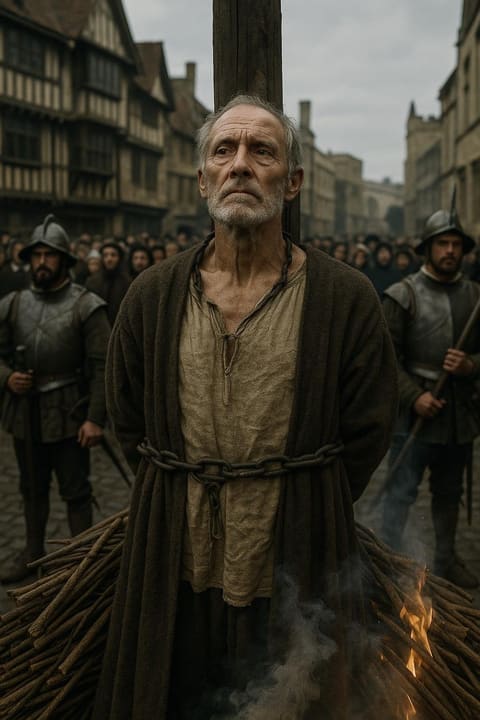
What followed was an extraordinary act of defiance. Cranmer’s executioners led him to the stake, his destiny entwined with dry wood and flickering flame. As the fires drew upon him, Cranmer thrust his right hand into the blaze, the hand that had shakily signed his recantations now becoming an offering to the truth he reclaimed. "This unworthy hand," he proclaimed—his statement of contrition not just for the eyes of men but as a testament before the divine.
The Hand that Signed the Confession
Cranmer's dramatic gesture challenged expectations of retracted renunciations. It wasn’t mere fire that blazed in the eyes of witnesses that day—it was the fierce manifestation of human will, a martyrdom not just of flesh but of principle. His right hand, seen by many as a betrayal, became the emblem of a conscience awakened. This unforgettable image haunted the annals of history, ensuring Cranmer’s actions wouldn’t fade into obscurity like many martyrs before him.
Read next: The Day a Tudor Bishop Refused to Crown a Usurper
There, in Oxford, the weight of his defiance balanced the scales of his confessions. It uncloaked a reality overlooked by many—a man bound by his beliefs, who, despite his failings, sought redemption in flames both purifying and punitive. For the common onlookers, it was a visceral scene, a tempest of smoke, screams, and unyielding spirit—a lesson on the irreducible complexities of human conviction.
Why Cranmer's Choice Echoes Through Time
The echo of Cranmer’s sacrifice extends beyond the stake, resonating in the annals of both religious and human history. His tale is one of profound complexity, illustrating how truth can remain elusive even in moments of extreme clarity. Cranmer's defiance serves as a parable for the struggles inherent in holding beliefs under duress—a reminder that even the strongest among us can falter, yet still find the strength to reclaim honor.
The story of Thomas Cranmer reveals the dichotomy between authority and self, endurance and expire—mirroring in its end, the turbulent transitions of Tudor England. His burnt hand heralds a stark refusal to recant his faith, etching into the collective memory an indelible confrontation with conscience. It challenges us to consider the forces that shape our truth—highlighting the unwavering courage it sometimes takes to defend what we believe, even at the ultimate cost.