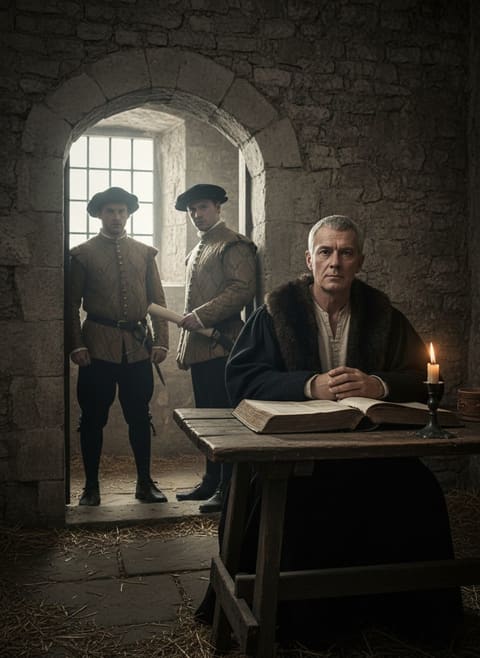
The stone walls of St. Mary's Church loomed around him, an austere canopy echoing faint gusts of the March breeze from the open window. In the flicker of the candlelight, Thomas Cranmer stood resolute, the fiery gleam from the torches outside reflecting in his eyes as he clasped his hands together, their chill dulling any last remnants of doubt. His fingers trembled slightly—it was not fear, but anticipation. This was the moment the world would speak of long after smoke and ash claimed the remains of his mortal coil.
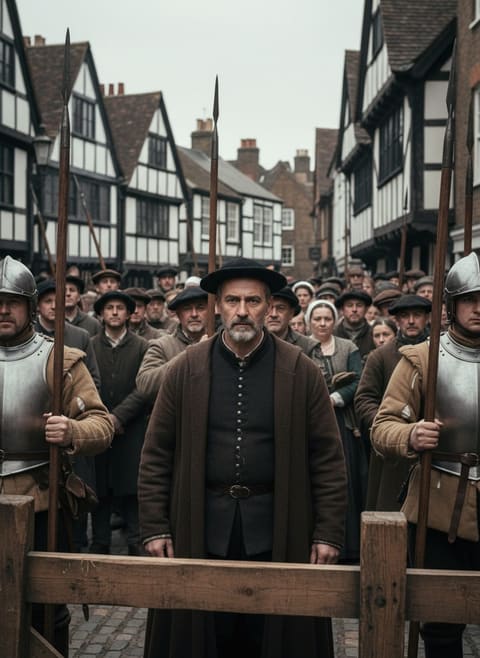
Outside, the congregation awaited, a mass of faces swimming in shadow, curiously expectant and slightly bewildered. Whispers passed like ghosts from one set of ears to another. This was the morning of March 21, 1556, when the air was tense with the mingled scents of damp earth and incense, heavy with the foreboding of a history-altering sermon. The Archbishop of Canterbury, stripped of titles and dignity, prepared to deliver a message none expected to hear. A confession had been signed—an act that had once promised deliverance but was now a burden too great to bear.
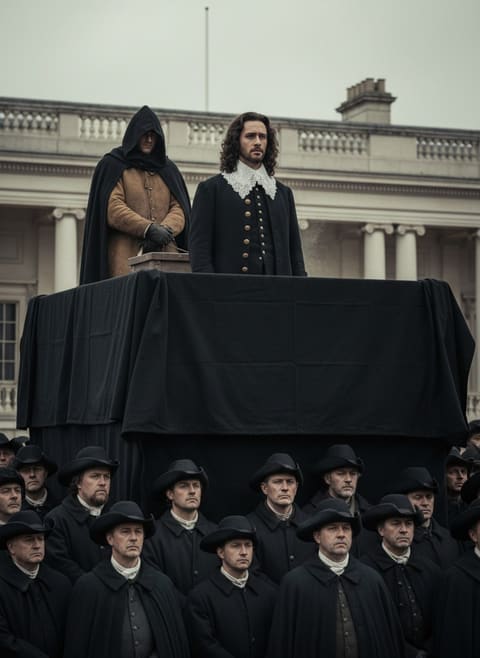
Cranmer ascended the pulpit, each step resonating like the tolling of a distant bell. His eyes scanned the crowd with a gentle solemnity, noting familiar faces interspersed with strangers, each one awaiting the reaffirmation of his recantation. The air seemed to hold its breath as he opened his mouth, his voice calm yet imbued with an unyielding resolve, a foreign clarity in the quivering doubt of the moment.
"I renounce all previous confessions," he declared, the words burning as fiercely as the flames would soon consume his flesh. The stunned audience met his pronouncement with a murmur of disbelief. Cranmer had taken a decisive step not towards safety, but towards the fire's purifying embrace. The hand that had signed his own salvation, now condemned him, and with an unwavering probity, he denounced all that had been signed. The crowded church was engulfed in stunned silence, broken only by the ministerial shuffle of feet, as realization settled upon the assembled.
Read next: The Day a Tudor Chancellor Chose Death Over a Royal Lie
In the same breath that he had withdrawn his signed confessions, Cranmer avowed, "And as for the Pope, I refuse him, as Christ's enemy and Antichrist, with all his false doctrine." His speech cascaded through the hall like a tempest; each word imbued with a hard-learned fervor, each syllable a denouncement of the tether that linked him to the church he no longer recognized. It was a tumultuous repudiation—the kind that wrote imprints on history's canvas.
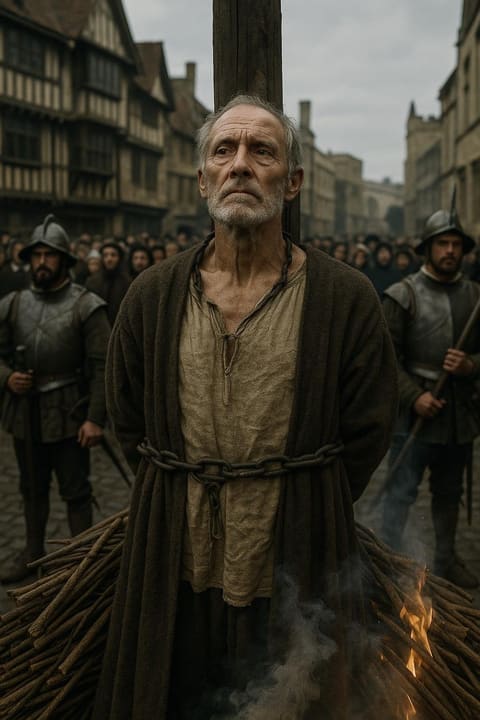
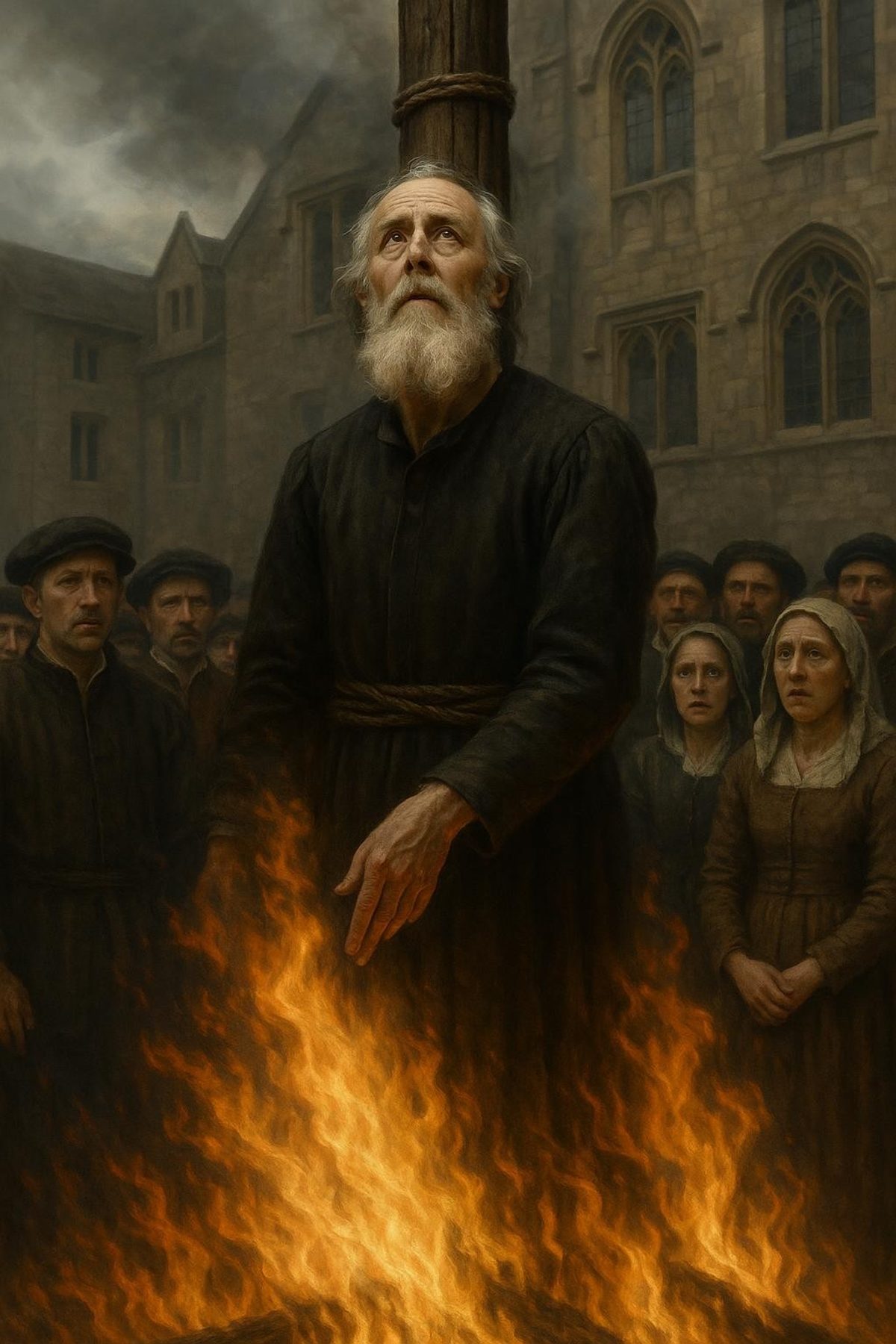
As the time for protestation dwindled, he descended from the pulpit, his heart unburdened by the act of truth. Conscious of the inevitable fate awaiting him, he was neither hurried nor repentant as he stepped toward the pyre set at Oxford's notorious Broad Street. The scene was ready for the specter of smouldering sacrifice—wood piled meticulously, flames flickering in anticipation. Amidst the gathering crowd, somber faces bore witness to an unfolding tragedy—it was an archbishop walking not toward perdition, but legacy.
The executioner stood at the ready, secure in the procedural certainty of his grisly duty. Cranmer turned his gaze skyward, upon the grey heavens that refused a glimpse of sun, the vast firmament like an unmarked testament to his final deed. It was his right hand—the hand of betrayal, the hand that had momentarily faltered and grasped at the promise of earthly redemption—that he extended first into the waking fire.
Read next: The Day a Tudor Bishop Refused to Crown a Usurper
"This hand hath offended," he uttered, calm amidst lapping tendrils of heat, as flames twisted around flesh, a light so fierce it blotted the midday sun. Cranmer's face flickered in the glow, pain transcending into a serene acceptance, an unspoken beacon of sacrifice. He neither flinched nor recoiled; the fire was not merely destructive but transformative—pain yielding to the purity of conviction untarnished and unbroken.
As his form was gradually claimed by the sweltering embrace, earthly concerns fell away, replaced by the enduring specter of faith unyielding. From this inferno, a declaration erupted against tyranny and divine justice, as if in death he found a voice more potent than any granted in life. It was a religious and political stance that defied earthly authority, unified not in words but in that ultimate, silent offering—an offering that stained execution with martyrdom. A soul unbowed, purified through fire, emerged in the annals of Tudor England—an unorthodox flame extinguished yet not forgotten.
In Cranmer's sacrifices lies a testament to principle, a beacon for those who grapple with moral compromise in the face of overwhelming pressure. His legacy underscores the resilience of human spirit when met with unconquerable truth, the silent yet overpowering push of conscience against the weight of mere survival. In Oxford, on that fateful day in 1556, one man's fiery departure from life's stage reverberated further than any had imagined, for it was a conflagration ignited not from flesh but from an unwavering, resounding conviction—one that hoped to outlast the ravages of both time and fire.