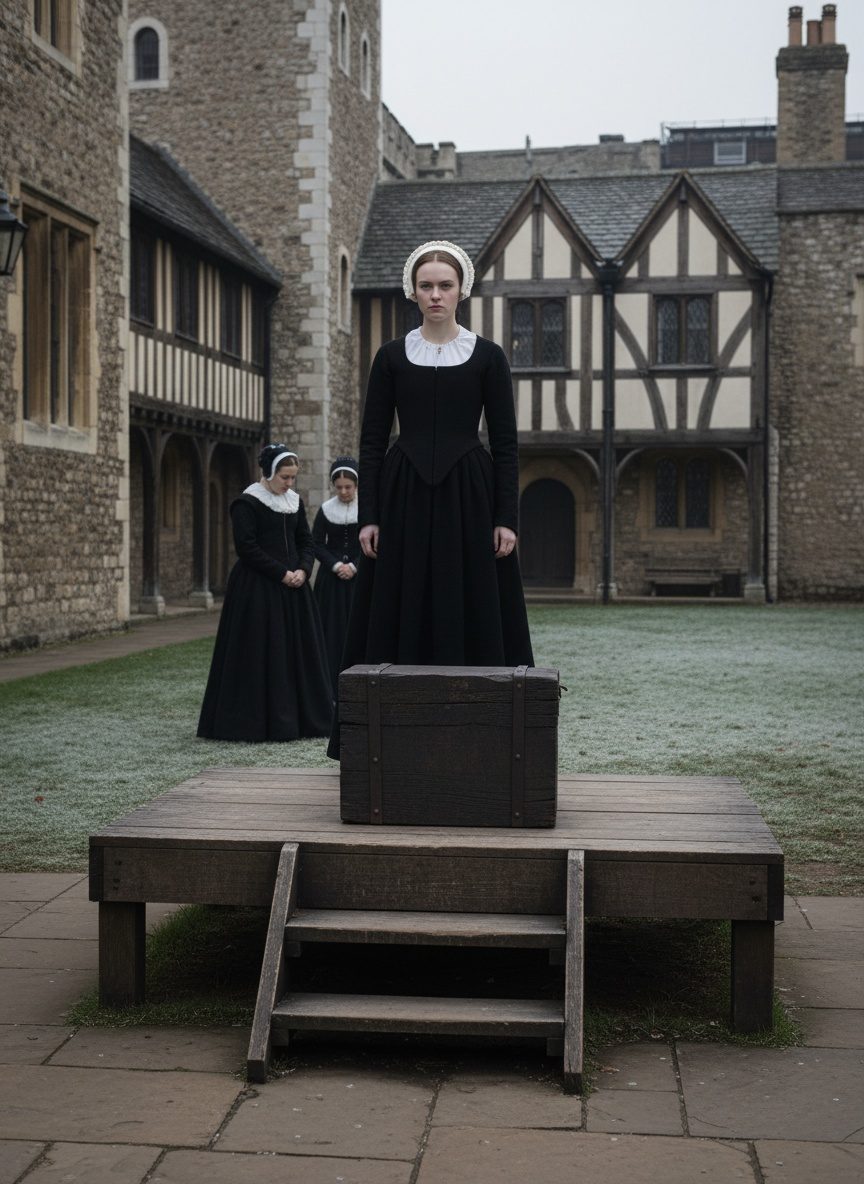
February 1554. A biting wind swept across the Tower of London's stone courtyard.
The Shadow of a Crown
Lady Jane Grey's story is the kind of legend history pens with regretful ink—too often overshadowed by her moniker as “The Nine Days’ Queen.” Mere months ago, the delicate yet indomitable teenager had been thrust into England's tumultuous political arena, crowned amidst political machinations none of her own making. On that cold February morning of 1554, she was no longer a queen nor a mere pawn; she presented herself as a young woman of firm resolve.
Jane's brief reign was marked by her unwavering commitment to her Protestant faith, a defiance that ultimately cost her the crown and her life. The political scheming that led to her ascent was steered by those eager to preserve Protestant rule in England, seizing the opportunity presented by King Edward VI’s declining health. Jane, chosen in defiance of Catholic Mary Tudor’s rightful succession, found herself at the heart of a conflict far older and larger than herself. Her nine days as queen were turbulent, yet they cemented her status as a uniquely tragic figure amidst the Tudor dynasty’s tapestry of intrigue.
The March to the Scaffold
Slowly, deliberately, Jane stepped out into the Tower yard. The stone pathways, long accustomed to the solemn patter of condemned footsteps, bore witness once more. At sixteen, she exhibited a courage that belied her youth, her serene demeanor cloaked in a sense of unwavering determination. Those who watched, breaths held in the chill air, saw not just a girl but a woman marked by her convictions.
Read next: The Day a Tudor Chancellor Chose Death Over a Royal Lie
Standing before the scaffold, Jane offered no plea for mercy, no tearful lament. Her refusal to capitulate or recant her Protestant faith resonated with those present. The silence that met her clear, unwavering voice carried the weight of ages. History often simplifies Jane Grey to the reluctant claimant of the English crown. Yet, on that fateful morning, she was much more—a testament to the strength an individual could muster in the face of impossible choices.
Faith Above All
As expectations bent under the weight of impending death, Jane's devotion never faltered. History seldom pays due to her profound theological commitment—shaped by tutors who imbued her with both knowledge and an unshakable faith. Her unfaltering stance offered a clarion call, resonating not only during those harrowing final moments but also in every decision she had made along the way.
Jane's execution, a grim manifestation of political and religious contention, signified more than an erasure of her brief reign. It stood as a stark reminder of the turbulent tides sweeping across Tudor England, where political loyalty was as mutable as the ever-shifting London fog. For Jane, renouncing her beliefs equated to a surrender of self. She declined the entreaties to save her life through recantation, facing death in serene defiance.
The Legacy of Tower Green
Even as the axe fell, Jane's legend began to take root in England’s collective memory. Her figure became a symbol, cast and recast in poetry and prose across centuries, embodying innocence entangled in the ruthless dynastic ambitions of a realm in flux. The courtyard where she breathed her last offered a stage for the enduring theater of English history, played out not in spoken words but in the silent testimony of stone and shadow.
Read next: The Day a Tudor Bishop Refused to Crown a Usurper
Lady Jane Grey's story is one of tragic brevity but enduring impact—her spirit lingering amongst the gray walls of the Tower, whispering of courage borne amidst despair. With each recital of her tale, its elements are re-shaped, portraying her less as a powerless victim and more as a steadfast believer defined by her choices under duress.
The Indelible Imprint
Why does Jane Grey's story persist in capturing our imagination? Perhaps it is the juxtaposition of her youth against her composed aristocratic resolve that compels us to remember—a reminder that strength of character often flourishes in the throes of adversity. Her life and death echo through the annals of history as a narrative of conviction, the enduring struggle between political pragmatism and personal integrity.
In an era where power often lay shrouded in violence and maneuverings, Jane’s tale remains a poignant story of profound personal sacrifice. Her legacy is a reminder that dignity can remain unyielding, even in the shadow of the axe. Lady Jane Grey's brief, bright flame cautions each generation not to underestimate the quiet power nestled in defiant hearts, standing firm against the sweeping gales of their time.