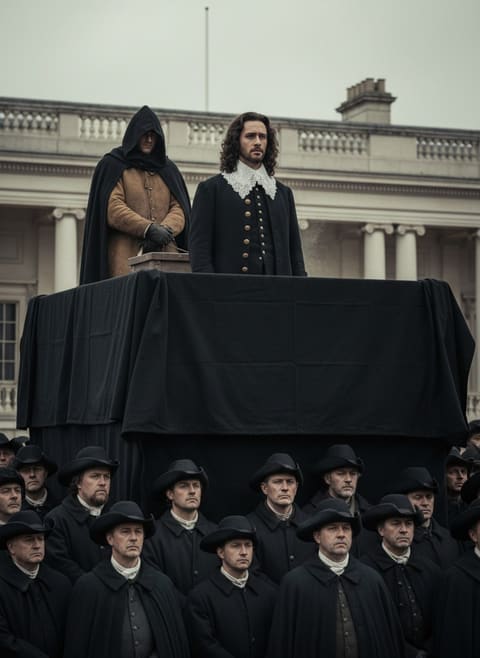
Anne Askew is a name few remember. But the flames of her courage illuminated a world steeped in shadows.
A Gentlewoman Caught in the Storm
In the maelstrom of Tudor England's religious tumult, Anne Askew stood as an unlikely figure. Born into a gentle family, perhaps she was expected to tread the conventional path of marriage and motherhood with quiet dignity. Yet, Anne’s journey was anything but ordinary. Her intellectual curiosity and devoutness led her into the stormy seas of Reformation England. Here, faith was a battlefield, and she, a warrior armed with words instead of swords.
Her presence in Henry VIII's court was initially indirect. Yet her voice, through writings and discussions, gained a resonance that unnerved many powerful figures. Her words challenged the orthodoxy, advocating for a purer interpretation of Christianity that was gaining momentum across Europe but was sternly opposed by England's ecclesiastical establishment. As Anglican reforms ebbed and flowed with the monarch's whims, Anne's unwavering stance became both her shield and her downfall.
The Rack Awaits
Treason and heresy were perilous words under Tudor rule. Anne's ceaseless advocacy and her refusal to recant could only lead her to the dreaded Tower of London. At a time when the ink of power balances was still wet, Anne was seized not for her nobility but for her troubling persistence. Most women would be spared the brutalities reserved for hardened traitors, yet the authorities deemed her defiance too dangerous.
Read next: The Day a Tudor Chancellor Chose Death Over a Royal Lie
The Tower was a place where whispers were drowned by screams, where secrets were extracted with iron resolve. It was here that Anne, the only woman known to have faced the rack within those confining walls, was subjected to the infamous device. They stretched her slim form until nature's joints protested with tearing agony. Yet amidst such raw force, it was not her body they sought to break—it was her spirit. They wanted names, accomplices, fellow believers. But Anne Askew, frail and bound, gave them only silence and prayers.
Carried to the Flames
The journey to Smithfield was grim and unlike any other. Paralysed from her injuries, Anne was carried in a chair to her execution. The streets of London, narrow veins of stone and shadow, echoed with the murmurs of onlookers who had gathered to witness her final moments. Though broken in body, her spirit seemed to sit unshackled, as if she alone were free amongst a throng of captives.
She was tied to the stake, wood stacked high around her, a beacon soon to be lit. For Anne, who had endured so much, it was not death that was to be feared. As the flames drew near, witnesses recalled not hysteria, but an unsettling serenity. Anne’s silence was more eloquent than any speech that day. She did not just face the fire; she became one with it, transforming an act meant to instill fear into a testament of unyielding faith.
Smithfield's Silent Echo
The fires died, yet the silence resonated, rippling through history. Those who had condemned her perhaps hoped that her death would serve as a warning, a silencing of the dangerous doctrines she represented. Instead, it lit a fuse that would ultimately contribute to England's religious evolution.
Read next: The Day a Tudor Bishop Refused to Crown a Usurper
Smithfield itself, a market by trade, became interwoven with Anne's tale, its cobblestones carrying whispers of the past. Travelers and traders could not traverse it without sensing the echo of her resolve. In an epoch where women’s voices were rare in the public sphere, Anne Askew’s silent stand splashed color onto a seemingly monochrome era.
The Lingering Flame
Stories have their roots deep in the soil of their time. Anne’s legacy, though not often recounted, asks a simple yet profound question: what is the nature of true courage? In an age ruled by power and fear, her life—and death—illustrate an unflinching adherence to inner convictions over earthly demands.
Anne Askew's journey through torture and flames captivates not because it was unique in its suffering, but because it showcased the extraordinary endurance of belief. Long after the flames extinguished, she remains an indelible character in Tudor history, a moment where the strength of one stood resolute against the multitude.