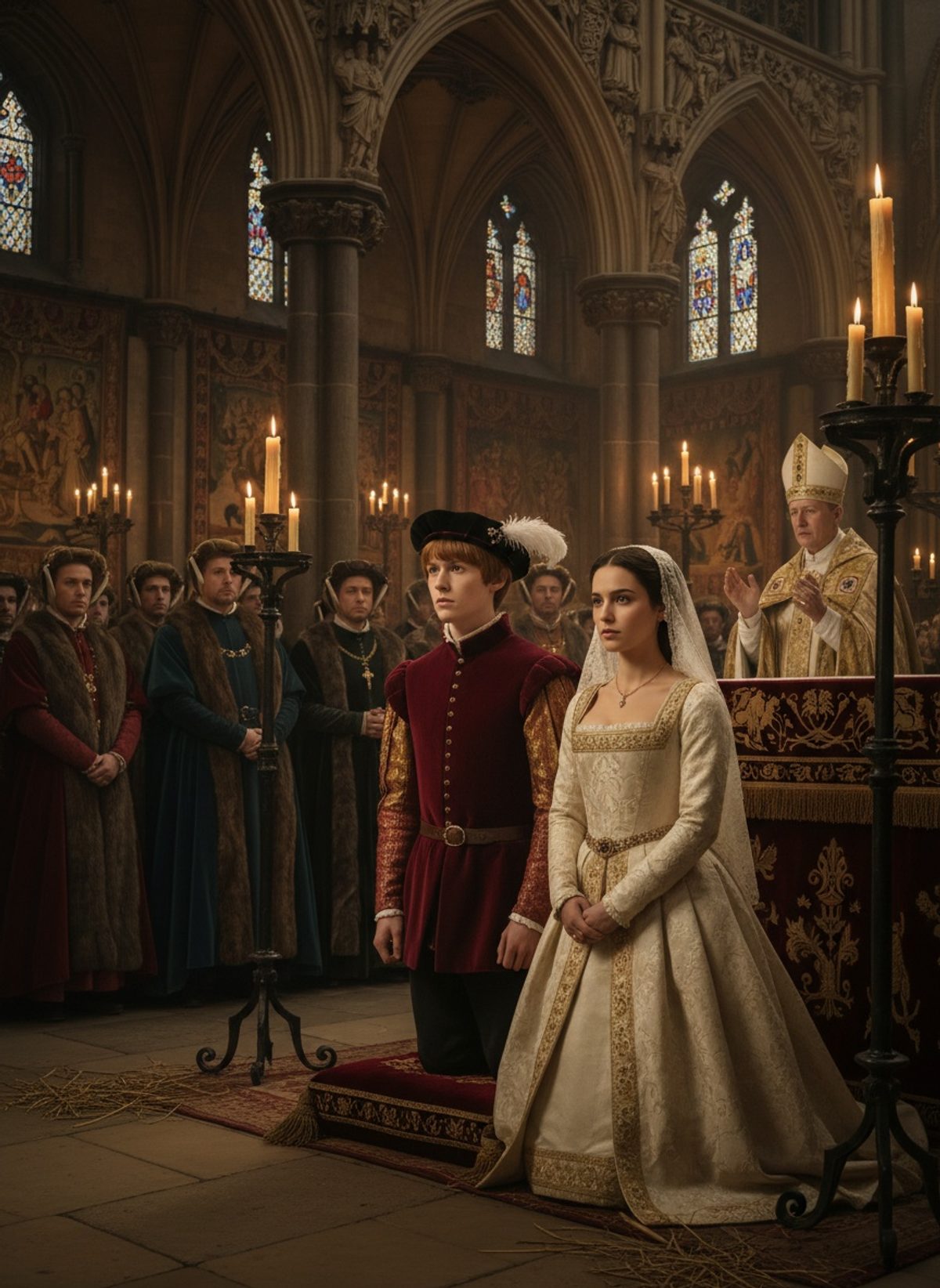
November 14, 1501. Light spilled across the tapestries of Westminster Abbey, dancing through the stained glass and casting an ethereal glow upon the gathered lords and ladies.
The Prince with the Name of a Legend
No English prince bore more expectation from birth than Arthur, Prince of Wales. Destined to unite two bitter houses, the fragile peace held together by the Tudor rose was entrusted to this boy named for the greatest of Britain's mythic kings. Arthur had been groomed from birth for the throne, a living symbol of a new era after decades of bloody civil war. The weight of the crown already lingered over his young head, not as a crown of jewels but as a tapestry of hopes.
Arthur's education was rigorously supervised; he was immersed in the humanist ideals of the Renaissance. His tutors ensured he was well-versed in governance, theology, and philosophy, crafting what they hoped would be a potent ruler. At fifteen, Arthur was ready to step into the future his forebears had envisioned. Yet, this future hinged not just on his shoulders but also on his marriage to Catherine of Aragon—a union intended to solidify an Anglo-Spanish alliance that would make England a force to be reckoned with in European politics.
The Spanish Infanta in a Foreign Land
As Arthur's bride, Catherine of Aragon embodied the promise of an international alliance as her bridal procession wound through the streets of London. The youngest daughter of Ferdinand and Isabella, she arrived from Spain following a perilous journey across the Channel. Her path was adorned with ceremony and finery: tapestries gifted by the City of London, music that echoed off the ancient stones, and feasts that lasted into the night.
Read next: The Funeral That Drew More Mourners Than Any in Living Memory
Catherine had been groomed for queenship from childhood. Her education was steeped in languages and courtly etiquette, preparing her for the intricate dance of alliances and courtly life. When she married Arthur, it was beneath the towering arches of Westminster Abbey, where the solemn vows exchanged promised to unite the two great nations through their future offspring.
The Shadow of the Consummation Question
Despite the grandeur of their wedding, Arthur and Catherine's time together was brief and curtailed by tragedy. The couple retired to Ludlow Castle, a bleak and isolated seat of power near the contentious Welsh borders, where Arthur was to learn the art of rule. Yet mere months into their marriage, Arthur's health faltered; whispers of the dreaded 'sweating sickness' or a simple chill circulated like ghosts in the stone corridors.
Trapped within the cold stone walls as winter passed into a reluctant spring, Arthur succumbed. It was a death both untimely and enigmatic, his departure shrouded not only in grief but controversy. Cries of consummation or lack thereof regarding his union with Catherine began to hiss through the corridors of power—a question that Catherine would deny fiercely when faced with it again years later.
A Widow's Heart in a Kingdom's Balance
When Arthur died, the hopes and alliances tied to him trembled like fragile glass. Suddenly, the future of England looked uncertain. In an unforeseen twist of fate, fifteen-year-old Catherine found herself alone in a foreign land. Her status, once assured, teetered precariously upon the political chessboard. A widow who held within her the potential to challenge the papal religious laws, her future—and England's—shifted into the hands of Arthur's younger brother, Henry.
Read next: The Day a King Wept and Gave His Crown to His People
Younger, tempestuous, yet bursting with ambition, Henry was now the heir apparent. All eyes turned upon him, including those of countries watching England for signs of weakness. He was just ten years old then, the future irrevocably altered, as he inherited not only the title of Prince of Wales but also the stormy path of his brother. The death of Arthur rippled through the throne, precipitating an undercurrent of doubt and strategic maneuverings.
From Brother’s Bride to Queen, and the Fate of a Kingdom
In the shadowy corners of Tudor England, Catherine's fate danced on a razor’s edge. Her detachment from her native Spain grew as negotiations over her marriage continued exhaustingly. She became a political pawn whose value resonated in the shifting alliances that defined Europe. Invitations to return to Spain met with reluctance; she had invested years in England's courts, learning their customs and language. In time, Catherine's path circled back to the possibility of marrying her brother-in-law, a union fraught with its own perilous implications but ultimately pursued.
Years later, when Catherine did marry Henry VIII, the hopes that once adorned her union with Arthur shifted as well. In a poignant twist of irony, the stability she and Arthur once promised the Tudor dynasty could not withstand the personal ambitions and volatile desires of her second husband. Instead of securing a united realm, her marriages encapsulated the very storms of religious upheaval that came to characterize the Tudor era.
Arthur, Prince of Wales, left behind not only the echoes of imagined legacy unfulfilled but a kingdom on the brink of revolution. His departure remains a hinge on which the doors of history swung open to the turbulence of his brother's reign and the religious crosswinds that blew through England afterward. His story is an indelible reminder that the fortunes of a realm rest upon the most unpredictable of human frailties.