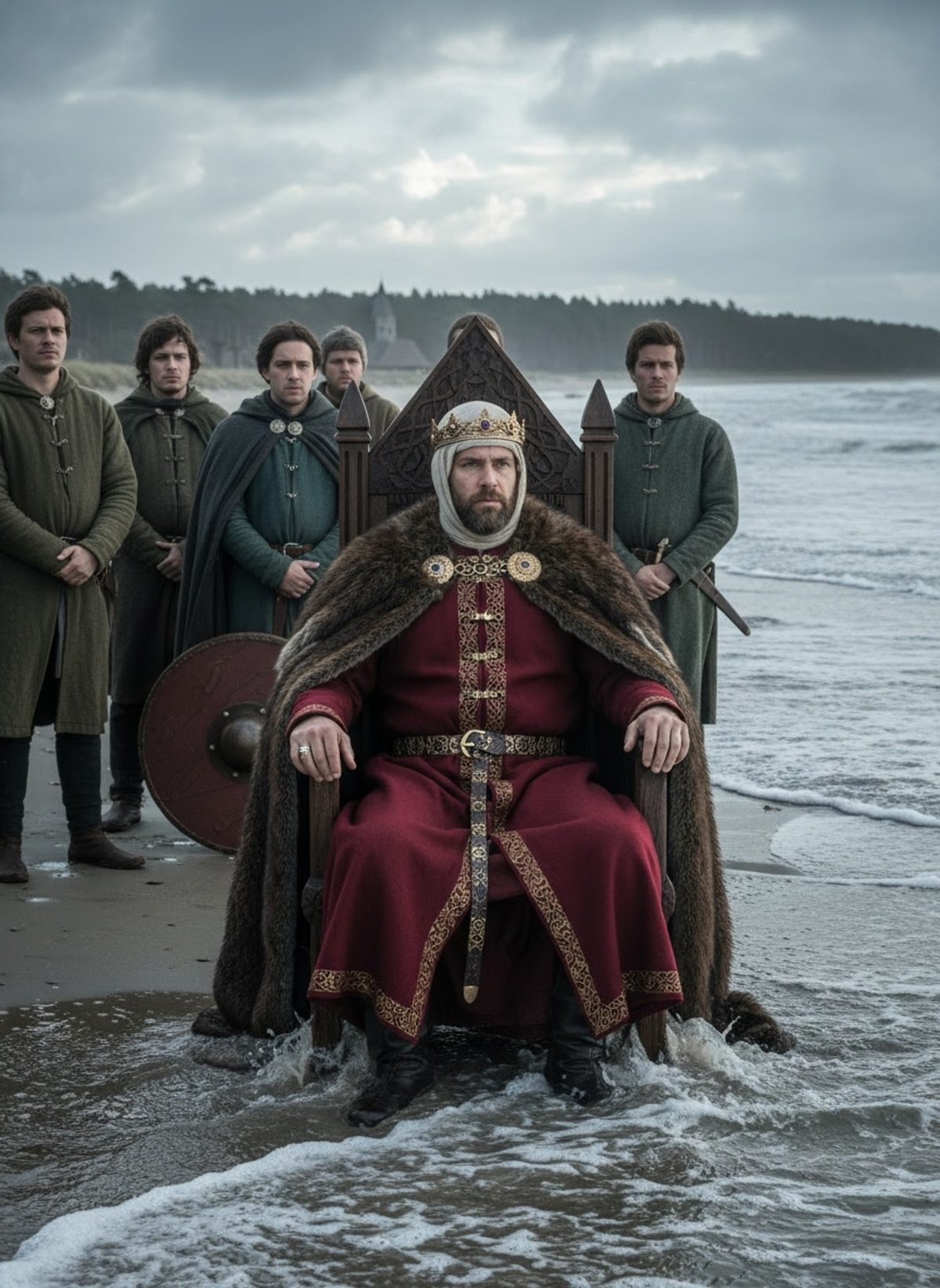
Anglo-Saxon England crowns King Cnut as a divine ruler. But does he really possess divine power?
The Making of a Northern King
King Cnut of Denmark rose to significant prominence by 1020, with power that swept across England, Denmark, and Norway. He stood at the helm of a vast North Sea empire, melding disparate cultures into one cohesive entity. As the years passed, his indomitable rule turned whispers into roars among his courtiers, proclaiming him near to the divine.
Cnut's ascent was marked by tact and brutality, qualities well-respected in a world defined by the clash of swords and the hum of trade. Beyond the battlefield, he showcased an adeptness in governance, fostering cohesion and peace in a region notorious for its disarray. It is little wonder then, that his lords began to build him up as more than a monarch, ascribing nearly sacred status to him.
The political climate of the time demanded that leaders were revered, perhaps even worshipped. The fabric of loyalty and power was interwoven with the threads of myth and legend. Cnut understood this dynamic keenly and, aware of the thin line between reverence and hubris, plotted a defining act of kingship that would reverberate through the ages.
Read next: The Night Godwine Swore an Oath — and England Split in Two
The Path to the Shore
The atmosphere was thick with anticipation when Cnut, flanked by his courtiers, made his way to the shoreline. Picture the scene: a day clouded with waves crashing violently, the salt spray tinging the air. On that day, King Cnut was not merely walking to the sea; he was on a journey to undercut ideas of divine rule.
Carrying his throne towards the edge where land met water, his followers must have marveled. Here was their king, the embodiment of power, ready to command nature itself. This was not simply a spectacle for sentiment; Cnut intended a lesson for his followers about the limits of mortal power and the deception of flattery.
The sight would have been an unforgettable image: the throne set upon the sand, Cnut seated, with the wide horizon as his backdrop. If whispers had circulated of a king of infinite capacity, this act was set to shatter illusions with the cold truth of reality.
The Ebb and Flow of Power
King Cnut, draped in royal robes, issued a commanding order for the waves to cease their advance. One can imagine the revelry, the cloak of confidence worn by those convinced of Cnut's omnipotence. Yet even as his words hung in the salty air, the waves continued their march unchecked, the tide oblivious to this sovereign's command.
The seawater, persistent and indifferent, surged forth to kiss his feet, then climb to his ankles, finally soaking his regal robes. Cnut remained steady, eyes possibly closing for a moment to feel the truth of the embrace, before rising with understanding on his lips. The moment was designed to speak universal truths.
Turning to his entourage, Cnut proclaimed the ultimate lesson: only a higher power, something greater than kings and kingdoms, could command the seas. He implored them to understand that true reverence lay beyond earthly crowns. This scene, unfolding on England's beaches, drew a line in the sand between mortal rulers and the divine.
Beyond the Horizon
Beyond the seashore, Cnut's demonstration carried echoes that rippled through the courts of Europe. It was a moment that redefined the role of a king, not as a figure of unchecked divinity but as a governor under a higher authority. It was a quiet yet profound declaration of humility in an age resplendent with ostentation.
Read next: The Day King Edmund Refused to Betray His People to the Danes
This act did more than demystify his rule; it solidified Cnut's legacy as a king who, rather than heaping worship upon himself, sought to temper the fervor of admiration with a dose of realism. His lesson was clear: focus your idolization where it truly belongs—not on the fleeting nature of human kingdoms, but on something eternal.
Cnut’s intention was understood, a message proclaimed subtly yet powerfully to his followers that reason should temper reverence. His wisdom was in illustrating the limits to human power, forever capturing what it meant to be a king anew.
The Swelling Tide of Time
The tale of King Cnut by the sea endures not just as a fanciful fable, but as a powerful reminder of restraint, a crown's weight measured equally by its humility. The relevance of this story echoes into contemporary times, as leaders navigate the shores of power, assailed by tides of influence and flattery.
King Cnut’s gesture taught that wisdom often lies in recognizing one's limitations and that true leadership is exercised not in commanding the sea but in understanding one's place within it. His legacy has unfurled like the waves he gazed upon, a testament to balance in leadership and the courage to defy godhood with human humility. Cnut left us with a simple, enduring truth: no king can hold back the tide.