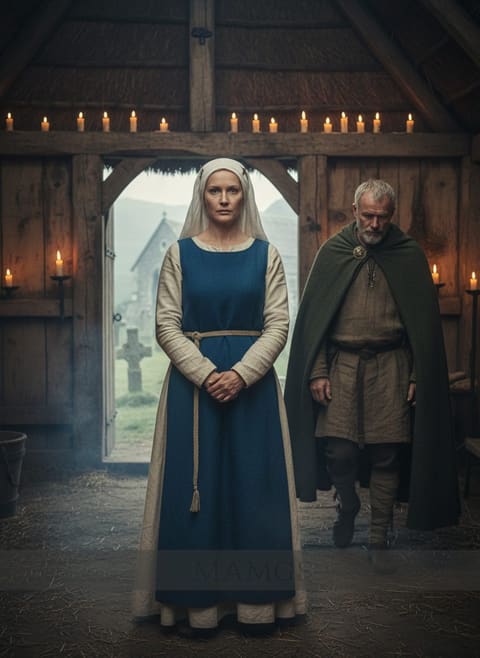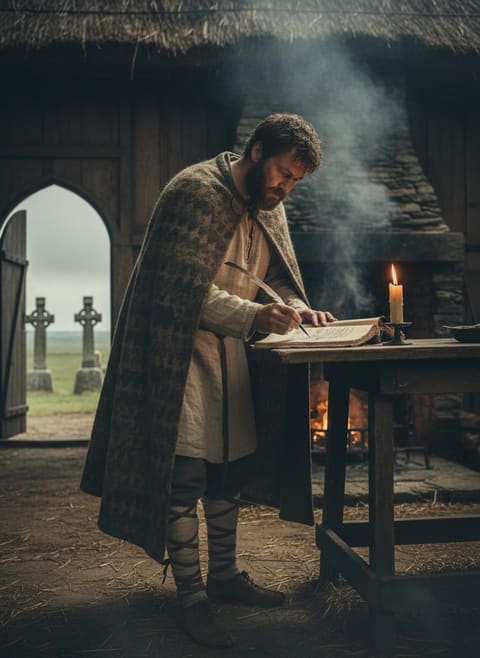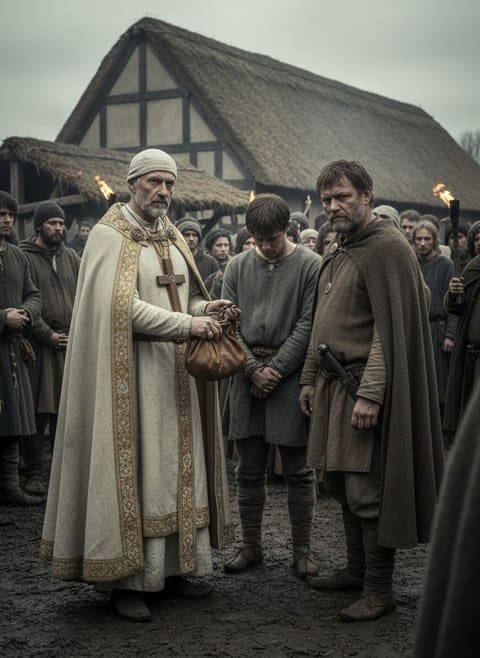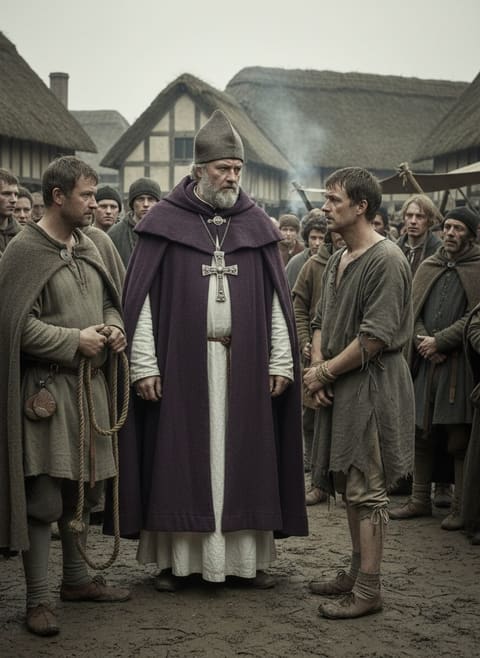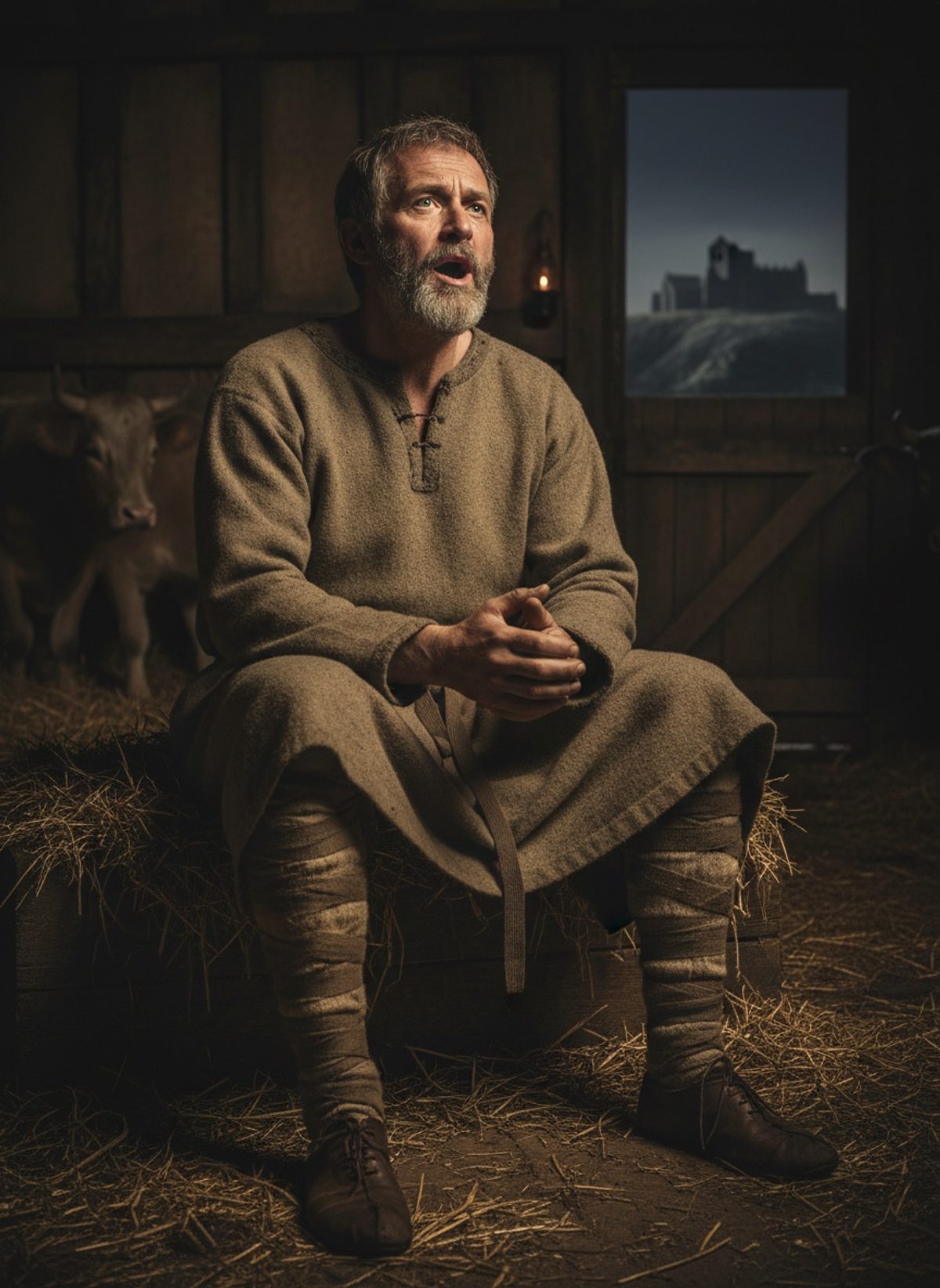
The Northumbrian sky looms heavy with the whispers of dusk as shadows stretch across the sweeping grounds of Whitby Abbey. The stone edifice stands resolute against the encroaching night, overlooking the jagged cliffs where the restless North Sea churns, forging a union of land and water that has witnessed countless tales untold. The air is thick with a fragrant blend of salt and soil, carrying the quietude that descends with twilight. Yet, beneath this serene facade lies a tension, a silent battleground within homes, fields, and hearts, for this is a time when every gathering around the hearth calls for voices to meld in song, and music is woven into the very fabric of life itself. It is a time of shared verses, of communal stories. But what crawls in as comfort for many is a source of dread for one humble cowherd. His nights were long anchored in silence, until the night he dreamed and awoke the dawn of English poetry.
The Cowherd's Silence
In the chaotic blend of warmth and laughter that spills from the hall of Whitby Abbey, where voices rise in spirited melody, a figure quietly slips away. Caedmon, the cowherd, retreats into the solitude of the night, avoiding the revelry that requires what he lacks—song. A man of humble means but daunting fear, Caedmon was plagued by an inability to participate in one of the most vital aspects of his culture. He tended the cattle by day, a task that demanded diligence but no eloquence. The task suited him, as the world of song remained an enigma he could not unravel. Each feast at the abbey became a fortress of anxiety, a gathering of companions that illuminated his deficiency rather than his presence. His silence became his shield, preserving his dignity while imprisoning his true potential.
Caedmon's reluctance to sing was not simply a matter of choice—it was a fear cemented by the absence of words when they were most required. This deficiency cut deep into his soul, in a time when the oral tradition of storytelling and singing was a lifeline to the past, a beacon for the present, and a guide for the future. To sing was to connect with the divine, to walk in the path of the ancestors, to be part of a lineage written not in ink but in voice. For Caedmon, the silence was isolating, threatening to tether him permanently to the fringes of his community, until that fleeting whisper of night, when sleep held more magic than the day promised.
The Dreaming Voice
It was on one such night, as Caedmon lay restless in his quarters, that the ordinary met the extraordinary. Slipping into a dream that soon enveloped his every sense, he found himself amidst a scene transcending the corporeal world. A stranger, perhaps an angel, stood before him—their presence ineffable, a beacon of light and clarity. With authority yet gentleness, the stranger beckoned Caedmon to sing, asking him to illuminate the wonders of creation in verse. The command reverberated through the dreamscape, shaking the foundations of his innermost fear. Yet, in that ethereal realm, Caedmon felt a warmth unfurl within him, a burgeoning courage that gave life to words he had never dared to think, let alone speak.
Read next: The Viking Women Who Ruled Britain's Northern Shores
When he awoke, the shadows of sleep subsided to reveal something profound; his mind held the verses as if etched into his very being. In agony and elation, Caedmon sat, wrestling with disbelief—could his waking voice carry what his dreaming voice had sung so beautifully? With hesitant resolve, he uttered the born-again hymn. It transformed the air into something mythic, as if reality grasped the tailwind of the celestial. This was no ordinary song; it was a gift, not self-made but divine-assisted. Such was the gravity of his transformation that even the Abbey's revered Abbess Hild heard of this unlikely manifestation of art. She listened, with courtly decorum but an open heart, to what Caedmon had become—a vessel for divine narrative, carrying a truth so compelling, it could only be seen as a celestial offering.
The First Poet
The hall that had once been an intimidating stage became, instead, a sanctuary where the hesitant whispers of Caedmon’s talent were nurtured into sonorous declarations of faith and wonder. Abbess Hild, a figure of immense authority and compassion, recognized the sanctity of his verses, declaring them a gift from God meant to be shared with the world. Under her guidance, Caedmon transformed from a mere cowherd into the first named poet in the English language. His song, often referred to as "Caedmon’s Hymn," became a lodestar in the night sky of Anglo-Saxon literature, offering the earliest inkling of a distinctly English voice in written records.
Read next: The Day a Saxon Bishop Stood Alone and Freed a Market Full of Slaves
Caedmon's life, once marked by reticence and withdrawal, blossomed into one of purpose and contribution. His is a narrative of divine inspiration manifesting in the humblest of men, reminding us of the creative spirit's boundless reach. Beyond just a hymn about creation, his story underscores the idea that art and expression are latent within us all, waiting for their own awakening. Even a simple cowherd, isolated by fear, bore within him a seed of transcendent beauty, lying dormant until a dream became a conduit for the miraculous.
This account reminds us of the profound impact that one voice can have on a cultural horizon—the shift from lips sealed in silence to a resurgence of shared storytelling that has resonated across ages. It illustrates how, even in the most daunting of times, the potential for creativity waits patiently for its moment to be called forth into the light. In the rolling fields where Caedmon once tended cattle, where shadows danced in steadfast ritual at the day’s close, one man’s voice found its wings. It soared, a new ripple in the currents of time, altering the course of narrative history, whispering across centuries that no song, once given, is ever truly lost.