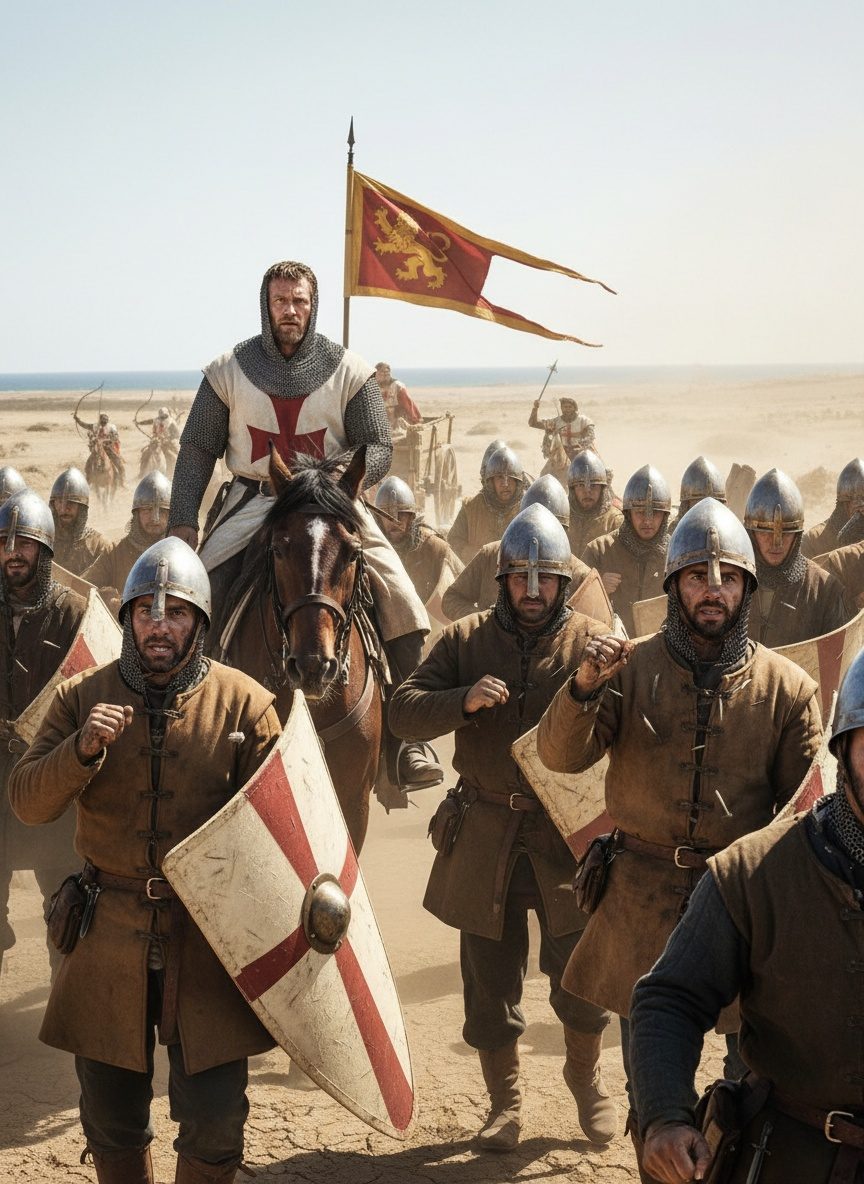
The coastal plains of Palestine in the summer of 1191 were a crucible of heat and menace, where the air shimmered with the sun’s intensity and the horizon wavered under its assault. Crickets chirped incessantly, their haunting hum mixing with the low murmur of a weary army inching forward beneath a merciless sky. Dust clouds, kicked up by trudging feet and hooves, lingered in the dry breeze, choking men and beasts alike. This was the world through which Richard the Lionheart led his crusading band, a land alive with the whisper that every shadow might conceal an enemy as determined as the sun to sap their strength.
For Richard, King of England, every drawn breath in that arid land was fraught with purpose. He faced not only the burning sands but also a relentless adversary: Saladin, the great Muslim military leader and Sultan of Egypt and Syria. The stakes were enormous. Control of Jerusalem, the Holy City, the very heart of Christendom, lay at the end of their journey—a jewel that shone brightly yet felt unbearably distant, nestled as it was behind a wall of skilled warriors eager to deny it to the crusaders.
Richard had embarked on the Third Crusade to reclaim Jerusalem after it had fallen to Saladin in 1187. His reputation preceded him, a king renowned for his bravery and prowess in battle—qualities that earned him both admiration and expectation. His soldiers and commanders counted on his impetuousness, the fiery charge of Richard the Lionheart, to smash through the enemy. Yet, as weeks dragged into one another under Israel’s blazing sun, it was not impetuosity that marked his leadership but patience—a calculated resolve to wait when so many cried for action.
Saladin’s horsemen were as elusive as they were deadly, a fleet of specters striking the flanks of the slow-moving column, leaving chaos in their wake before evaporating back into the landscape. The discord within Richard’s ranks grew; a gnawing hunger to unleash their martial fury and end the tormented standoff pressed upon them. The incessant skirmishing with Saladin’s hit-and-run tactics took its toll, draining the stamina from the heartiest of men and horses, testing their discipline to its limits.
Read next: The Day an English King Drowned an Army in a Marsh
The pleas from Richard’s commanders to engage pushed against the steadied resolve of the king. Their charges felt emaciated by hesitance. The English king, however, understood the terrain of warfare as a skilled painter perceives his canvas—where others saw skirmishes, he saw opportunities, one brushstroke revealing the vulnerabilities that would expose the entirety of Saladin’s strategy. Richard intuitively understood that patience itself could be wielded as a tactical weapon with precision as sharp as any sword.
In bracketing secrecy, Richard developed a plan that leveraged the quintessential human tendency for predictability. His army inched through the rugged territory with deliberate pace, courting their pursuers into a rhythm, preempting their pattern with silent acknowledgment. Through steady attrition, Saladin’s forces expended their advantage, the natural cadence of surprise giving way to complacency. The Lionheart’s men learned to endure, like stone amid an encroaching tide, until the moment they could strike back with devastating precision.
Their resolve was tested not just by heat and skirmishes but by the specter of despair that often whispers insistently from the shadows of every tent at night: would they be grist for this ancient mill without encountering the glory of open battle? This gnawing uncertainty, however, became tempered with a hardened trust in their leader, even as hope waned through the sliver of darkened hours. Under a canopy of stars, they clung to the conviction that their sacrifice would purchase a victory that lingered just beyond their exhausted imagination.
Finally, after what felt like an eternity, Richard's army met Saladin’s forces outside the city of Arsuf. The intermittent skirmishes that had harassed his ranks fell silent, giving way to the sound of weapons drawn en masse, steel singing through the tense air. The battle was monumental, a cacophony of clashing shields, piercing cries, and the dizzying din of martial chaos. Richard’s restraint up until that point had placed him into position where surprise and readiness coalesced into overwhelming force.
The heart-stopping violence of battle and the strategy of waiting that preceded it reveal a different side to Richard: one of calculation rather than fury. The king whose epithet echoed with the roar of assault revealed caution could mask bravery’s twin face. Above all, he demonstrated that strategic patience could harbor as much daring as a headlong charge—an insight as piercing as the arrows that darkened Arsuf’s skies that day.
This story speaks to a timeless truth in any struggle: sheer will and bluster can achieve much, but the discipline to wait, to bide one's time until the conditions align, is a potent and often overlooked strength. It is a testament not only to medieval tactics but to the human condition itself—where the most formidable adversary is not always one’s opposite number but the impatience that rests within. Richard the Lionheart's two weeks of waiting on the scorched roads to Jerusalem underscores the complexity of bravery, suggesting that patience in adversity can, at times, be the most profound form of valor.