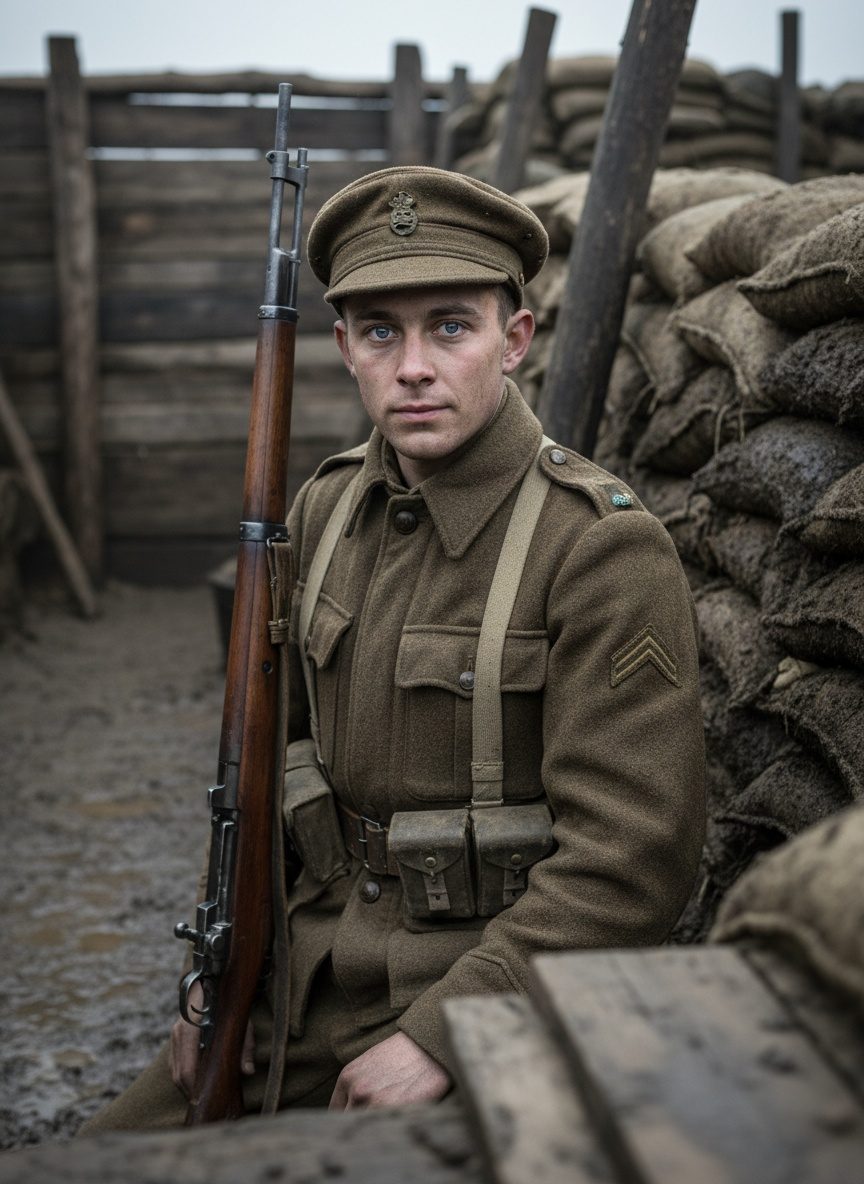
He was twenty-three years old. He had been discarded as not fit for duty twice before finally donning the uniform of the lance corporal.
The Painted Eyes of War
Somewhere amid the reverberations of cannon fire and whispers of the dying at the Battle of the Somme stood a young man in October 1916. He represented a new breed of soldier — not through rank, but through the sheer force of will required to face the endless Artois skyline. The young lance corporal of the Oxfordshire and Buckinghamshire Light Infantry is an emblem; his portrait paints an image deeper than most commissioned officers. The Oxfordshire and Buckinghamshire Light Infantry, a regiment already worn thin on the front lines, hung its intangible medals on men like him, who continued to fight even when their superiors faltered.
October saw the Somme drag laboriously onward. Fields that once whispered with wheat now roared with artillery fire. In this malevolent theater of war, the lance corporal stood as a figure arrested in a moment. His portrait became not just a countenance captured but the embodiment of relentless perseverance, carrying the weight of his regiment's honor upon the mere patch of his single stripe.
The Soldiers' Regiment
The Oxfordshire and Buckinghamshire Light Infantry had a storied past — one that spoke of British soldiers who carved history through presence rather than pedigree. By 1916, the regiment had already become accustomed to accepting the harsh reality of war's ferocity. When faced with opponents cloaked in machine gun fire and no-man's-land anamorphosis, the men enveloped themselves in the steely resolve born from necessity and camaraderie.
Read next: The Day a British Stretcher-Bearer Refused an Order to Save Lives
It was not uncommon for men who served in such regiments to remain obscure to broader military history, eclipsed by generals and strategies rather than the simple testament of human tenacity. However, these regiments did not depend solely on a cadre of well-bred officers — they relied on the courage of men like our lance corporal, whose utmost dedication allowed the regiment to maintain a shadowy eminence in reports and whispers of war. The truest laurels were quotidian, woven from the threads of their unfailing adherence to duty and a fearless approach to survival.
The Landscape of Courage
The battlefield of the Somme, with its chivalrous efforts buried under mud and repeated shell blasts, posed an arena not simply of military maneuvers but of psychological endurance. The environment was unprecedented in its capacity to reshape the human spirit — trenches housing soldiers under relentless existential threats and skies that ushered all but the heaviest artillery with ambiguity. It became a perpetual nightmare made real.
In these conditions, our lance corporal demonstrated a peculiar dichotomy of strength — tempered by the vulnerable understanding of war's cruel reality wrapped within the illusion of invincibility youth often carries. It was often under these pressures that such individuals transcended their given roles into bastions of support for those around them. Every sunrise over the murky enclaves brought an unassuming resolve to a young man whose characteristics were rarely cataloged but ever discernible to those within his immediate milieu.
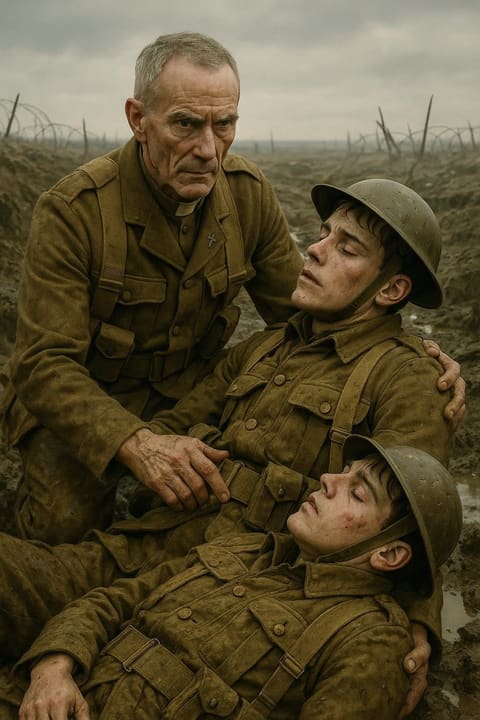
Read next: The Day a Army Chaplain Gave His Coat to a Dying Stranger
Defining the Unremembered
While official records of world-shaking decisions and grandiose strategies often overshadow individual tales, it is within the microcosms of such unrecognized stories that the essence of human spirit truly resides. The young lance corporal in question may never have donned a higher rank or seen his name canonized among the patriotic annals bought by higher command, but he shared a valuable inheritance — the shared conscience of all those who endured history's relentless march.
War is rife with contradictions, and just as the earth of the Somme bore unending misery, it also sheltered resilient defiance in the form of men who prevailed by virtue of personal sacrifices. The lance corporal carried more than the injury and fraying garments — he carried a part of the Oxfordshire and Buckinghamshire's irrevocable spirit, representing a quiet tale of endurance under impossible demands. These silent heroes echo beyond the monumentality of battle, serving as threads that weave the unyielding tapestry of human perseverance in the face of unbeatable odds.
In stories like his rests the understanding that great wars are not composed of medals and commands alone but are instead defined by the humility and heart of those who survived the distance with unspoken heroics, shaping a legacy beyond military prowess and into the embrace of shared history.