She was barely five feet tall. Yet, when Bhikaji Cama spoke, the world listened.
The Needle in the Empire's Eye
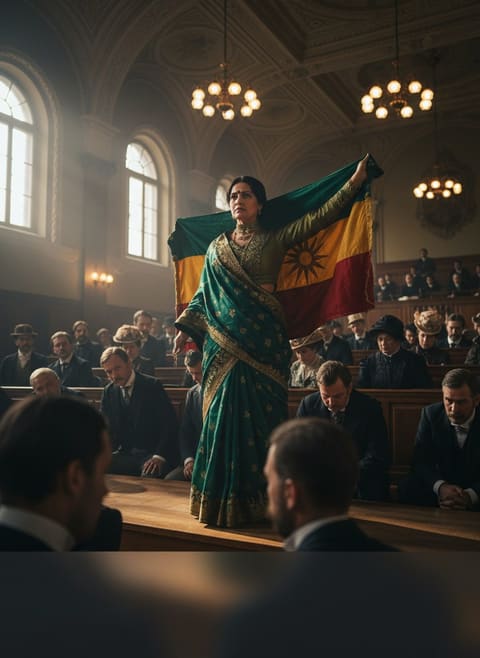
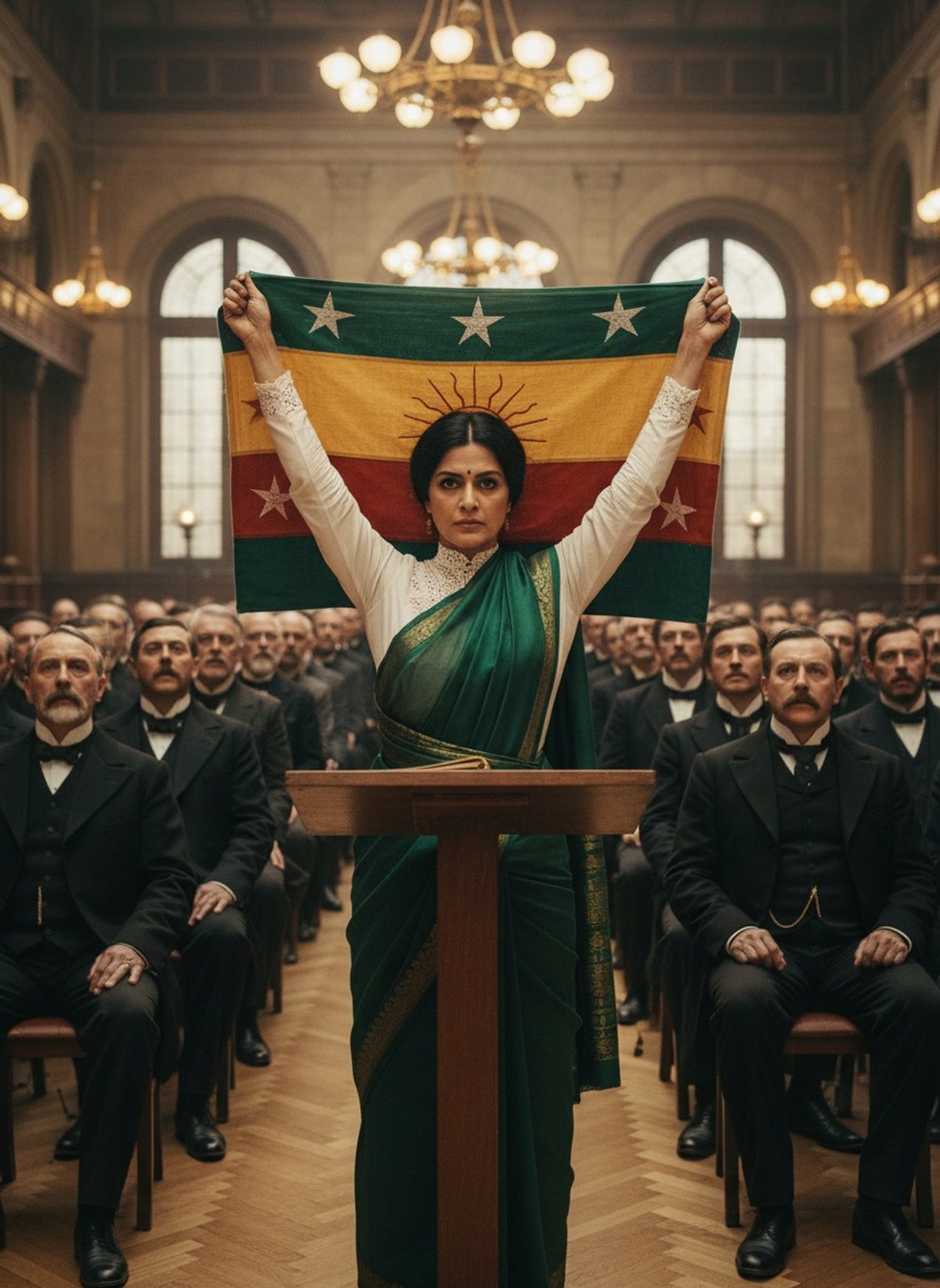
On a warm summer day in 1907, the city of Stuttgart buzzed with the voices of change-makers from around the globe. It was here that the International Socialist Congress summoned delegates who dreamt of reshaping the world order. But amidst the fierce oratory that filled the grand halls, one quiet act resonated louder than any speech. Bhikaji Cama, a name unfamiliar to the British establishment but whispered among Indian patriots, stood radiant with determination. In her hands, she held more than just a piece of fabric; it was the emblem of an untold future.
As Cama unfurled the flag, threads stitched with hope woven by exiled revolutionaries, the silence was palpable. The room, filled with delegates from various nations, witnessed a symbolic tearing—a breach not just of protocol, but of imperial facade. The Union Jack, a symbol of British dominance, was not welcome in Cama’s declaration of independence. She presented instead an initial vision of an Indian emblem, a flag that spoke of freedom and self-determination. Although the flag she held was handmade and not yet recognized officially, it carved a powerful message into the imperial consciousness. What was dismissed by some as an audacious act was for Cama a necessary stand.
How did an Indian woman come to challenge an empire on its own continent, at a time when the subjugation of her homeland was intensifying? To understand this, we must trace her journey through the labyrinth of colonial politics and revolutionary networks. Born in Bombay into a Parsi family, Bhikaji’s early life hinted little at the storm she would weather. Yet as an adult, she grew increasingly aware of the suffering sewed into the fabric of colonial rule. Famine, poverty, and oppressive governance were slowly shredding India's social fabric apart. Her life's thread entwined with the fight against these injustices, knitting her destiny with that of her people.
Read next: When the Rani of Jhansi Rode Out and Refused to Kneel
The Rebellion in Threads
Bhikaji Cama found herself in London in the early 1900s, propelled there by a bout of illness and the promise of medical treatment. Yet the city quickly became more than just a place of physical healing. In the heart of the British Empire, she made connections with other Indians living in the diaspora, finding fellow revolutionaries and intellectual agitators who were planting the seeds of dissent among those who occupied the seats of power. It was here, amidst the fog and gas lights of Edwardian London, that her political consciousness fully bloomed.
Cama’s London years were marked by her involvement with influential nationalists who were as determined as she was to agitate for India's liberation. She established a firm connection with Shyamji Krishna Varma, a vocal advocate of Indian self-rule, and utilized his platforms to rally support. In a capital city insulated by wealth and empire, she managed to stitch together a network of supporters whose influence transcended borders. Her political activism, coupled with an indomitable spirit, ensured that the voice of Indian independence was heard in the corridors of power.
But not all her work was done within closed rooms and whispered meetings. During this time abroad, Cama also honed her ability to communicate directly with the masses. Unlike many of her male contemporaries, who confined their influence within circles of the elite, she found power in the broad swathes of the populace who suffered silently. It was her outreach to common workers and her involvement with socialists and labor rights activists that became a cornerstone of her mission. By transcending traditional roles assigned to women, Cama single-handedly wove a fabric of rebellion that would outlast her lifetime.
A Flag That Spoke Louder
The Stuttgart moment did not come out of nowhere—it was a culmination of Cama's strategic foresight and enduring passion. Through her speeches, writings, and perhaps most iconically, through the flag she unveiled, she proclaimed an India free from British rule. The flag itself was a defiance, a tactile counter-narrative in an age dominated by imperial iconography. Constructed collaboratively by Indian nationalists in exile, it not only symbolized a nation longing to break its chains but also imagined a future of dignity, equity, and self-reliance.
Read next: When Bhambatha Rode Into the Valley and Defied the Crown
In the eyes of the world gathered at Stuttgart, and back home in India, Cama’s act was seen as a flash of inspiration. The courage needed to cut through the expectations of gender and imperial politics at the time cannot be understated. Despite the presence of towering male leaders, it was Bhikaji Cama, a woman, who first brandished a flag that said: "India for Indians." Her defiance inspired a multitude who had been waiting silently for a signal, a call to rise for a cause greater than themselves.
In those moments on the stage, what stood apparent was not just the hope for a nation’s autonomy but an insistence on being seen as humans deserving of that right. To a people accustomed to subjugation, the message was unequivocal: We will no longer be silent bystanders to our oppression; we will be the authors of our liberation.
As Bhikaji Cama’s name slowly emerges from the shadows of history, her story asks us to reconsider the many untold legends that challenge unyielding powers. She reminds us that resistance often begins with the smallest, most unexpected threads and that confrontations with towering empire don’t always happen on battlefields—they occur in meetings, through quiet acts of defiance, and sometimes, in the simple unfurling of a flag. These are the moments bubbling just beneath the surface of history, waiting to be discovered, cherished, and told.