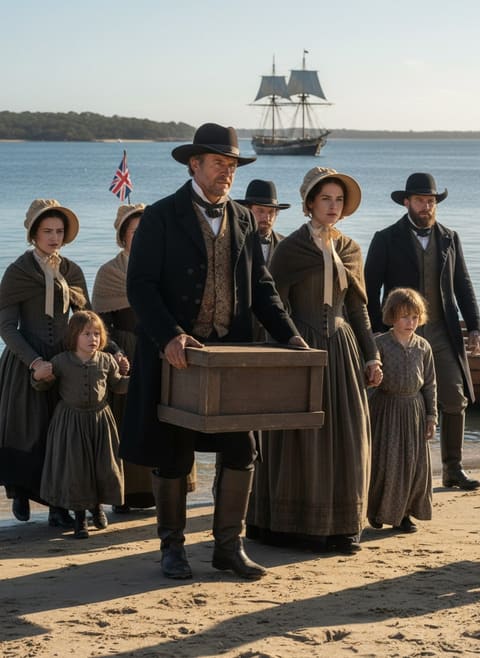
The salty breeze tangled her hair as she stood resolute on the Sydney docks, the wooden planks creaking beneath her boots. Around her, the morning air was alive with the clamor of promises and fears—the sound of ropes tightening, sails snapping, and the murmur of hopeful voices. Caroline Chisholm's eyes scanned the new arrivals, each young woman stepping shaky and hesitant from the ship, eyes wide with apprehension. They were alone, surrounded by the vast unknown of a new land, and it was here that Caroline took her stand—ready to turn uncertainty into opportunity.
The Waiting Shore
Sydney in 1841 was a panorama of potential—and peril. As a burgeoning colony, Australia promised new beginnings, but for the women arriving solo across the ocean, the harsh reality was often starkly different. They were part of a vast migration effort to populate the colony: each ship a vessel of aspiration. Yet, stepping onto the sun-baked docks without kin or confirmation of work, these women could easily find themselves adrift in a society still finding its own foothold.
Enter Caroline Chisholm, an Englishwoman with an unwavering sense of duty and philanthropy. Caroline, born in 1808 near Northampton, England, had been reared in the tradition of Evangelical philanthropy. Her own journey to Australia came years earlier, but her most significant impact began to manifest in 1841. As ships docked at Sydney Cove, she decided that no young woman would face these uncharted waters alone. With a fierce resolve, she became their guardian—meeting every vessel, greeting each new face with the promise of shelter and work.
Caroline's method was practical yet revolutionary. She transformed her mission into a seamless process. Initially, her focus was on providing immediate shelter. She leveraged facilities like the Maitland Immigrants' Home in East Maitland—a strategic choice, for East Maitland, designed by George Bayal White in 1828, was emerging as a pivotal legal and commercial hub in New South Wales. The East Maitland Immigrants' Home became a critical waypoint, a bedrock of stability and security for those like Mary Brown or Anne Smith, names that shared stories of hardship turned hope under Caroline’s watchful care.
Read next: When Edward Gibbon Wakefield Built a Colony From a Prison Cell, 1829
Resolute Compassion
Caroline’s work was not solely charitable—it was deeply pragmatic. Each job she secured was a lifeline cast into the turbulent waters of colonial uncertainty. Australian society was expanding but desperately in need of a workforce to sustain growth. Caroline saw this gap and interceded, setting up women in roles that not only secured their future but also contributed meaningfully to the burgeoning society around them.
What set Caroline apart was not just her philanthropy but her comprehensive understanding of systemic change. She recognized that for these women to truly thrive, a network needed to sustain them. With a remarkable organizational acumen, she lobbied tirelessly for the support of influential locals, imploring them to offer not just employment but acceptance into a community. This transformed potential isolation into engagement, crafting a model where colonist and settler ambitions meshed seamlessly.
Her impact rippled further. Within Sydney's bustling energy, she facilitated social evenings where employers and those seeking work could meet, an early precursor to the employment agencies we know today. This face-to-face interaction cultivated trust and respect, a radical shift from the daunting anonymity of incoming life in a colony. Her championing of inclusive society fostered connections beyond work — friendships and kinships interwoven into the fabric of settler life, creating bonds on both personal and professional levels.
Read next: When John Macarthur's Rival Built a Free Colony, 1836
The Rising Tide
Caroline Chisholm's legacy was not confined to her immediate actions but echoed in the lives she transformed. Each position secured led to stories of resilience, and her relentless advocacy began to shape public policy. Having influenced the establishment of the Family Colonization Loan Society, she provided mechanisms for family migration—a bold and impactful shift that reinforced community ties.
Her legacy found a home in concrete institutions like the Caroline Chisholm Cottage, a testament to her indomitable spirit. The structure, part of the original Smith’s Row built between 1831 and 1835 by John Smith, was one of the beacons where destitute immigrants found solace. The site stands to this day in the Hunter region of New South Wales—a historic touchpoint unequivocal in its tangible connection to those early, formative years of collective settlement.
In the grand vista of history, Caroline Chisholm offers an enduring narrative—that of individual tenacity shaping societal transformation. Meeting each ship with open arms, she shifted the fortune of an entire demographic. Her life is a reminder that sometimes, change arrives not on the tides of massive movements, but quietly, in the steadfast resolve of an individual waiting on the shore, determined to illuminate the path ahead.