The Western Front was about as far from India as the moon. Yet, in the autumn of 1915, a slice of home found its way to those muddy trenches — and it glowed.
By 1915, the Great War had consumed much of Western Europe in a relentless, churning conflict. The British Empire, stretching across continents, called upon its subjects from the farthest corners of the globe. Over a million Indian soldiers had answered this call, their journey taking them from the sweltering plains of Punjab and the lush backwaters of Kerala to the cold, unforgiving lands of France and Belgium. The expeditionary forces teemed with men who had likely never experienced frost or snow, their world limited to the late monsoon rains of their homeland. But what the frost-bound trenches stole in comfort, these men tried to reclaim with spirit and camaraderie.
Among the myriad soldiers entrenched in this gruelling conflict were young recruits and seasoned veterans alike, bound by duty, distant commands, and the weight of a foreign war. Hindus, Muslims, Sikhs — men from vibrant cultural milieus were thrust into an environment where bravery was their only solace, the glaring pale sky and churned earth their battle-tested wardrobes. Yet even among the dull thud of artillery and the ceaseless churn of mud, the bonds of brotherhood and shared homeland endured. And as autumn bled into winter, casting a chill across this cursed landscape, many minds turned toward the calendar and the approach of a celebration unique in spirit: Diwali, the Festival of Lights.
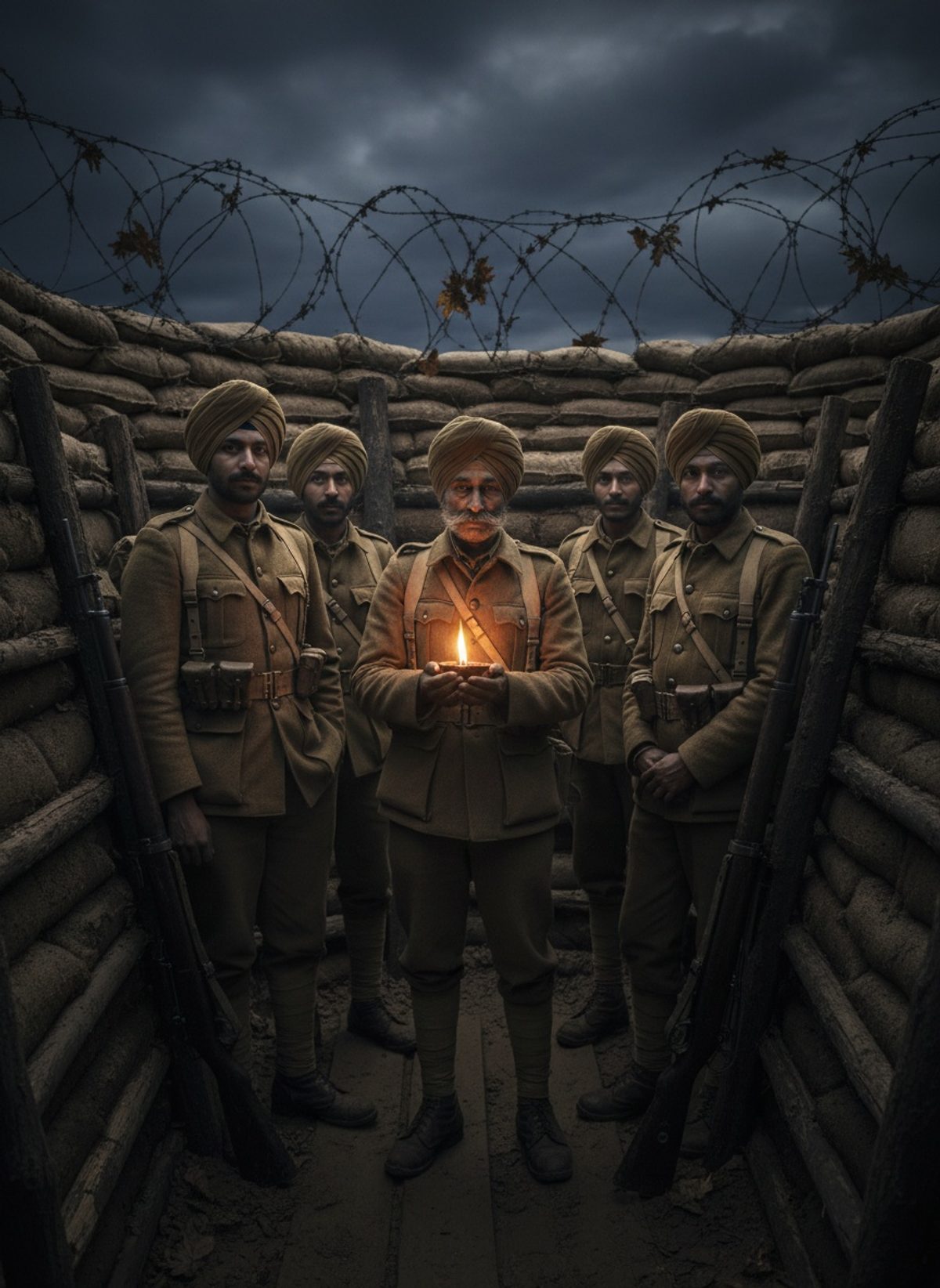
Diwali in India is a sensory tapestry — a festival of warmth, kinship, and new beginnings. Across the subcontinent, families illuminate their homes with earthen diyas, light sparklers that cast a glow on faces young and old, and exchange sweet treats as symbols of prosperity. It is a time when darkness cedes to light and hardships become tales of resilience around communal gatherings. For Indian soldiers on the Western Front, Diwali was not just a cultural tradition, but a lifeline, a connection to the life they knew and left behind, a resistance to the creeping ennui of warfare.
Read next: When Sergeant Roberts Put a Shell Through a King Tiger, 1944
Amidst the barbed wire and sandbags, these men gathered whatever candles and makeshift lamps they could procure. They set about creating a little bit of magic, a fragile solace amidst the chaos of war. Their resourcefulness conjured the spirit of Diwali in the grim interior of their dugouts — tea tins worked into lanterns, rations sparingly shared as feasts, and memories recounted across linguistic divides. The glow of each flickering flame was a thread sewing together the fabric of their distant homeland and their stark present reality.
To many of these men, letters from home delivered tales of village festivities and whispered reminders of familial embraces. The sharp notes of a harmonium or the words from a holy scripture might catch the night air, floating over the low ridges and no-man’s-land where silence was only broken by the crack of gunfire. On this particular Diwali, French mud hosted tales of conquest older than even the oldest battle-worn soldier — of Rama and his return to Ayodhya, of Lakshmi and promises of fortune.
For the Western Front, 1915 was a year which would inscribe itself into military chronicles for its futility and ferocity, but those grim tales often overlooked the smaller personal victories — like Diwali night when these desperate soldiers grasped light amid the world’s darkness. They didn't just weather the front; they burnished it with the humanity of their traditions, bridging distances with stories and shared silence filled with meaning.
Though tactical maneuvers governed their lives by day, it was these gatherings by night that fortified their spirits. Breaking from the cacophony of war, they found in shared culture a gleam of understanding: just as Diwali celebrates the triumph of good over evil, these men quietly battled to hold on to their goodness against the omnipresent evil of war. In clandestine ceremonies that outsiders might never catch a whisper of, they left behind for a space all flags and banners of Empire. Instead, they remembered the firesides of home — telling stories, murmuring songs, even thumping the odd drum hidden in packs from India.
Read next: When Simon Weston Survived Sir Galahad and Built a New Life, 1982
The soldiers’ diaries and dispatches often spoke of these moments, their lines written with thoughtful strokes. One soldier's words captured a collective sentiment: "Here in the frost of France, a single candle warms a soldier's heart as the fires of home warm an Indian night." Such sentiments spoke volumes of a generation caught in a conflict that reshaped cultures, yet found themselves even here illuminated by timeless connection.
The simplicity of a lantern flickering on trench walls stood in stark contrast to the large-scale horrors that defined the broader conflict. Comprising these moments of cultural plenitude was a profound message: as empires dominated expanses of land and horizon, the true lighthouses against the storms of history were never just kings or generals, nor were they etched in territories on a map. Instead, they pulsed alive through the bonds shared by those who, removed from the compass of power, chose light over despair and held on to their humanity with unyielding grace.
In a world teetering on chaos, the 1915 Diwali night on the Western Front stands as more than a footnote on a campaign map; never mentioned in military briefings, yet far more instrumental to the spirit of those who fought. The light that flickered across the trenches was testament to the enduring power of human culture, and a defiant stand to keep the darkness at bay. Ultimately, it serves as a reminder that in even the grimmest of human experiences, there lies a core unyielding resourcefulness and faith — that no empire, no war, no expanse of distance can ever wholly extinguish.