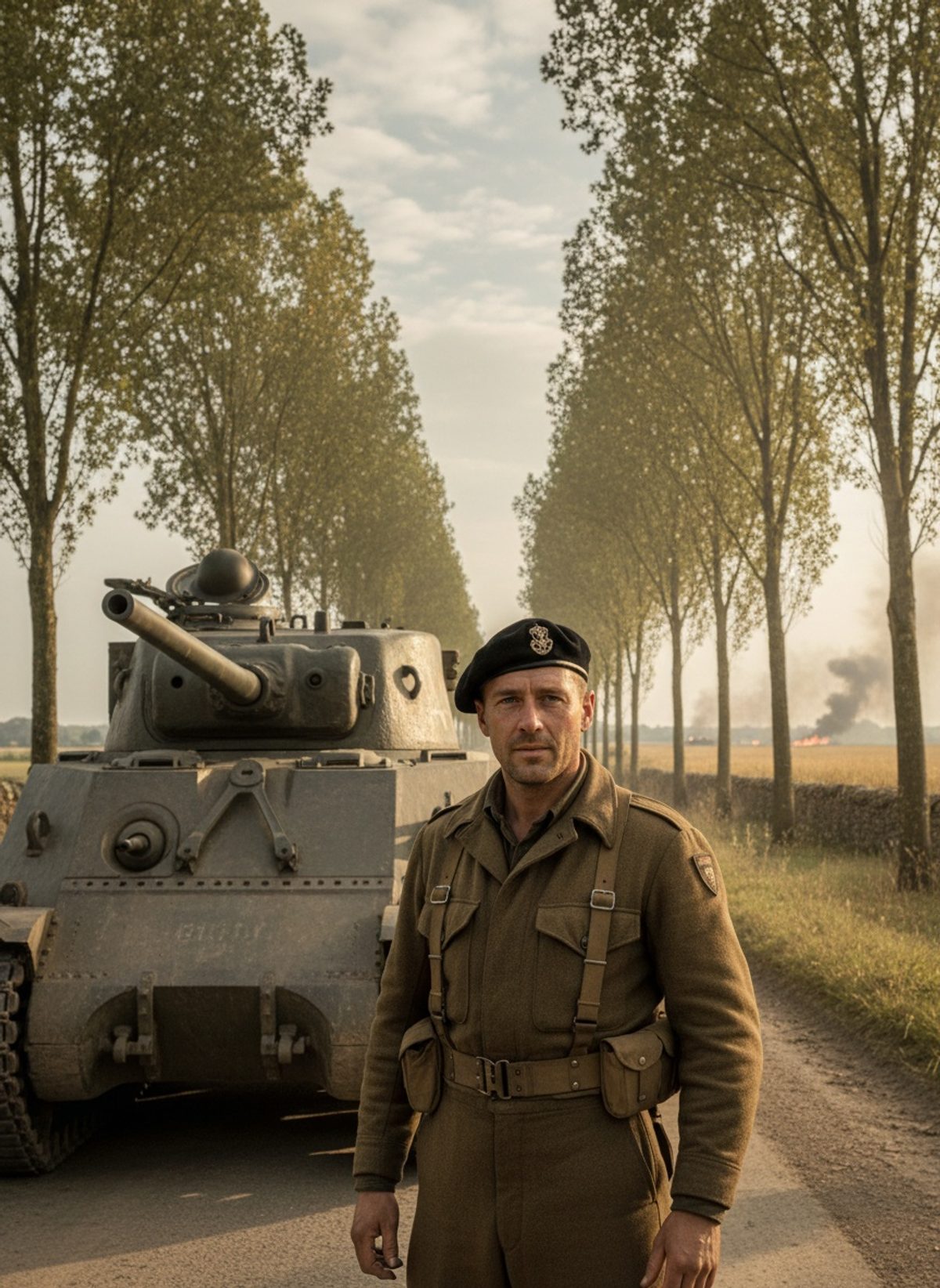
August 24, 1944. The late summer sun sank low over the French countryside, casting long shadows through the battered villages and fields.
Encounter in the Abandoned Crossroads
The rapid advance of the Allied Forces across France came on the heels of a string of victories following the D-Day landings. As German defenses crumbled, remnants of their once formidable Panzer divisions retreated in disarray. Somewhere north of Paris, amidst the chaos of retreat, young British sergeant, known only to history as Sergeant Roberts, commanded his Sherman tank through the dusty, crater-strewn roads. Their destination was not marked on any grand map but was critical—forty miles north lay a bulwark of retreating German forces trying to regroup for a final stand on the banks of the Seine.
War is an unpredictable beast. No one could predict the chance encounter that would place Roberts and his crew in the presence of one of the most feared armored vehicles of the war, the Panzerkampfwagen VI Ausf. B, or King Tiger. A monstrous beast of steel, the King Tiger weighed over sixty-eight tons, its formidable 88mm KwK 43 L/71 gun capable of roasting an Allied tank from over a mile away. Yet, on this day, the King Tiger was stranded—a mechanical failure, a bogged engine, and an idling in death-like stillness at an abandoned crossroads.
Sergeant Roberts sighted the hulking mass of enemy armor through the viewfinder. The Tiger's turret pointed inattentively to an empty landscape, yet its quiet presence alone spoke volumes of the terrors it could unleash. The decision to engage was daring, a matter of bravery and opportunity. The Sherman’s own 75mm gun was, in many respects, inferior to the King Tiger's, but Roberts and his crew had the element of surprise on their side. A well-placed shot could disable the Tiger, a potential asset if the German crew had not already fled.
Read next: When Britain's War Horses Were Left Behind in France, 1919
Biting the musty air, Roberts ordered the gunner to lay aim. The stillness of the abandoned battlefield cracked sharply. The shot landed true, crashing into the Tiger’s side armor. A plume of smoke erupted, and the behemoth sat lifeless, as though acknowledging its defeat. As the dust settled, the significance of the act became apparent. The wreck would remain a silent witness to the day's events, a testament to the changing tides in the war's favor.
The Symbol of Persistence and Power
In the ever-shifting chessboard of wartime Europe, each encounter, each victory, covered by peril and decisive action, held deep implications. The shell that Sergeant Roberts fired did more than pierce steel; it punctuated a moment of radical determination and resolve by the Allies as they swept through occupied lands. The King Tiger, engulfed in a shroud of its metallic obsolescence, became both a triumphant monument and a relic of vanquished might—a reminder that armor, no matter how thick, could not withstand the unexpected.
For the Germans, such losses were critical. The King Tiger was a strategic asset, a paragon of mechanical prowess and armored superiority. The Allies recognized the tremendous production resource it represented, each unit’s complex assembly demanding significant labor and materials. In static terms, every King Tiger taken out of commission was not just a tactical win but also a strategic blow. Enemy lines were left vulnerable, the once-feared war machines either scrapped or abandoned. What transpired on that summer afternoon with Sergeant Roberts' encounter, in the grand tapestry of war, was significant—it was a compelling story about human courage prevailing over engineered invincibility.
Today, that abandoned hull is enshrined in a museum, preserved for posterity, its craggy edges and perforated armor an invitation to delve deeper into its story. Touching its cold steel, one places themselves within the moment, understanding the dynamic outcomes of warfare that don't always make pristine footnotes in academic tomes. Eyes are drawn through the sights where Roberts once peered, imagining the palpable tension and grit that hung in the air, the scent of fuel, fear, and faint hope a silent witness to the choices of ordinary men under extraordinary pressures.
Read next: When the Black Watch Marched Into Atbara With Pipes Playing, 1898
Legacy of a Standstill Encounter
Though diminished over time in the annals of immense battles and seismic wartime strategies, this tale stands as a microcosm of a broader struggle. It encapsulates the complexities of human confrontation where the asymmetries in power and position are met with sheer audacity and will, echoing across generations. The tale of Roberts and the forsaken King Tiger strikes at the imagination and reverberates as a whisper from a past not so distant.
The King Tiger remains proudly displayed, an immutable piece of history and a complex loop binding the past with the present, inviting whispers to history enthusiasts to wonder at the individuals who saw not myth, but metal. The scars it bears are silent tokens to those moments when the map of Europe was redrawn day by day, inch by inch. It echoes with hard-earned lessons from theater commanders to the audacious tank commanders like Roberts, whose sharp decisions altered the course of events.
In contemplating such encounters, museums become more than just repositories of relics; they are chronicles of human spirit, ingenuity, and the unexpected turns of fate that underscore every line of the narratives found in textbooks. If history is memory, then these enduring instruments, witnessed by wide-eyed visitors and scholars alike, resonate with tangible reminders of the universal quest for endurance amidst odds. The King Tiger at rest—forever marked by that summer in 1944—bears ghostly witness, waiting patiently for visitors’ steps to pause and reflect on the remarkable truth that even giants can stand forever still, having no more battles to wage.