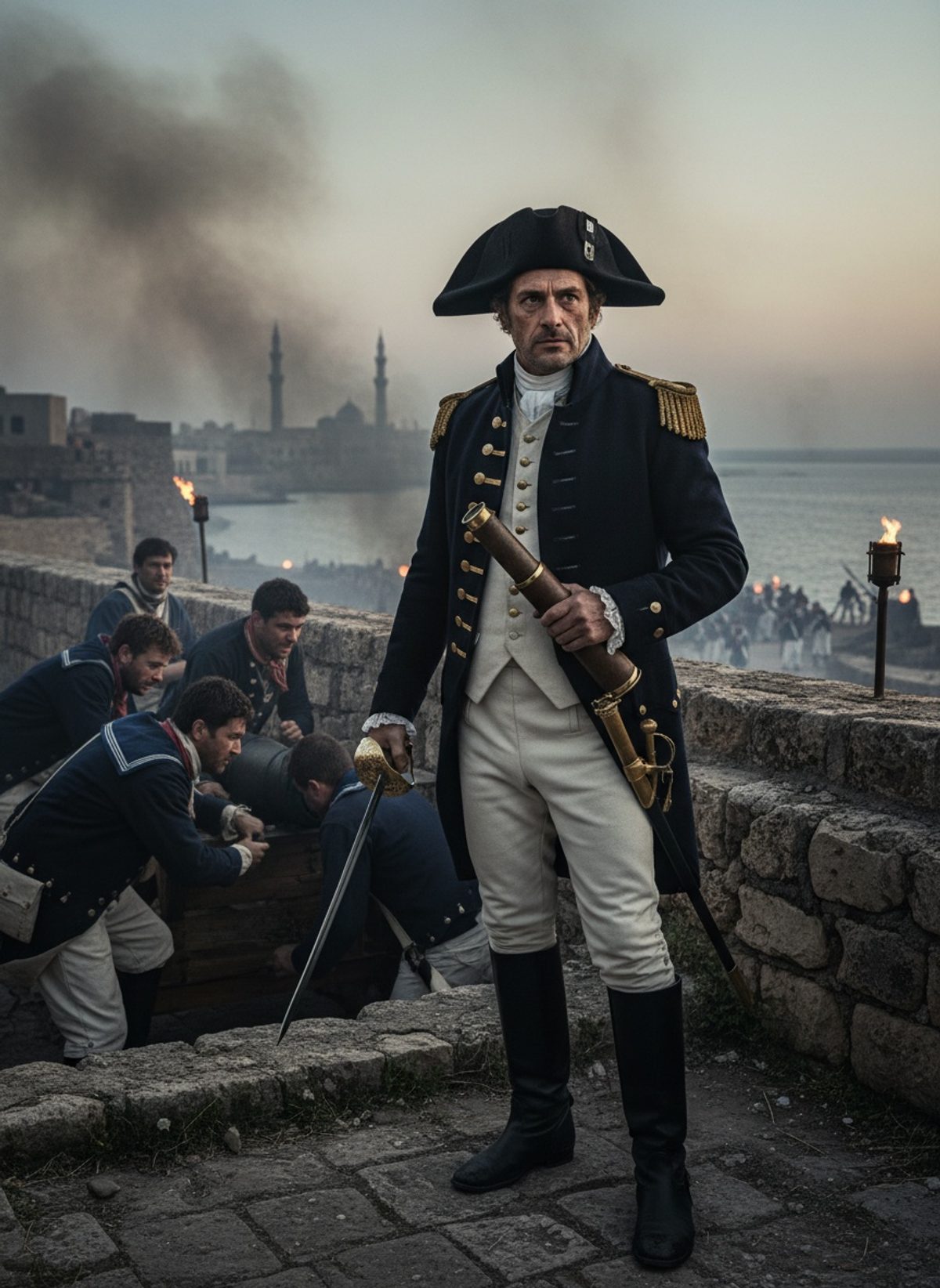
Commodore Sir Sidney Smith was a British naval officer. Napoleon Bonaparte considered him a mere pirate.
Amidst the sweeping sands and desert winds of the Middle East, the fate of empires often rested on unsung moments and unforeseen heroes. In 1799, as Napoleon Bonaparte sought to extend his revolutionary fervor eastward, a weathered stone fortification at Acre became the unlikely stage of defiance. Napoleon's ambition was monumental: to seize control of the eastern Mediterranean, carve a path to British India, and crown himself as a conqueror of the Orient. Yet, this overarching vision faltered, not because of clashing armies of equal size, but due to the determination and ingenuity of a few daring individuals led by Sidney Smith, a man often dismissed or vilified by his enemies.
Few would have imagined that Smith, who had once languished in the dank confines of the Temple Prison in Paris, would play a pivotal role in quenching the fiery aspirations of the Corsican General. Captured in 1796 during a mission to burn French ships at Le Havre, Smith had embarked on an audacious escape that would become legendary. Disguised and daring, his reappearance in naval actions against the French was both improbable and inspiring. Smith's very existence was a thorn in Napoleon's side, a testament to British resilience and resourcefulness.
As Napoleon's forces swept through Egypt and turned towards Syria, the fortified city of Acre, with its decaying walls, stood as the last bastion of Ottoman resistance. The strategic significance of Acre was not lost on either side. Its capture would open the gates to further ventures into the Levant and potentially beyond. For Napoleon, it was a lynchpin in his grand strategy; to Smith, it was an opportunity to defy not just one of France’s greatest military minds, but the notion of inevitability itself.
Read next: When VJ Day Came and Britain Held Its Breath, 1945
Envisioning the scene at Acre requires a departure from the typical grand battlefields of Europe. This was not a campaign of vast mechanized divisions, but of close-quarter skirmishes and relentless sieges. Napoleon, with his seasoned troops seasoned under the harsh Egyptian sun, relied on brute force and artillery superiority to annihilate resistance. Yet, as the cannons of the French army roared like metal serpents, ever crumbling the decrepit bastions of Acre brick by beleaguered brick, Smith and his men melded innovation with raw courage.
Smith’s plan was audacious in its simplicity: to reinforce Acre's fortifications with Royal Navy gunners. These sailors, trained aboard the rolling decks of His Majesty's ships, found themselves atop bastions instead, holding an impossible defense against a horde of seasoned soldiers. Though these gunners were outnumbered, they were not outfought. With critical reinforcements and supplies, delivered with the precision of the Royal Navy, Smith infused the city with a lifeline that would last sixty-two days.
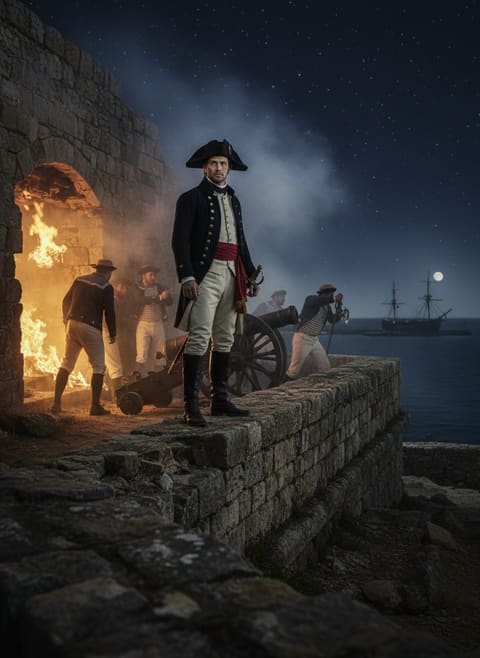
In the relentless cadence of day-after-day bombardment and hand-to-hand combat, Ottoman soldiers found unexpected comrades in blue-coated British sailors. This extraordinary alliance of necessity fought not only with muskets and cutlasses but with the crude machinations of war wrought in urgency—improvised mines, repurposed ship cannons, and relentless ingenuity. Night fell amidst burning barricades and hastily erected fortifications, the air thick with the acrid scent of gunpowder mingled with the salty breeze. Smith's spirited presence uplifted weary defenders, and possibly most importantly, unnerved Napoleon by distorting his expected narratives of triumph.
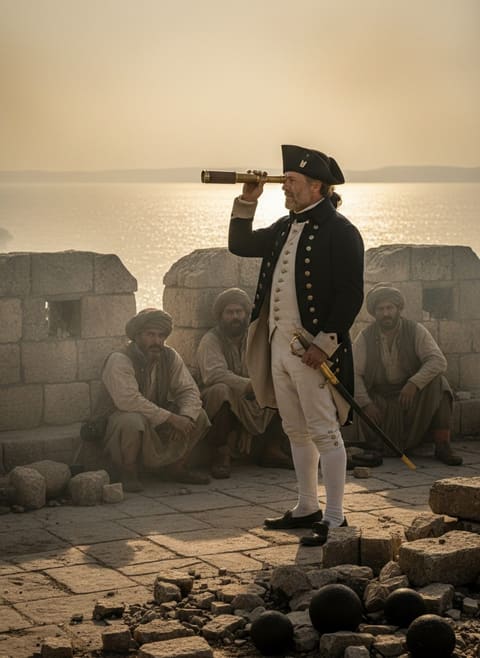
These were not just men defending stone walls; they were guardians of an idea—an idea that overt ambition, no matter how grand, could not overshadow the resolve of determined defenders. Bonaparte, peering through his looking glass from amidst the chaos, saw his aspirations repeatedly dashed against Acre's walls. Each sortie met with attrition instead of glory; each plan found itself checked not by overwhelming force, but by spirited resistance.
Read next: When the Camel Corps Rode Into Khartoum Too Late, 1885
The outcome was both unexpected and profound. As the French onslaught relented and withdrew, Napoleon's grand vision of an Eastern empire was irrevocably marred. What was to be a stepping stone to legendary conquests became a nagging blemish on his otherwise stellar military career. Perhaps most unsettling of all for Napoleon was being thwarted not by opposing empires, but a naval officer who some dismissed as a mere pirate.
The ramifications of Smith's unexpected and standoffish victory were felt far beyond Acre's borders. It altered the trajectory of Napoleon's eastern campaigns and demonstrated the unerring impact of individual valor against the tide of conquest. Forty years later, the memory of Acre persisted—not just as a naval encounter but as an enduring symbol of defiance against insurmountable odds.
In reflecting upon the siege of Acre, we find not just a chronicle of tactical proficiency but an essential reminder of history’s penchant for elevating the seemingly inconsequential into the realms of legend. While Napoleon remains a towering figure of military brilliance and ambition, it was the courage of people like Sidney Smith that interwoven within the grand narrative, altered the course of events. Through the mists of time, their tales whisper that strength lies not just in conquest, but also in the steadfast guardianship of what one holds dear, no matter how obscured by the grandeur of empires. In Acre, the world saw that a 'pirate'—a knight merely by title—could stand against a titan and emerge a savior, forever etching the words of defiance onto the sands of history.