
The deck pitched sideways under his feet as the schooner Royalist sliced through the opal waters of the South China Sea. James Brooke, a man seemingly carved out of the very spirit of the Victorian era, watched intently as the island of Borneo drew closer, its dense jungles cloaked in a thick mantle of mist. The air around him was alive with the cacophony of sea and sky, and yet, an unshakable focus sat in his eyes. This was not just a voyage; it was a gamble that teetered on the edge of madness and magnificence.
As the schooner made its way up the Sarawak River, Brooke surveyed the lush landscape before him. He had arrived with little more than conviction and daring, driven by a vision as grand as the untamed frontier before him. The local population, embroiled in rebellion against the Sultan of Brunei's representative, the Rajah Muda Hassim, had grown weary of oppression and heavy taxation. It was this volatile scenario that Brooke found on his arrival—a tinderbox, waiting for a spark.
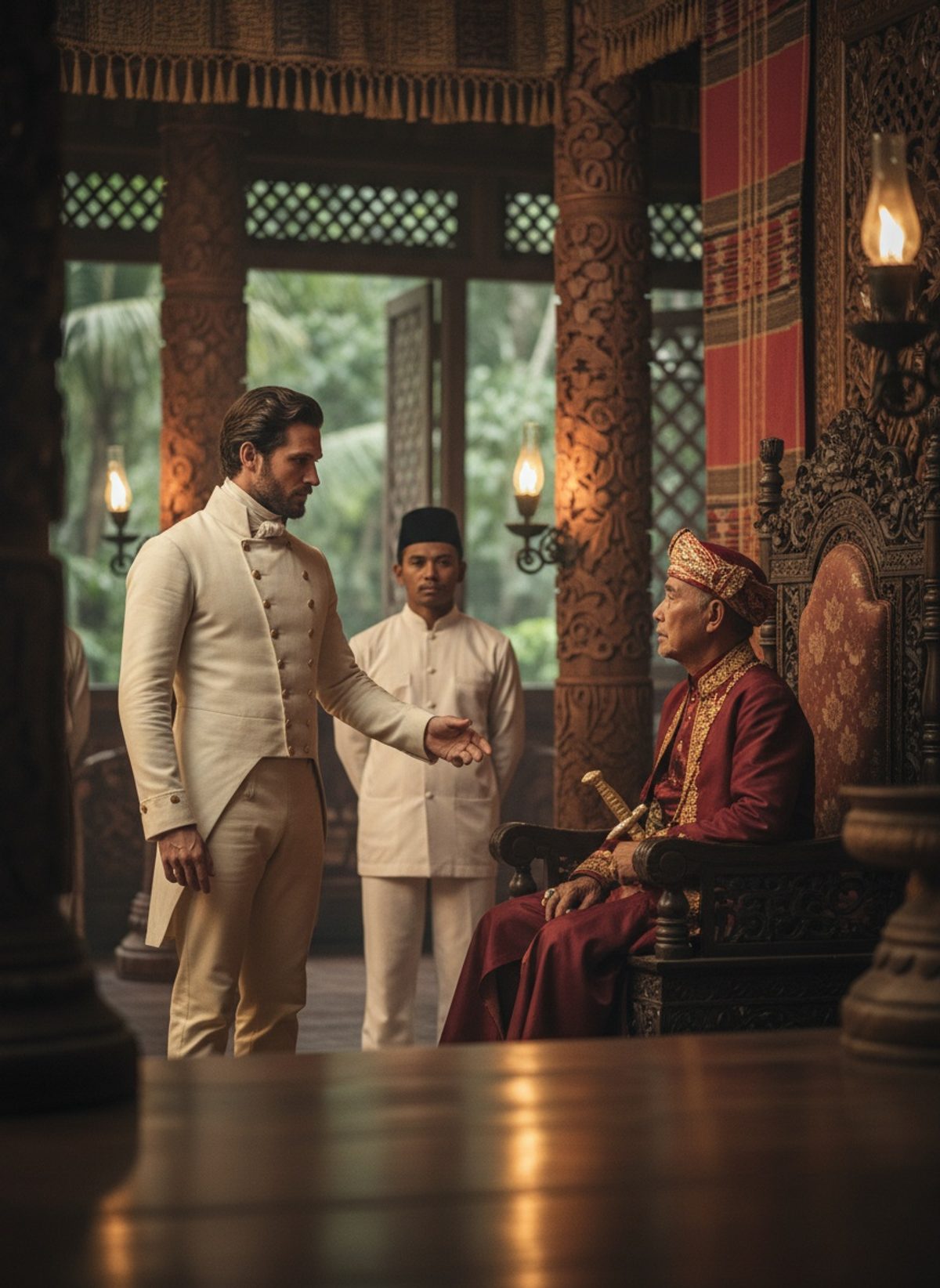
Meeting with the beleaguered Rajah Muda Hassim was Brooke's first priority. The rajah, burdened by the weight of rebellion, saw in Brooke more than just a foreign adventurer. With his small but well-armed crew, Brooke was exactly the kind of ally he needed. Their meeting was tense, the air thick with desperation and the potential for opportunity. It was in these fragile moments that dreams of empire were fashioned. With an assertive yet amiable charm, Brooke offered a deal: his military aid in exchange for authority over the region. A new dawn could break over Sarawak, they agreed, if the rebellion was quashed.
The tactical advantage the Royalist offered was small but significant. The schooner's presence essentially turned the tide of intimidation and firepower in favor of the rajah's forces. Brooke's crew and their weapons soon discovered themselves entrenched in skirmishes against rebels whose ferocity was matched only by their desperation. With cannons roaring and muskets spitting fire, Brooke showcased both strategic acumen and raw courage. The rebel forces, though fierce and fearless, were no match for such determination allied with technological superiority.
Read next: When Arthur Wellesley Entered Tipu's Palace as a Nobody, 1799
As the hours of conflict turned to days, victory began its slow march into sight. The rajah's forces, rejuvenated by their newfound strength and leadership, gradually regained control. It was a hard-won success, painted with the sweat and blood of both the paid and the passionate. In the aftermath of the tumult, the rajah, true to his word, named Brooke the Rajah of Sarawak in 1841—a title that carried with it awe, respect, and the delicate weight of expectancy.
Brooke's reign was as much about building as it was about maintaining. Once ensconced as rajah, he went about establishing a system of governance that was at once exotic and familiar. Brooke had visions of a realm that could serve as a model of both European and native ideals. Under his rule, piracy was curbed, headhunting was suppressed, and much-needed law and order began to thread its way into the fabric of daily life. Despite being a foreigner, his policies were rather forward-thinking for the time. He worked towards unifying the disparate local tribes and clans, incentivizing peace where there was once only tension.
The way Brooke embedded himself into the culture and politics of Borneo is perhaps best reflected in his relationship with the native Dayak tribes. Using diplomacy and respect, rather than exploitation, he garnered a rare trust, taking an active role in the settlement of disputes. Yet, the veneer of Brooke’s newfound power could never entirely mask the tensions simmering beneath. His Western roots continually colored his rule, making relations with traditional indigenous leaders complex.
Word of this unique kingdom ruled by a British adventurer soon reached the ears of those back in London, painted in hues of both skepticism and fascination. How had one man from the thrumming heart of Victorian England installed himself as a monarch in the far-flung wilds of Borneo? The British government itself, initially hesitant, began to take a more active interest as the potential for broader imperial influence became clear. Brooke's title as the White Rajah caught the imagination of a Victorian society hungry for tales of adventure and exotic empires.
The ripples of his burgeoning kingdom rolled across the British Empire, challenging the views of imperial governance and raising questions of sovereignty and rule in borrowed lands. The "White Rajah" was not just a curiosity but a symbol of the era's unrelenting quest for expansion. More than a decade later, the relationship between Brooke and the British government would see formal recognition as Sarawak became a British protectorate, further entrenching its place on the global stage.
Brooke's later years were not without controversy. Accusations of corruption, debates over his approach to governance, and the inevitable friction between colonial power and local politics cast shadows. Yet, this extraordinary tale of audacity and empire persists, a reminder of the complexities and contradictions inherent in the age of imperialism. Brooke's precarious dual role—as both protector and ruler—highlights the inherent tensions in a time when the world was reshaping itself beneath the boots of empire builders.
Today, the legend of James Brooke, the man who turned the tide of a rebellion to become the White Rajah of Sarawak, offers a nuanced reflection on leadership, legacy, and the manifold paths history can carve out. Seen through the prism of time, Brooke's story raises enduring questions about the nature of power and the epiphanies and blind spots of those who wield it. His kingdom, born of ambition and shaped in the mold of a singular vision, serves as a compelling chapter in the broader saga of empire-building—an episode both remarkable and resonant, inviting reflection on the stories left out of the textbooks and the ones we are yet to tell.