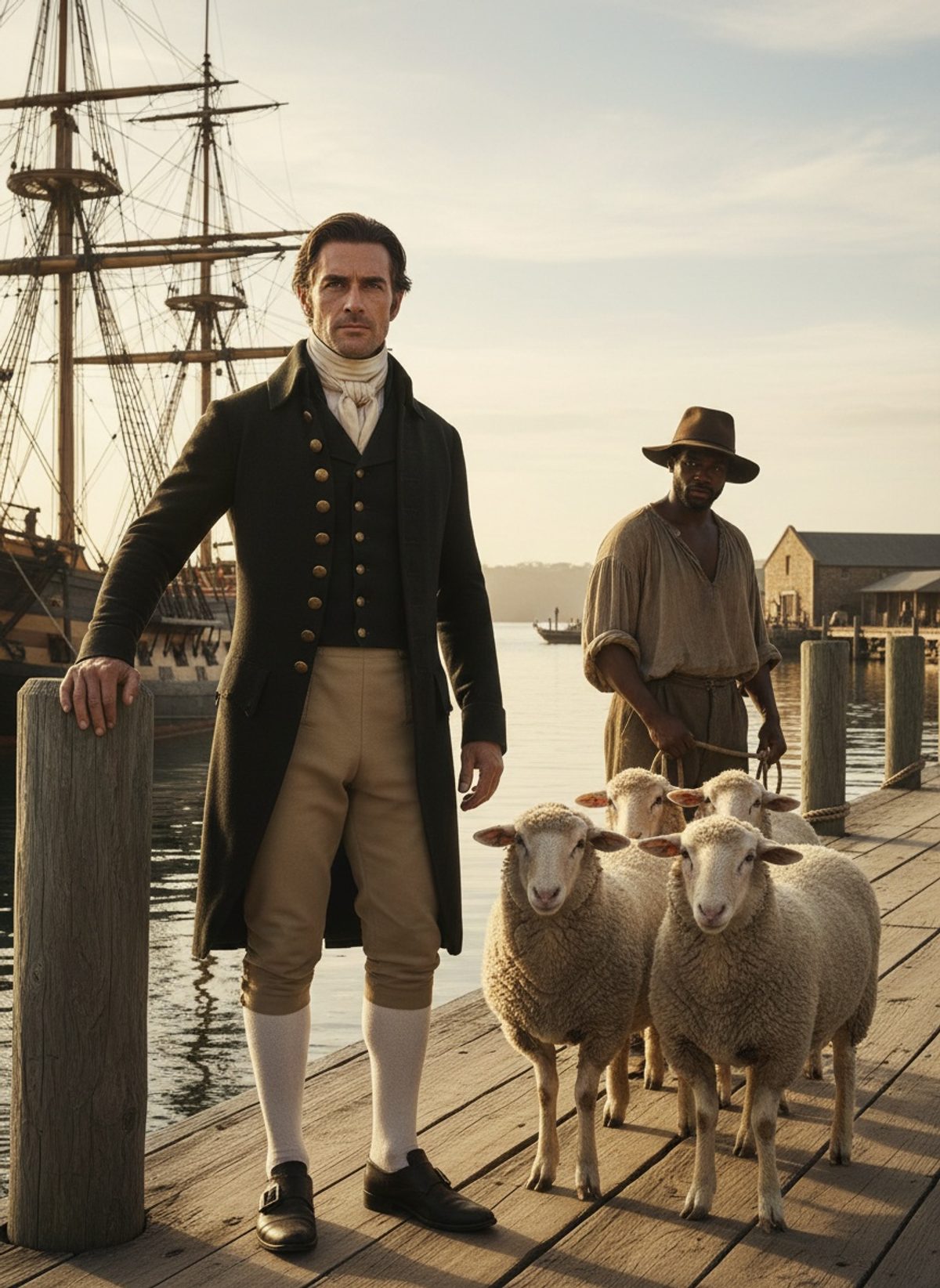
1803. The steady creak of wooden planks filled the cabin as the ship sailed through a restless sea.
The Unlikely Shepherd
John Macarthur was no ordinary settler. Arriving in the penal colony of New South Wales as a military officer, he quickly gained a reputation not for his disciplined leadership, but for his combative nature. Known for clashing with governors and dueling with fellow officers, Macarthur was a man often at odds with authority. Yet behind the rebellious facade lay a visionary mind attuned to the economic potential hiding within the convict island.
It was during his time in New South Wales that Macarthur's interest in agriculture was piqued, particularly the production of wool. At a time when Britain's Industrial Revolution spurred an insatiable demand for raw materials, wool stood as a valuable commodity. Macarthur's aspirations took solid form when he set his sights on the prized merino sheep—animals lauded for their superb wool. In 1803, as a self-imposed exile, he embarked on a journey back to England, carrying with him the seeds of transformation for an entire continent.
The Secret Cargo
Inside the grumbling confines of the ship's hold, Macarthur guarded a small flock of merino sheep—a breed renowned for its fine, soft wool, far superior to any produced by the coarse-haired sheep already habitating the Australian colony. These sheep were not easily obtained; Spain, which jealously guarded its merino stock to maintain monopoly over the wool trade, rarely allowed them to leave its borders. However, it was Macarthur's cunning and persistence that enabled him to acquire a few of these exceptional animals from Cape Colony, setting the wheels of change in motion.
Read next: When John Macarthur's Wife Sailed Sheep to a New World, 1797
As the ship traversed the tumultuous oceans, Macarthur kept a vigilant eye on his precious cargo. Every bleat echoed with the promise of a new future, a pastoral vision that challenged the perception of Australia as mere penal outpost. The colonies, deeply mired in struggles for basic sustenance and governance, had yet to realize their potential for industry and prosperity.
Return to the Far Side of the World
The return journey to Sydney signaled a metamorphosis not only for Macarthur himself but for the colony at large. Arriving back in New South Wales with his prized merinos, Macarthur was armed with a plan to transform the rugged land into one of the greatest wool-producing territories in the world. His efforts to establish a merino breeding program were met with skepticism. Yet he remained undeterred, driven by an ambition that bordered on obsession.
Macarthur's agricultural holdings at Camden Park, within the Sydney basin, became the fertile ground for this wool revolution. The resilient climate of New South Wales tested the adaptability of the Spanish sheep, but in doing so, it also imbued their wool with unique qualities that would eventually capture international acclaim. Macarthur's experiments and innovations in breeding techniques showcased his shrewd understanding of both agriculture and market dynamics.
Dueling Adventures and Economic Triumphs
In championing the wool industry, Macarthur's legacy was not without controversy. His fiery, indomitable personality saw him embroiled in numerous disputes with colonial authorities—a result of his relentless push for economic progress. One of the more notorious clashes culminated in the Rum Rebellion of 1808, where Macarthur played a pivotal role in the overthrow of Governor William Bligh. This tumultuous episode captured the essence of Macarthur: a figure intertwined with both the chaos and the creativity that shaped the fledgling colony.
Read next: When Edward Gibbon Wakefield Built a Colony From a Prison Cell, 1829
Yet, far beyond the political intrigue, it was the transformative impact of Macarthur's merinos that left a lasting mark on the Australian continent. Their introduction reshaped the economic landscape, with wool exports surging to become one of Australia's most significant industries. The once-overlooked convict settlement began its journey towards becoming an agricultural powerhouse, bolstered by the tireless efforts of this divisive yet undeniably influential figure.
Ripples Across the Continent
The voyage of the merino sheep had profound implications. By igniting Australia’s wool industry, Macarthur's bold endeavor catalyzed the development of a robust pastoral economy, fostering growth in infrastructure and commerce. Wool became a cornerstone of Australia's economy, paving the way for widespread prosperity and global recognition. This transformation reverberated through the decades, embedding itself in the fabric of Australian society and culture.
John Macarthur's turbulent journey—from military officer to agricultural pioneer—underscores the power of vision and tenacity in shaping the destiny of a nation. The merino sheep, once a secretive cargo on the high seas, now stands as a symbol of Australia's resilience and ingenuity. As we reflect on this remarkable chapter, it challenges us to consider the hidden catalysts that lie in the shadows of history, urging us to acknowledge their enduring influence on our world today.