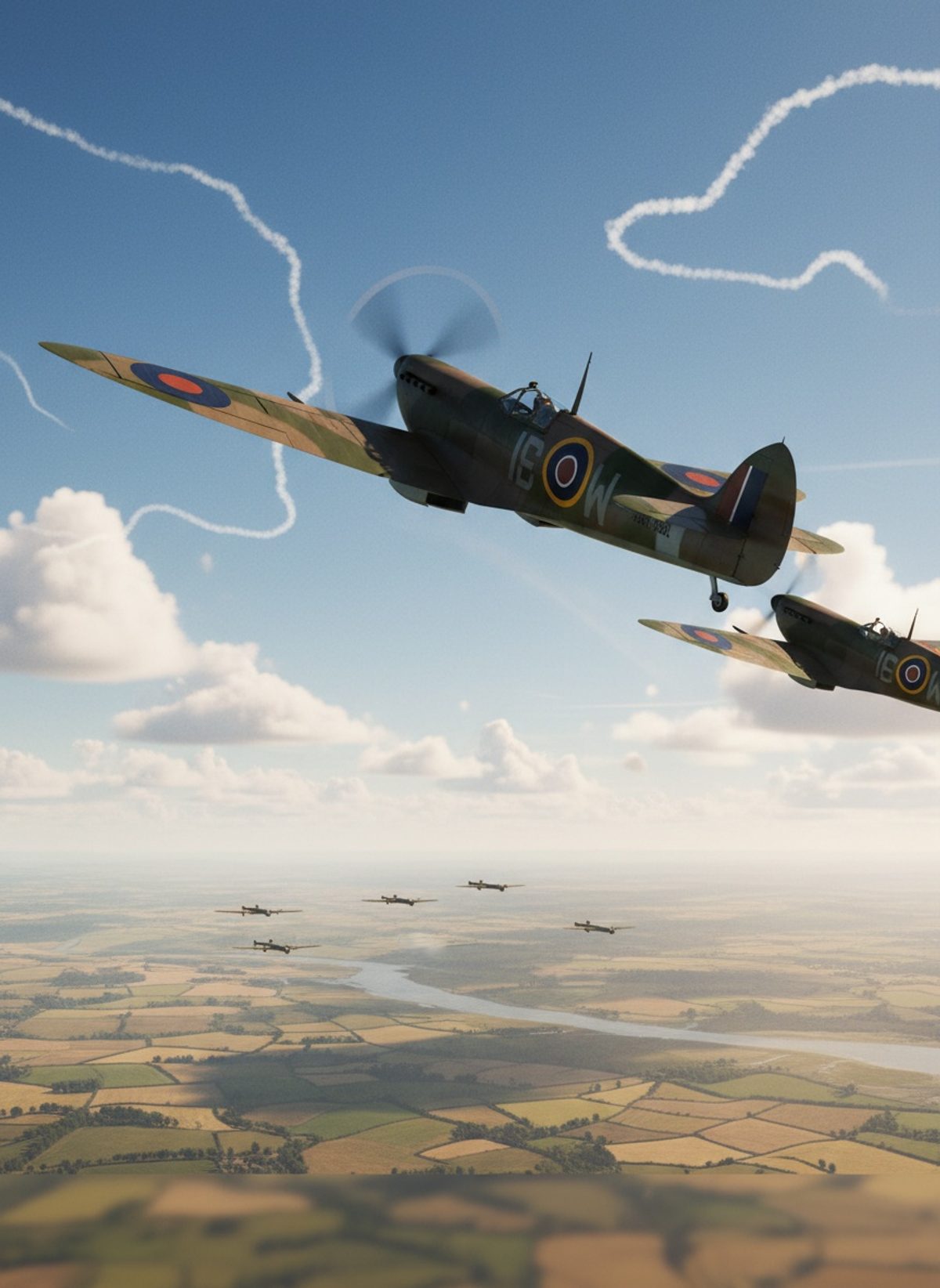
Around 1,500 aircraft took part in the air battles of a single day. On 15 September 1940 the Luftwaffe launched its largest and most concentrated attack against London, in order to force the RAF into a battle of annihilation and open the way for the invasion of England, Operation Sea Lion. Most of the fighting fell to Air Vice Marshal Keith Park's No. 11 Group, and by the end of the day RAF Fighter Command had defeated the German raids. The action was the climax of the Battle of Britain.
Park and No. 11 Group
No. 11 Group covered the south-east corner of England, from a line running from near Southampton to Aylesbury and then across to Lowestoft. Its sector stations ringed London: Northolt to the west, North Weald and Debden to the north, Hornchurch to the east, and Biggin Hill and Kenley to the south. On the evening of 14 September No. 11 Group had 310 fighters, 92 Spitfires and 218 Hurricanes. Park's tactics were disputed within the RAF: Air Vice Marshal Trafford Leigh-Mallory, commanding No. 12 Group to the north, was critical of the way Park and Air Chief Marshal Hugh Dowding, commander of Fighter Command, were conducting the battle.
Hitler had ordered the Luftwaffe to destroy the RAF as a prelude to Operation Sea Lion, and after an RAF raid on Berlin in late August he ordered it to concentrate its attacks on London, in the belief that this would draw Fighter Command into a large, decisive battle. German intelligence believed the RAF was close to collapse, and striking at vital points in London that the RAF would be forced to defend offered the chance to destroy its remaining fighters and win air superiority. At a meeting on 14 September, however, Hitler dismissed over-optimistic reports from the Luftwaffe high command that the RAF was on its last legs. Without air superiority Sea Lion could not proceed for the time being, and he deferred his decision on the invasion until 17 September. German bomber crews, though, were told that the RAF was down to its last reserves and that one more assault would clinch victory.
Good weather was predicted for France, Belgium and southern Britain on 15 September, and staff officers of Luftflotte 2, based in Brussels, planned a two-pronged attack. The first prong was to hit the network of railway tracks in the Battersea district, which linked London to the West Midlands and other industrial cities in the north. The second, larger attack, scheduled for the afternoon, was aimed at the docks: the warehouses of the East End, the Surrey Commercial Docks south of the river, and the Royal Docks to the north.
Read next: The RAF's Youngest Wing Commander at Twenty-One
The Morning Raid
That morning Winston Churchill arrived at the operations room at RAF Uxbridge, where he would watch the day's events from a viewing gallery overlooking the plotting tables. At 11:04 the first German aircraft, Major Alois Lindmayr's Dornier bombers of KG 76, reached Calais and were picked up by the Chain Home radar station at Dover. Park and his senior controller, Wing Commander Lord Willoughby de Broke, watched the plots with Churchill. It was not possible to tell which plots were bombers and which were fighters, and interceptions had to be timed with care, since a premature scramble could leave the fighters short of fuel. After a discussion with de Broke, Park sent nine squadrons into action at 11:15. The German formation had broken up in cloud as it climbed and had to re-form, and a strong head wind slowed the Dorniers, burning up the limited fuel of their Bf 109 escorts.
Park's view, endorsed by Dowding, was that inflicting large losses on the Germans mattered less than safeguarding his own forces. He sent small numbers of fighters to intercept, minimising losses in the air, but he would not let the bulk of the German bombers reach their targets unscathed, because the loss of the vital sector stations could cripple the defence system. As long as some cost was imposed before the enemy dropped his bombs, the RAF could remain intact to meet the threat again the next day, and Park believed the Germans would give up if they could not win air superiority.
In contrast, Leigh-Mallory backed Squadron Leader Douglas Bader of No. 242 Squadron, who planned to use three to five squadrons in a 'Big Wing' formation. Positioning such a large formation took time, so the Big Wing often failed to prevent bombing raids on No. 11 Group's airfields and engaged the bombers only as they withdrew. Leigh-Mallory accepted this, arguing that it did not matter when an interception was made, as long as it accounted for a large number of enemy aircraft. Despite his reservations, on the morning of 15 September Park ordered that the Big Wing be tested, and the Duxford Wing of 56 fighters, led by Bader, was airborne by 11:22.
Contact over Kent
Park's plan worked. At 11:50 Spitfires of Nos. 72 and 92 Squadrons from Biggin Hill attacked the German top cover out of the sun near Canterbury, and squadron after squadron followed. By attacking all along the route, Park forced the Bf 109s to use up fuel in dogfights, and when the outskirts of London came into view at 12:07 they began to break away for France. Ray Holmes of No. 504 Squadron, out of ammunition, rammed a straggling Dornier, which crashed onto the forecourt of Victoria station; its bombs fell on or near Buckingham Palace. Holmes bailed out injured, but survived. Bader's Duxford Wing arrived over the target as the Germans began their bomb run. The bombs cut the tracks at Battersea in several places and halted rail traffic, but the lines were out of action for only three days. The morning attackers lost six bombers and twelve Bf 109s, and the RAF lost 13 fighters. At 13:00 the German formations were plotted heading back to France, and Churchill was delighted with the results.
The second, larger wave was airborne before the morning's bombers had landed: 114 bombers with a heavy fighter escort, a German force of 475 aircraft. Park repeated the morning's tactic, and the RAF put 276 Spitfires and Hurricanes into the air. At 14:35, seeing every squadron committed, Churchill asked what reserves were available. Park said there were none; he meant No. 11 Group alone, and at his request squadrons from the sectors of Nos. 10 and 12 Groups closest to London were committed to its defence. Cloud from 2,000 to 12,000 feet made it hard for the controllers to direct their squadrons, but it also covered the targets. The bombers found clear skies over West Ham and bombed it at 14:45, while KG 2 could not find the Surrey Commercial Docks and dropped its bombs over a wide area. According to West Ham borough records, 17 people were killed. German bombers forced out of formation tried to reach France under cover of the cloud, but virtually all were destroyed. In the afternoon raid the Luftwaffe lost 21 or 23 bombers and at least 12 fighters; the RAF lost 15 fighters.
All the German bomber units were intercepted that day and scattered as they withdrew, and the formations failed to inflict severe damage on London. The Air Ministry announced that 175–185 German aircraft had been shot down; the true number destroyed was about two-thirds lower. Park was livid with the inflated claims, placing particular blame on Leigh-Mallory's Big Wing, and his lesson for the day was that things needed “tightening up”. He knew the ratio of losses was 2:1 in Britain's favour: a decent performance, but not Fighter Command's best.
Read next: When the 15th Scottish Division Crossed the Odon at Dawn, 1944
Beyond the Horizon
On 17 September, unconvinced that the Luftwaffe could secure the air superiority needed for Sea Lion to proceed by the set date of 21 September, Hitler postponed the invasion until further notice. Within days RAF reconnaissance aircraft were reporting fewer barges in the German-held Channel ports. Having been defeated in daylight, the Luftwaffe turned to the Blitz, bombing London and the major industrial cities by night until May 1941. At the beginning of December Hitler told his high command to abandon Sea Lion, although he did not officially cancel it until 3 March 1942.
Park's handling of the actions was a masterpiece of aggressive defence, although a big set-piece offensive played into his hands and he was not under the pressure he had faced in August. During both major engagements Fighter Command had used less than half of its strength; it would have been able to meet the Luftwaffe again the next day.
The Luftwaffe's failure to destroy the RAF on 15 September was a decisive failure, and the Battle of Britain ensured that the Western Allies had a base from which to launch the invasion of Western Europe in 1944. 15 September is commemorated each year in the United Kingdom as Battle of Britain Day.
Part 4 of 24: One Second World War story a day, 16 November to 9 December