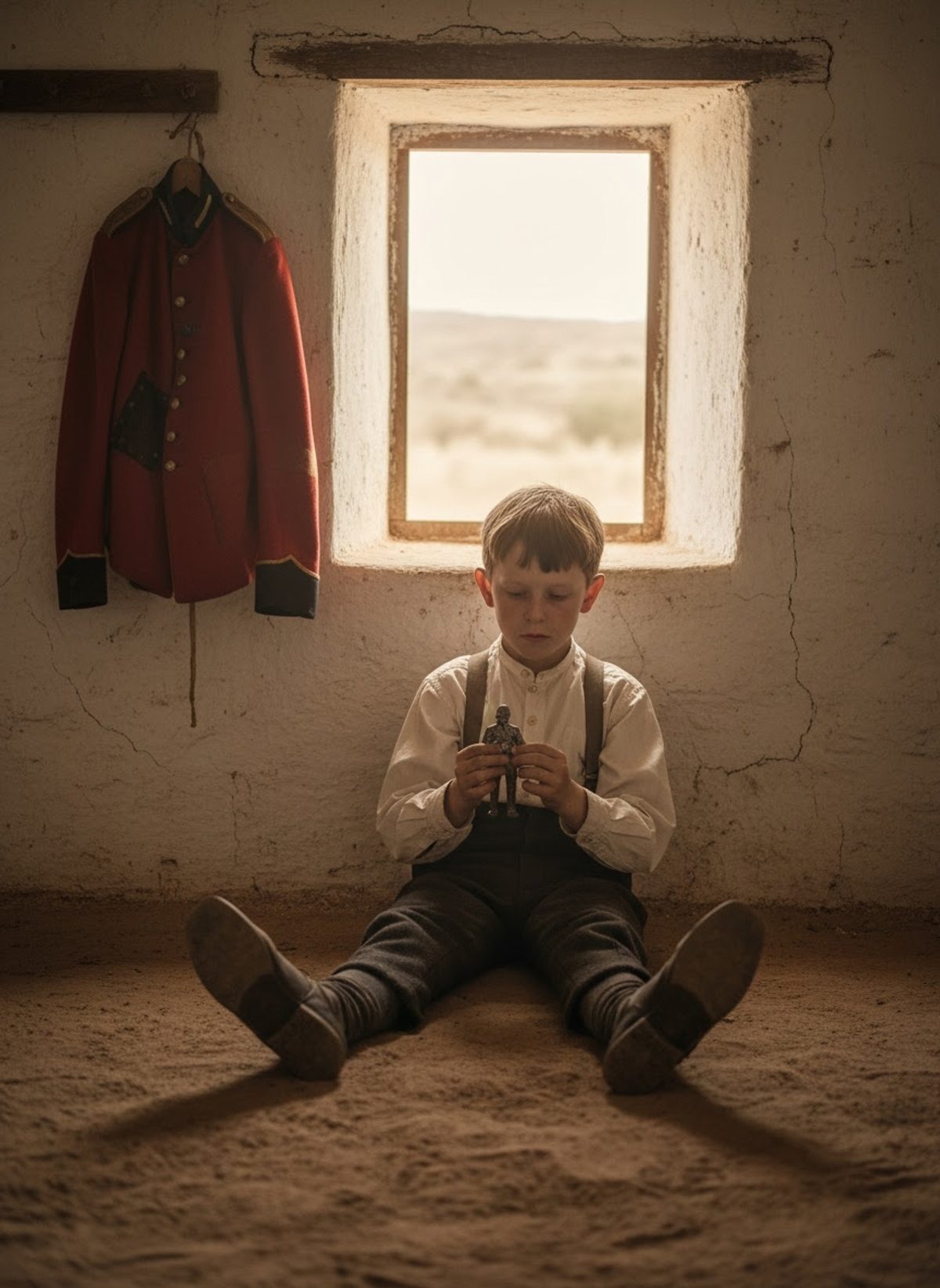
He was just a boy of eight. Yet, this young lad from Ladysmith held onto something more resilient than the iron will of grown men: a tin soldier.
Besieged in Ladysmith
The Second Boer War painted South Africa's skies with the smoke of gunfire and put cracks in the fortresses of British morale. Among these strongholds was the town of Ladysmith, caught in the iron grip of a Boer siege that stretched for 118 excruciating days. Under that suffocating blockade, food dwindled, hope wavered, and within the walls, danger seeped in with each whispered breath of typhoid and enteric fever.
Among the besieged, a family faced an unbearable struggle. The father, a color-sergeant of the Royal Irish Fusiliers, carried not only weapons but also the heavy duty of morale. As he set about his military duties, his wife fought another battle indoors, where her son clutched his only toy—a tin soldier—carried from wherever safety took them.
The little soldier, tucked into a biscuit tin, endured the shellfire alongside its young owner. It was a symbol of innocence amid chaos, a tangible piece of normalcy in a world turned upside down. The child's father, a stalwart figure to those under his command and a beloved presence in his family, struggled against the silent enemy of disease as enteric fever began to claim its due.
Read next: When Keith Park's Fighters Broke the Great Raid on London, 1940
Endings and Beginnings
It was nine days before the relief force finally broke through the encirclement that the boy's father succumbed to the fever, leaving a wife and son behind. His passing marked not just the end of a life but the shattering of a family's small semblance of stability. Yet, the boy's grip on his tin soldier never faltered; it became a touchstone in those shadowed days, a promise of survival against all odds.
The relief of Ladysmith on February 28, 1900, brought jubilant scenes to the beleaguered town. Thousands of besieged residents rushed to greet the new dawn free from the Boers' relentless siege. The boy, his heart heavy with the fresh sting of loss, carried his tin soldier through the cheers and tears towards a future muddied with uncertainty. The passing of his father became a quiet echo within the cacophony of liberation.
The family's story became one of many embedded in the tapestry of Ladysmith's siege, less vivid but equally poignant. The tin soldier, preserved through bombardments and personal tragedy, took on more character than the battered walls around it.
A Toy and Its Legacy
The boy grew, and with him, the significance of his tin soldier deepened. To others, it might seem nothing more than a piece of metal, yet to him, it was a monument—an emblem of endurance. This little toy bore silent witness to a chapter of history enfolded in personal loss and communal struggle.
How can a toy carry such weight? Perhaps in its steadfastness, offering companionship through nights when shadows were thickest. Where others saw merely metal and paint, the boy saw courage, unwavering and undiminished. He safeguarded that soldier as the years advanced, as a testament to both the past it represented and the future it forged.
Read next: When Vickers Built a Tank the Empire Could Actually Afford
The memory of the siege itself, often placed in shadowy corners of larger historical narratives, remains caught somewhere between survival's rawness and victory's glory. To the boy who became a man, the siege was a crucible, the tin soldier one of its survivors.
The Heart of History
Amid the tides of history, individual stories shine through, shaping how we remember entire epochs. The tin soldier from Ladysmith, tucked into a biscuit tin and guarded through days of desperation, stands not for victory or defeat but for resilience—the resilience of a boy who refused to let go of what little he had left.
This account does more than weave a tale of personal survival during history's violent throes; it invites reflection on the artifacts we keep and why they matter. Each carries untold stories, whispers from the past that speak to our shared humanity. Sometimes, a scrap of metal might hold all the hope one needs to face uncertain dawns.
And in sharing these stories, we offer future generations not just the facts, but the humanity that underpins them. The boy and his soldier remind us that history's true marvel often lies not in its monuments but within its small, enduring relics.