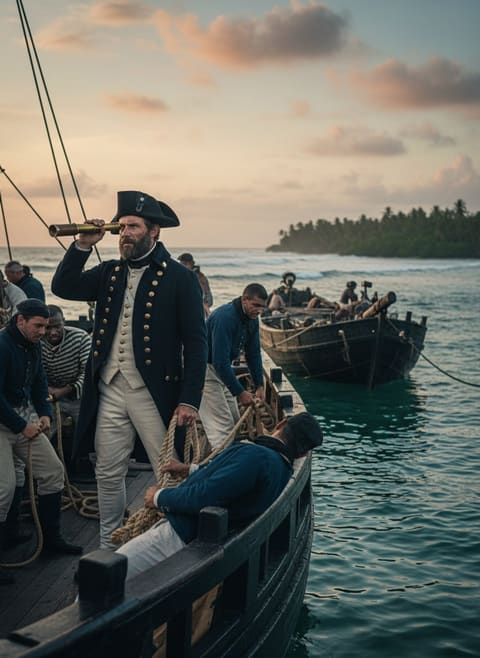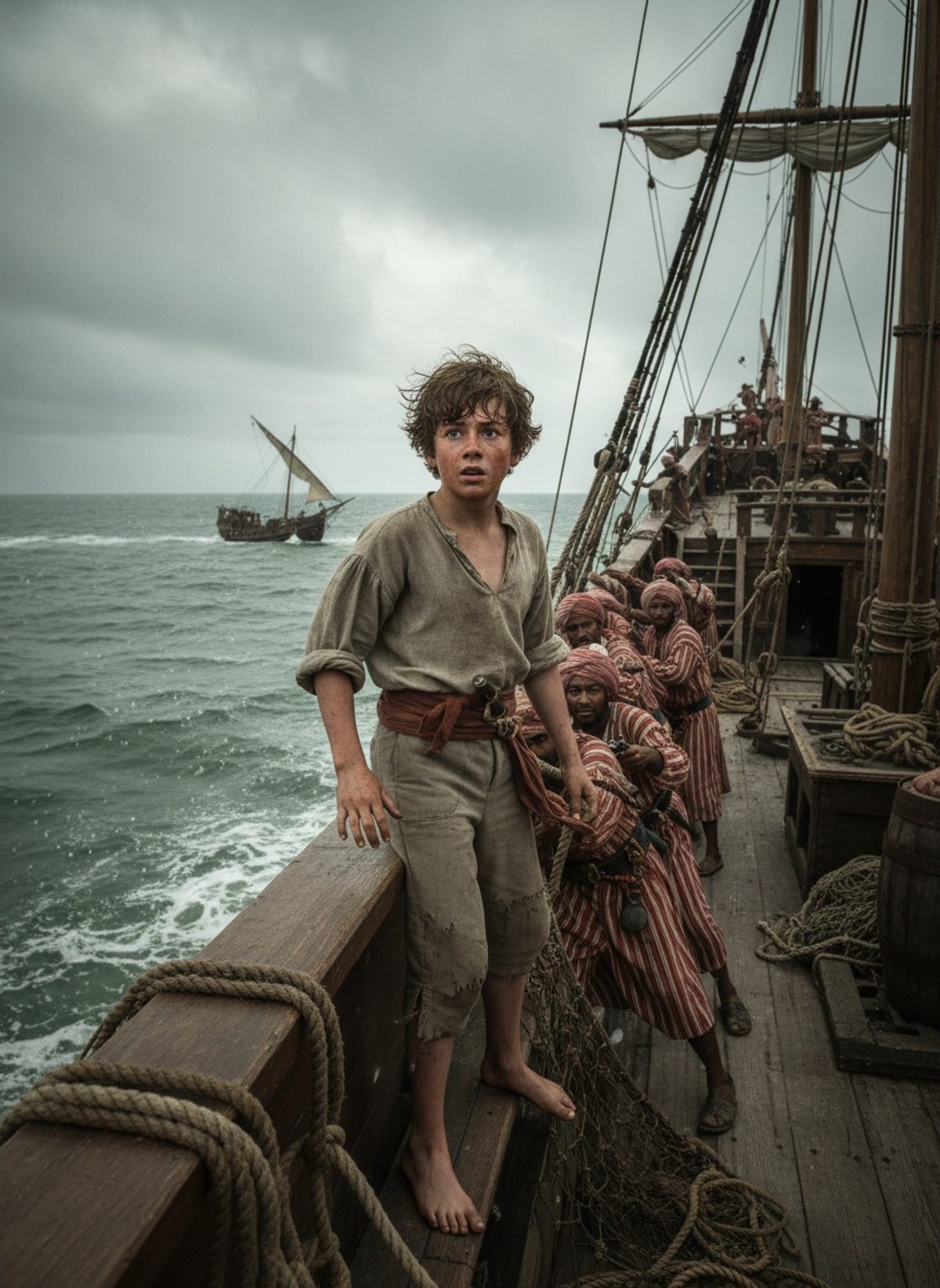
May 13, 1715. The sea shimmered with deceptive serenity off the coast of Portugal.
The Fateful Voyage Begins
Thomas Pellow, a spirited eleven-year-old from Penryn, Cornwall, stood on the deck of his uncle's merchant ship, eyes gleaming with the thrill of adventure. The Atlantic stretched before him, full of undiscovered horizons and the promise of a sailor's life. His uncle's ship was one among many that sailed the bustling trade routes of the British Empire, reaching toward riches promised by exotic markets. But fate had another kind of encounter in store.
Amid favorable winds, the ship cut through the water with an air of determined purpose, yet even the keen eyes of seasoned sailors missed the ominous silhouette shadowing them—a formidably fast vessel, prowling the ocean with predatory intent. It was a Barbary corsair, the kind that snaked along busy trade routes, ready to seize opportunity and cargo alike.
The Dreaded Encounter
It came without warning. A sudden burst of motion across the waves, a dark sail billowing dramatically against the azure sky. The corsair closed the gap with alarming speed, and panic rippled through the crew. Defiance sparked on the lips of Pellow and his comrades, but their ship was no match for the ruthless efficiency of the raiders.
Read next: When Broke Sailed Into Boston and Dared Them to Fight, 1813
Clad in flowing robes and wielding curved scimitars, the corsairs boarded the merchant ship with a practiced savagery. The air filled with shouts and the clash of steel, overcoming the brave defiance of the Cornish sailors. For Pellow, it was a sensory onslaught as confusion and fear churned in the depths of his young heart.
The ships rocked together like wrestling sea beasts as the corsairs claimed their prize—not just the ship and its goods but its very crew. A rough hand fell on Pellow’s shoulder, marking the end of his world as he knew it.
The Sultan’s Court
Swept across the sea and into the heart of Morocco, Pellow entered a realm as foreign as a dream. News of their capture travelled swiftly, but it would be decades before any hope of rescue crossed his horizon. Meanwhile, a different type of survival began.
In the court of Sultan Moulay Ismaïl, Pellow’s fate interwove with that of many enslaved souls, all bound to the whims of one of Africa’s most formidable rulers. The Sultan, known for his grand constructions and a fearsome regime, was building an ambitious kingdom—one stone, one slave at a time.
Pellow’s youth and resilience saw him spared the harshest of fates—death or lifelong drudgery on the Sultan’s architectural dreams. Instead, he was absorbed into the court’s intricate labyrinth, his European origin marking him out as both exotic and useful.
The Long Wait for Freedom
Pellow’s years in Morocco unfolded in a land of startling contradictions. Despair merged with unexpected kindnesses, survival became a game of wits, and every sandstorm and sizzling day was a reminder of England's distant shores.
The Sultan's court was a bustling microcosm of power struggles and cultural exchanges. Pellow, keen and observant, gradually learned the language and customs, carving a niche of relative security amongst exotic intrigue. The understanding he developed of his captors and their lands became his shield and his sword.
Read next: Built for Nelson's Navy. Sunk by the Luftwaffe.
Yet, throughout his imprisonment, the ache for home never dulled, nor did his resolve to return. With a heart as restless as the ocean, Pellow maintained hope, seizing upon rumors and murmurs of peace negotiations with a fervor burning brighter than the Moroccan sun.
Homeward Bound
In 1738, after twenty-three long years, Pellow's patience and perseverance were finally rewarded. A new ruler sat upon the Moroccan throne, more amenable to foreign negotiations, and Pellow found his opportunity to petition for his release. His relentless spirit and hard-won respect among his captors granted him a place among those liberated, allowing him to sail back to the land of his birth.
The journey homeward was not without its own trials, a reverse echo of his boyhood voyage. But even as the familiar cliffs of Cornwall rose into view, Pellow knew he was not the same boy who had departed so many years prior. The salt of the sea mingled with tears as his heart sang with the bittersweet promise of homecoming.
The story of Thomas Pellow, preserved in his own harrowing writings, offers a vivid glimpse into a world and an era often glossed over by tidy narratives of empire and dominion. It is a tale of resilience and the human spirit’s tenacity in the face of seemingly insurmountable odds. While Britain cast its net of influence far and wide, boys like Pellow remind us that the lives swept up in its wake were multifaceted, marked not just by conquest but by survival. Understanding this complexity helps us appreciate the many layers of history, too rich to be captured by textbooks alone.