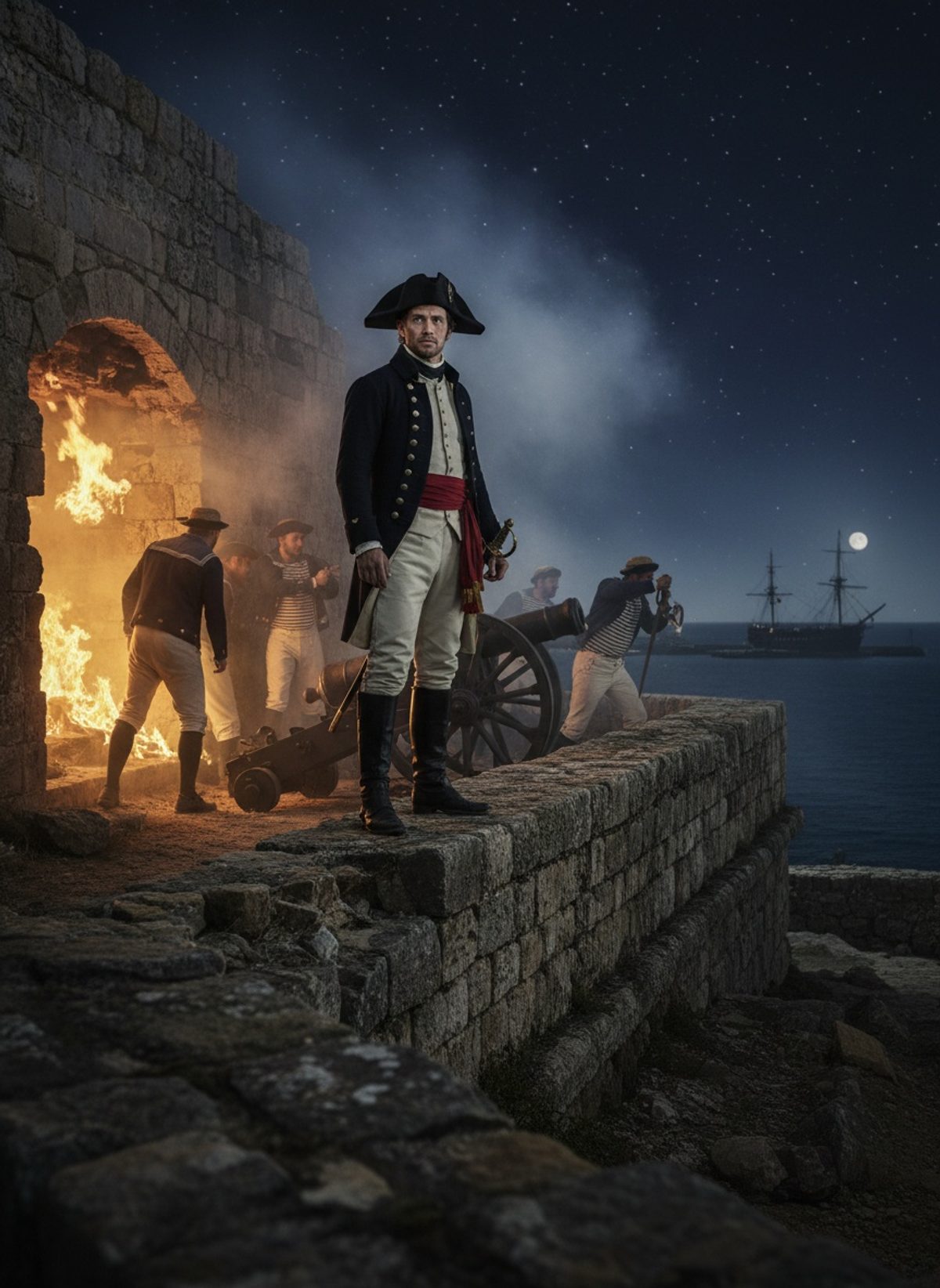
Napoleon Bonaparte was a force of nature on the battlefield. Yet, a single wall in the ancient city of Acre revealed even his limits.
When the year 1799 dawned, Napoleon stood poised to extend the French Empire's reach beyond Europe, aiming to carve a path through the Middle East toward India. It was a bold gambit, one befitting the ambitious general whose strategic genius had seldom met its match — until it collided with the unyielding determination of a British naval captain: Sir Sidney Smith.
The Franco-Ottoman conflict over the region had reached a fever pitch, with Acre being the prized gateway to the coastal plains and beyond. This city, nestled along the eastern Mediterranean's edge, was Napoleon's stepping stone to greater conquests. However, what the future emperor encountered was not a crumbling fortress ready to buckle under French might, but a bastion of resistance led by a singularly resourceful Englishman.
Sir Sidney Smith was more than a typical naval officer; he was an enigma wrapped in a sailor's cloak. Known for his unorthodox tactics and an aptitude for inspiring loyalty among disparate forces, Smith brought with him a wealth of experience and a reputation as a maverick. The French had grown aware of his exploits, with Napoleon dubbing him simply "that man," a testament to the respect and frustration he commanded in equal measure.
Read next: When a British Soldier Survived on Jungle Roots in Burma, 1944
With the siege of Acre in full swing, Napoleon expected a swift victory. His armies, seasoned veterans of earlier triumphs, laid siege to the fortified city, confident that no wall could withstand their might. Yet, Smith transformed the age-old battlements into a staging ground for resistance. The French siege artillery, aiming to pulverize the city into submission, found themselves thwarted by defensive innovations Smith orchestrated seemingly on the fly.
Smith's approach to warfare was akin to a chess player predicting moves six steps ahead, refitting ships as floating gun platforms, and coordinating a mosaic of defensive measures that astounded the French. The Ottoman garrison, revitalized by Smith's hands-on leadership, transformed into a lean, cohesive unit under the pressure of his indomitable spirit. With the unexpected aid of a windfall of naval reinforcements, including Smith's own HMS Tigre, the defenders of Acre stood like an immovable rock amidst a tempest.
Napoleon's engineers, schooled in the art of siege-craft, repeatedly assaulted the city's defenses, each time rebuffed with a vigor that belied Acre's crumbling exterior. Smith, propelled by an untamable resolve, tooled and retooled his strategies, turning each failure into a lesson, every breach into a counterattack. The city's resilience became a testament to the ingenuity of its British defender, who seemed to embody the very spirit of the fortress he protected.
Long before dawn broke the sky with light, the battle for Acre waged on through the dark hours, a cacophony of cannon fire and human cries echoing off the city walls. French soldiers, weary from the unrelenting resistance, found themselves ensnared within their own dreams of conquest. As siege ladder after siege ladder splintered under defensive fire, Napoleon's aura of invincibility began to fray.
Read next: When Monty's Mentor Lost an Army at Tobruk, 1942
The city held — day after grueling day, the expected collapse never came. The relentless assault yielded no ground, as the months slipped by and fever, starvation, and fatigue set in among the French ranks. The walls, scarred and chipped, stood tall, bolstered by every ounce of Smith's inventive tenacity. The beleaguered French forces faced the spine of a city refusing to break, a hero who never tired, a strategy as fluid as the waters brushing Acre's walls.
For Napoleon, the outcome was more than a military defeat; it was a strategic failure of stunning proportions. The time and resources lost at Acre stretched implications far beyond the bounds of a single siege. It cast shadows over his Eastern ambitions, forcing a retreat to Egypt that would lag like an anchor on his grand designs for empire. Smith, with his ragtag band of defenders, had done the unthinkable: he had inflected the first bitter tinge of defeat on Napoleon's vaunted career.
Even as history has celebrated Napoleon's many victories, the Battle of Acre remains a potent reminder of the thin line between success and failure on which the fates of empires can hinge. One wall and one officer stood against the tide of dreams and ambition, shaping a story history nearly forgot. Sidney Smith's improbable stand at Acre is a testament to the power of a resilient spirit and the ripple effect one man's tenacity can have on the trajectory of empire.