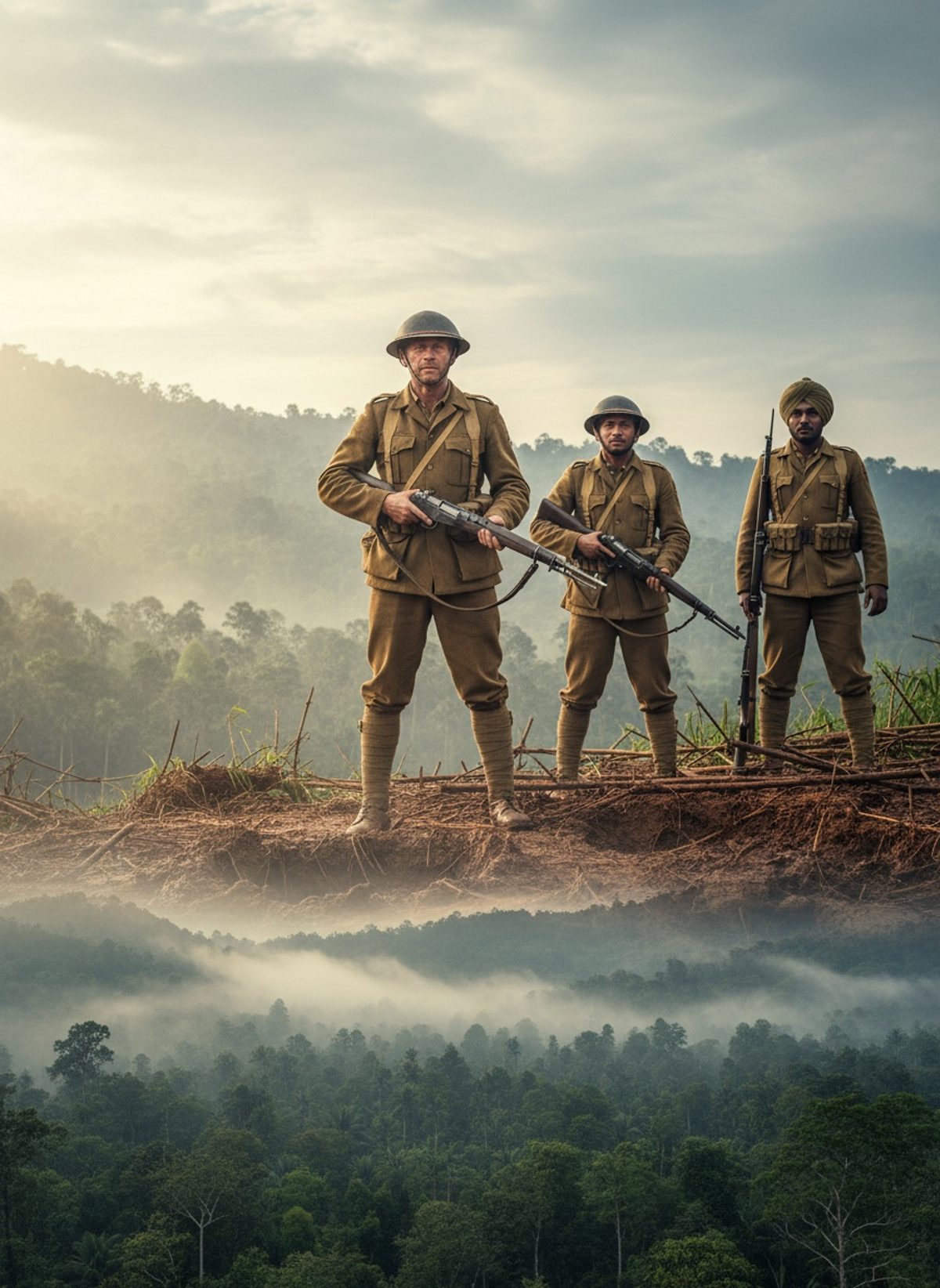
The clatter of grenades echoed like thunder over the moist jungle ridge, a deafening cacophony that shattered the otherwise eerie silence of the night. For the British and Indian troops crouched in their shallow foxholes, the tension was a nearly tangible thing, binding them together in a common will to survive. Across the narrow tennis court, their Japanese adversaries were close enough to see—almost close enough to hear the barked commands that propelled them into the life-or-death struggle they had never anticipated. This was Kohima, a name unfamiliar to most but etched indelibly in the annals of military history—a battle that marked the first significant land defeat of the Imperial Japanese Army during the Second World War.
Spring of 1944 found an ambitious Japanese Army pushing through the dense, unforgiving jungles of Burma, their sights set on India, the jewel of the British Empire. The plan was audacious, conceived with a striking boldness that characterized much of Japan's military strategies during the war. The goal was to march 85,000 strong into India, rally the Indian National Army, and ignite a rebellion against British colonial rule. Victory in this theater would secure Japan's southern flank and divert Allied forces away from the Pacific front. Yet, poised at the gateway to India stood Kohima, manned by a meager 1,500 British and Indian soldiers who had hunkered down to fend off the seemingly unstoppable Japanese advance.
The battle unfolded on terrain that was as much an enemy to the combatants as the opposing forces were. Kohima's ridge loomed like a natural fortress, shrouded in mist and dense foliage, presenting a formidable barrier that the Japanese intended to conquer and bypass. The ridge's defenses were entrenched with positions arrayed across its length, their locations scarcely visible until one was nearly upon them. The British garrison included battalions of the Royal West Kents and Gurkhas and other units that were rotated out as the brutal conflict dragged on. Their orders were simple but dire: hold at all costs. Grappling in this setting demanded courage, endurance, and an iron will far beyond standard military requisitions.
The infamous tennis court lay at the center of Garrison Hill, a patch of serene recreation unyielding under the onslaught transforming the area into a grim no-man’s land. This site's proximity meant combat was astonishingly intimate, with skirmishes sometimes fought at distances of a few meters. Soldiers from both sides hurled grenades and epithets across the retaining walls, not knowing if their next breath would be their last. Supplies were perilously low, forcing the British to rely on airdrops that sometimes missed, tumbling into Japanese-held zones. The ability to hold the line was not merely a tactical decision but a testament to human resilience in the face of despair.
Read next: When Mary Seacole Nursed a War No One Invited Her To
The siege at Kohima was as much a psychological struggle as it was a physical one. Exhaustion was omnipresent, and the ceaseless rains brought flash floods and mudslides that seemed determined to drown both hope and humanity. The Japanese forces, accustomed to victory and surrender, were stunned by the ferocity and stubborn determination of the defenders. It was a reversal of their own experience in Southeast Asia, where they had rapidly overrun Allied forces with startling success. Now, it was their mettle and resolve put to the test, amongst the whispers of malaria and dysentery circling like invisible foes.
As days turned into weeks, reinforcements for the beleaguered defenders began to filter through. British reserves and Indian divisions clawed at the enemy’s flanks, and gradually, the noose around Kohima started to loosen. The Japanese faced increasing pressure as the tide of battle turned inexorably against them. Despite their superior numbers, the terrain, supply issues, and staunch resistance eroded both their cohesion and morale. What had commenced as a confident march into India soon turned into a desperate struggle for survival.
The culmination of this relentless clash came not through a singular decisive moment but rather through grinding attrition. By mid-1944, the Japanese were compelled to retreat, a word that had scarcely sullied their vocabulary until then. Kohima was retaken, and with it, the shattered remnants of the Japanese forces. This battle, though not popularly celebrated in the West, marked a pivotal turn in the direction of the war in the East. It set in motion a chain of defeats for Japan that ultimately ended with the freedom of Burma and contributed significantly to the eventual Allied victory in the theater.
Kohima might have been relegated to the dusty corridors of forgotten warfare were it not for its strategic and symbolic importance. It was here that the myth of Japanese invincibility was irreparably wounded, casting a long shadow over their military campaigns that followed. More than just a forgotten battle on a remote ridge, it stands witness to the enduring spirit of those who fought against overwhelming odds. Its echoes remind us of war’s complexity, where victory and defeat intertwine, not just through force of arms but through grim determination and an unyielding conviction to remain unbroken.