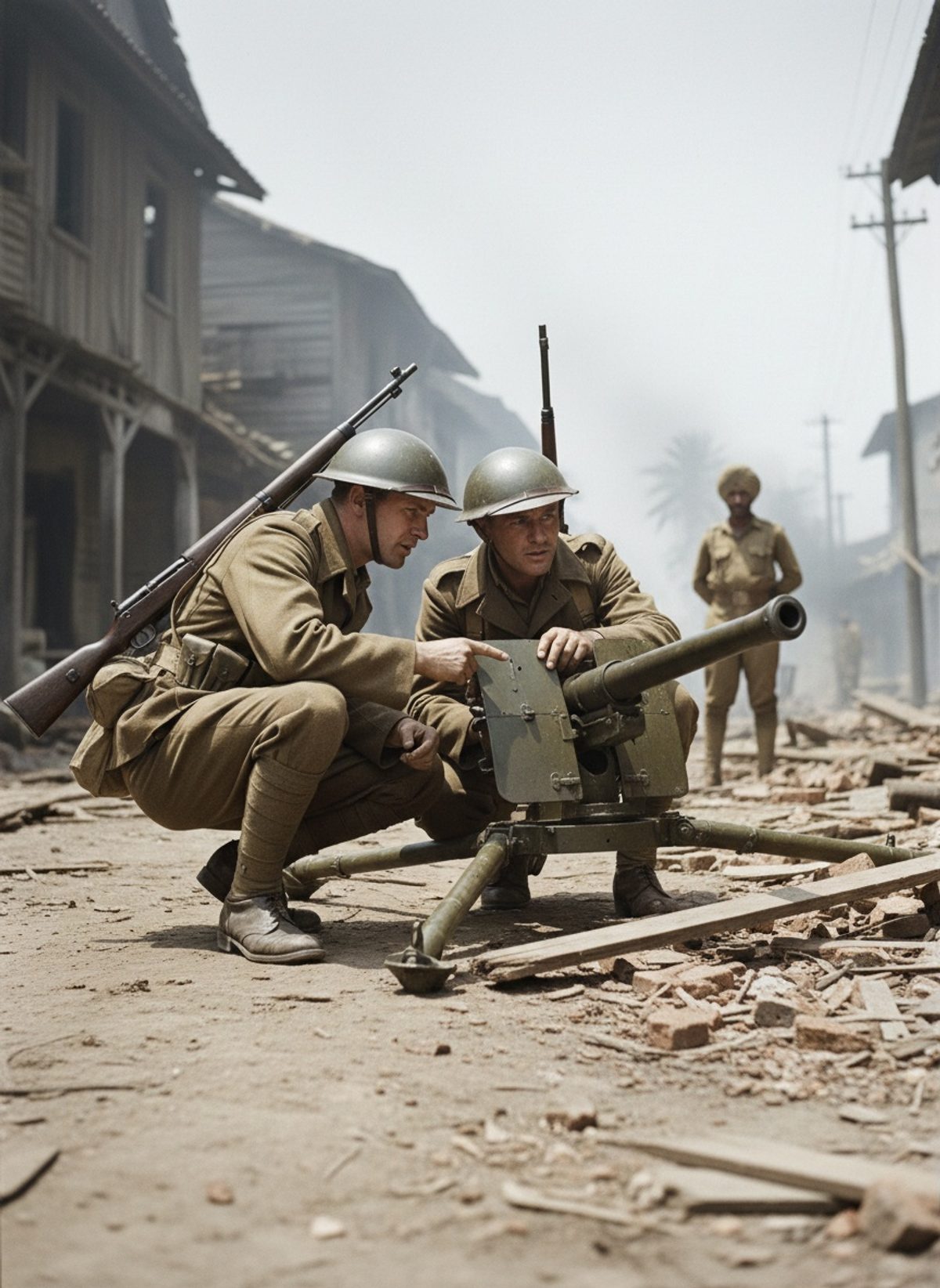
He was equipped with bamboo and camouflaged nets, rather than the metallic beasts of destruction one might expect. Yet, these materials helped engineer one of the most effective defenses against the advancing British and Indian troops. March 1945, in the rubble-strewn streets of Meiktila, Burma, the soldiers of the 14th Army encountered a network of cunning traps and surprises.
Into the Lion's Den: The Battle Begins
The capture of Meiktila was a crucial step in the Allies' campaign in Burma, a shimmering promise of reclaiming land lost earlier in the war. Meiktila was more than just a geographical objective; it was an intricate enemy stronghold that had to be dismantled piece by piece. As the British and Indian troops advanced, they were not met by overwhelming firepower from Japanese tanks or heavy armor. Instead, they faced an invisible menace lurking at every turn.
The Japanese had meticulously prepared their defenses, converting the town into a series of traps that transformed every street into a potential death zone. The true challenge lay in the ingenuity of these traps. Using available resources, Japanese engineers created simulated tank traps, utilizing simple materials that included bamboo frames covered in foliage, camouflaged pits, and false paths that led tanks and troops into ambushes. The effectiveness of these installations was as much psychological as it was physical, causing hesitation and sowing confusion.
The Silent Enemy: Ingenious Ambushes
Engineers from the Japanese army turned the urban sprawl of Meiktila into a terrain of hidden danger. The effectiveness of their creations was immensely profound. A soldier might turn a corner and unexpectedly find his path blocked by what appeared to be an indestructible barricade. To the untrained eye, these tank traps seemed like legitimate obstructions that would have required artillery to dismantle, but the reality was more deceptive.
Read next: He Was 58, Dying, and He Still Led the Charge
This deception extended to the sounds and shadows during the night. Bamboo clappers mimicked the noise of distant infantry, and skillful lighting exaggerated the presence of heavy machinery that never existed. As the Allies pushed into the town, their advance was significantly slowed by these cleverly erected illusions. It took time — precious and dangerous — to determine what was actual and what was a ruse, time during which the Japanese defenders could maneuver to more favorable positions or prepare counterattacks.
Anatomy of a Camouflage: Discovering the Secrets
When the guns finally fell silent, the soldiers cautiously moved forward, eager to claim Meiktila. What they found was a testament to Japanese resourcefulness and cunning. Beneath the facade of chaos and destruction, there lay a structured series of fortifications that had challenged the combined might of the Allied forces.
In large, seemingly reliable tank traps, soldiers found hollow structures cleverly disguised. Chassis made from bamboo and metal scraps were covered in foliage to simulate the look of actual tanks entangled in battle debris. Each street revealed new surprises — pits covered by cloth nets and concealed by ground materials that easily gave way under the weight of an unsuspecting vehicle. These discoveries were both a relief and a source of frustration for the troops who realized how the simplest of materials had nearly thwarted their advance.
Read next: He Stepped Forward in Lucknow and Offered His Life
Beyond the immediate tactical revelations, this encounter underscored the psychological aspects of warfare. It showed how deception and environmental manipulation could, at times, rival brute force in effectiveness. The captured battlefield, now stripped of its illusions, stood as a testament to the mind games played at the frontline.
Why This Story Matters: Lessons from Meiktila
The capture of Meiktila and the revelation of its defenses offer a vivid example of the unexpected complexities of warfare. On one hand, it highlights the resourcefulness and adaptability of the Japanese troops, who leveraged cunning over conventional strength. On the other hand, it serves as a reminder of the harsh realities faced by soldiers engaging in urban combat, where the line between reality and illusion is dangerously blurred.
In its essence, the story of Meiktila is a mosaic of human ingenuity under duress. It prompts us to consider how the rules of engagement are continuously rewritten not only by technology and armaments but also by the creativity and intellect of those who find themselves in the crucible of conflict. In remembering this battle, we acknowledge the broader spectrum of strategies that redefine what it means to hold or storm a line, long after the echoes of battle have faded into the corridors of history.