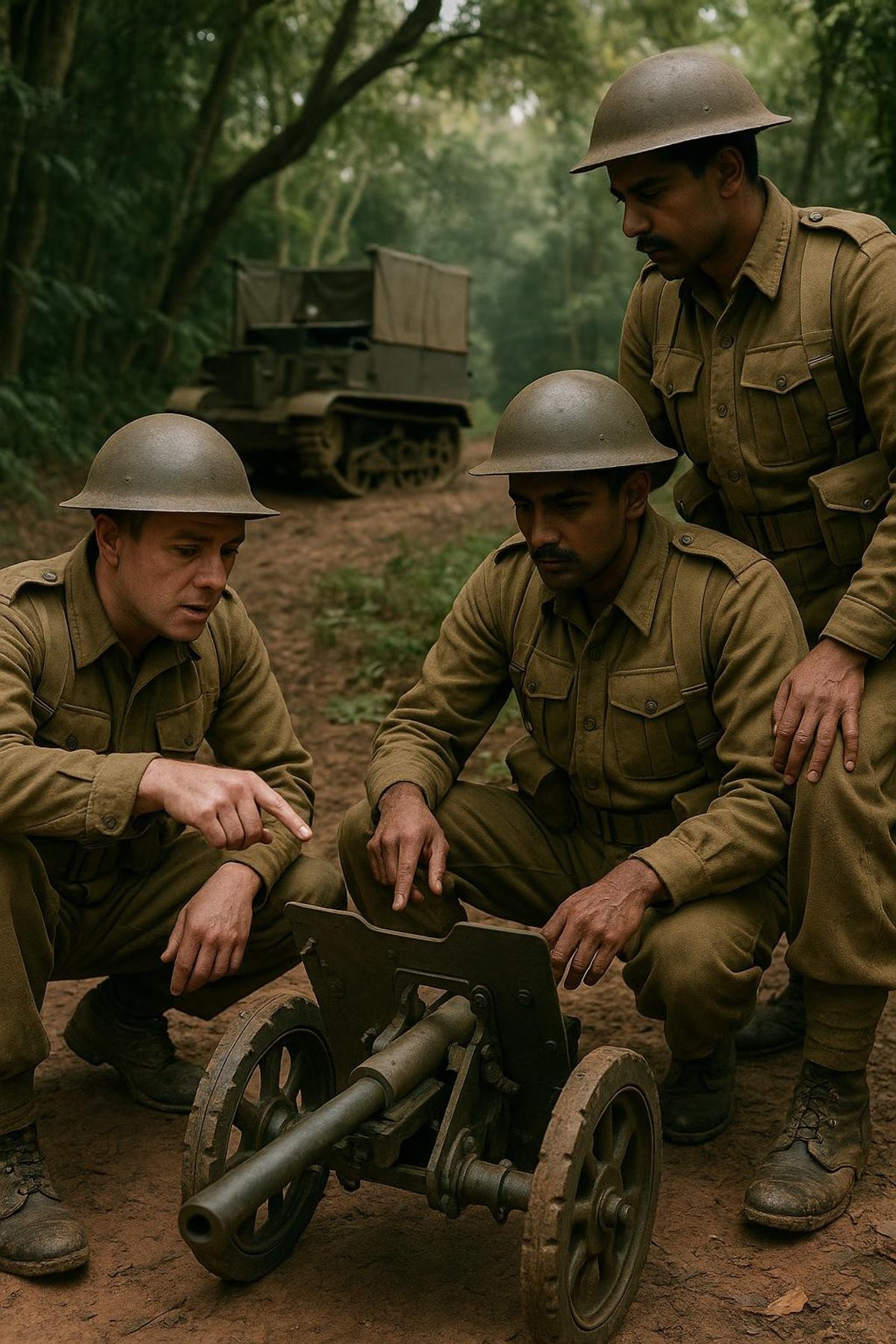
The jungle in Burma was a cursed theater of war. But in January 1945, there was a deliberate pause in the brutality as British troops stood before a captured Japanese 37mm anti-tank gun. This simple act of examination was steeped in both trivial curiosity and profound significance.
The campaign in Burma was an arduous one, set against a backdrop of dense, oppressive jungles that cloaked mountains and valleys in a near-impenetrable shroud. The land itself was a formidable foe—steamy and inhospitable, it favored stealth and endurance over raw firepower. Yet, as the British and Imperial troops harried the weary remnants of the Japanese forces, the capture of the Japanese 37mm gun symbolized a critical turning point. The Japanese, once masters of blitzkrieg strategies in the early years of the Pacific War, now found themselves on the back foot as their enemies pressed forward with unyielding resolve.
This 37mm gun, officially known as the Type 94, was originally designed for rapid deployment in support of infantry units against tanks and armored vehicles. Lightweight and relatively portable, it fired armor-piercing shells that could puncture the thinner skins of early-war tanks with singular efficiency. However, as the cruel reality of months turned to years, what was once a formidable weapon in the Japanese arsenal became increasingly obsolete. By the time British forces examined it in January 1945, the 37mm gun was a relic; a weapon built for a type of warfare that had moved beyond it—a gun designed in a time where it could hold its own against contemporaneous threats, now inadequate against the beefed-up armor of Allied tanks.
The British soldiers who gathered to examine their prize were seasoned men, hardened by jungle warfare, where each step was a potential encounter with death. The scene itself was stark; the gun standing aloof like a monument to past triumphs now dulled by the march of Allied progress. Behind them, a Bren Carrier, rudimentarily equipped with deep-wading screens, symbolized both innovation and adaptability—attributes that had come to define Allied tactics during this taxing campaign.
Read next: He Was 58, Dying, and He Still Led the Charge
These Bren Carriers were far from imposing, designed primarily as all-purpose vehicles rather than frontline pieces of equipment. Their presence may not have turned the tide of a single battle, but they were indispensable for transporting troops and supplies across inhospitable terrains and scarred battlefields. The deep-wading screens transformed these humble workhorses into amphibious machines, capable of negotiating the numerous rivers and streams that cut snaking paths through the Burmese landscape. Such ingenuity was emblematic of a larger shift; the Allies had learned to adapt to the setting—a crucial advantage that allowed them to push forward relentlessly.
For the British, this jungle war was part of a broader mission that stretched across continents and oceans. It was a story of reclaiming what had been lost and dismantling the empire that Japan had built across Asia with alarming speed and brutality. Yet, even in the midst of strategic gains, the soldiers’ curiosity about the captured gun spoke volumes about the psychological theater of war. It exemplified a moment where understanding the enemy’s tools, understanding what they had to bring to bear, became an intimate part of defeating them. It was less about the gun itself, perhaps, and more about who wielded it—and why they were losing.
Read next: He Stepped Forward in Lucknow and Offered His Life
Thus, the captured 37mm gun was a literal and metaphorical artifact of a bygone phase of the war. While the grinding pressure of the Allies closed in, the technological and logistical superiority of the Allied forces began to overshadow the early successes of Japanese forces, who were now pushed back. It highlighted the shifting allegiances of fate itself, as determined men bent the world to their will not by the strength of their machines, but by the unyielding spirit of collective purpose and invention.
The scene of the captured gun, the soldiers, and the waiting carrier was a snapshot memorialized in the minds of those present and in the annals of history, an echo of a war that was as much about mind as it was about metal, as much about the environments fought in as the enemies facing off. In studying these tokens of warfare, the British soldiers turned an object of dispatch into one of contemplation. By understanding what they held in their hands, they fortified their grasp on the promise of an emerging peace.
This episode matters not merely because of the triumph it symbolizes in the drudgery of war, but because of what it reveals about the evolution of conflict itself. Guns get left behind as tactics evolve, but curiosity, adaptation, and resolve are timeless. As much as the war in Burma was a clash of forces, it was equally a testament to human endurance, creativity, and the relentless drive to overcome the seemingly insurmountable challenges. As the jungle silence reclaimed the space once filled with the din of battle, it left in its wake the quiet hum of progress—a lesson hidden in the depths of the jungle, as untold as it is enduring.