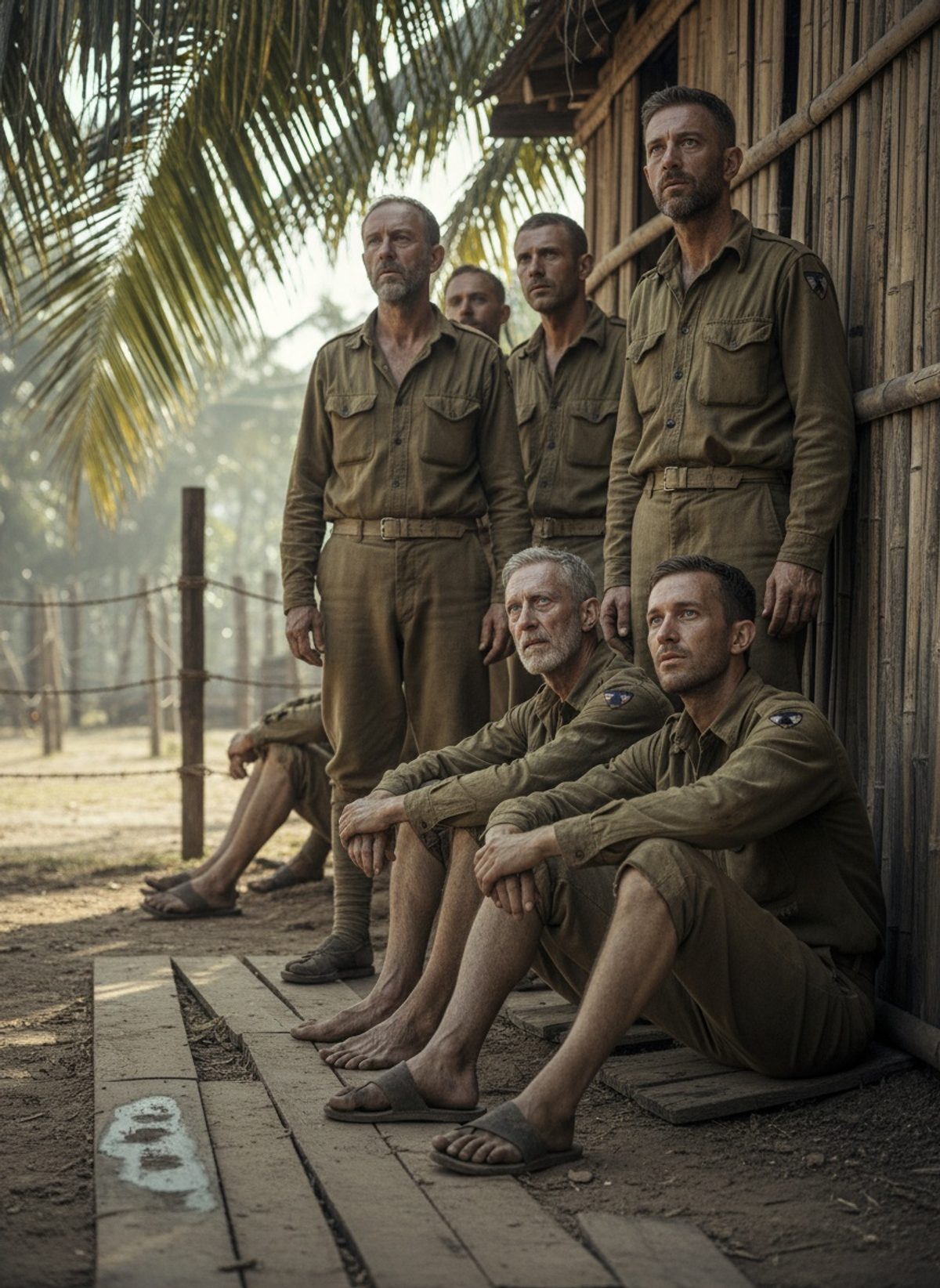
August 1945. The tropical air lay heavy and still over the ramshackle collection of barracks. Inside, emaciated figures moved with a deliberate slowness, conserving every ounce of energy.
The Echoes of Silence
For those living in the squalor of Japanese prison camps scattered across Southeast Asia, August 1945 signaled an unexpected shift in their grim routine. Many of these camps were tightly woven into the dense jungles of Thailand, Burma, and the Philippines, their boundaries defined by barbed wire and armed guards rather than the natural surroundings. The once-rhythmic clatter of boots and baritone commands reverberating off makeshift walls faded into an unfamiliar quiet. The prisoners noticed first by the absence of their constant threats. Their captors, once ferocious in their discipline and unwavering in their vigilance, simply… vanished.
These British and Commonwealth soldiers—and civilians—had endured over three years of relentless brutality and deprivation. Weighed down by the hardship, they had expected the war’s end to unfold with a dramatic fanfare, a liberation performed with triumphant speeches and shared relief. But instead, liberation’s harbinger was silence. A psychological torment of its own, as the sudden quiet smothered their fevered dreams of freedom.
The days following this abrupt hush stretched into a purgatorial state for the incarcerated. The tropical foliage around the camps, so alive with the cacophony of nature, seemed to amplify the stark void left by the absent guards. That August, prisoners shared furtive whispers, operating on instinct and hope, unsure whether they had been forgotten or were under a new, more insidious form of threat. Some prisoners dared to believe that the long-dreamed-of end had arrived. Others feared a trap, suspecting their tormentors lay in ambush or awaited final, terrible orders.
Read next: When the 15th Scottish Division Crossed the Odon at Dawn, 1944
Yet slowly, as the days unfolded, the realization took root that this was indeed the war’s end. The significance of the silence that first struck them would take longer to comprehend—a testament to both their instinctive resilience and the depth of their weary skepticism.
The Unlikely Survivors
The camps themselves were sordid monuments to survival against the odds. Inhabitants were largely men whose willpower and spirit had been tested by a litany of hardships: forced labor under a fervid sun, meager rations that mocked even the most meager definition of sustenance, and illnesses that ravaged their weakened bodies. The slim chance of surviving until the war’s end was a daily gamble against malnutrition and disease.
For three and a half years, from the fall of Singapore in 1942, the prisoners had shouldered a brutal existence under the weight of captivity. Constructing vital infrastructure for their captors, many toiled on projects like the infamous Burma Railway—a stretch of line that would come to be known as the "Death Railway" for the innumerable lives it claimed. The specter of cholera and dysentery loomed large in the cramped quarters of disease-ridden huts, where every dawn might unveil the lifeless form of a campmate who had fought his last battle in the night.
Inside these crude confines, makeshift kits and personal contraband became artifacts of resistance. A hidden spoon could denote a prized possession or a ration secretly acquired. Pieces of wire turned tools meant the difference between enduring captivity and succumbing to it. Among the meager comforts were memories of Sunday dinners and hearthside stories—ephemeral daydreams, yet essential for persistently nurturing the spirit.
Read next: When the Royal Marines Yomped 56 Miles Across East Falkland, 1982
When the guards withdrew, prisoners peeled back layers of barbed wire not purely to step into freedom, but to ascertain their own survival. Their footsteps carried a weight of uncertainty. Outside the confines, the lush green of the jungle held not only the promise of expansiveness but also the shadow of an enigma. In the days that followed, rumors coalesced into news: the world beyond had shifted irrevocably, and victory belonged to the Allies. The ensuing celebrations of liberation were tempered by contemplation of lives changed irreparably by years of imprisonment.
The Lost and the Found
With the formal cessation of hostilities, the day-to-day reality entered a period of transition. For liberated prisoners, the pathway back to their homes wound through shadows of the experiences they desperately yearned to leave behind. Evacuation was as much a logistical feat as it was an emotional endeavor. Former prisoners became numbers in a massive operation to reunite displaced soldiers with their homelands, confronting the truth that life as they knew it would never wholly resume.
Months and years after liberation, these men—these survivors—found themselves grappling with shadows of memory, the phantoms of a silence that had once been the harbinger of freedom. Many participated in pilgrimages back to where they once wore their makeshift wire frames, confronting scenes interwoven forever into their fabric of consciousness. For some, returning meant reconciliation; for others, it was an affirmation of living on against a garland of odds. Former captors and captives, at times, faced resounding reckonings—stories told and untold shaped by the resilience and mercy of the human spirit.
It is this incredibly nuanced tale that highlights an echo across not just the corridors of time but into the essence of our shared humanity. You may not find it in the traditional textbooks, but understanding the complex legacy of these prisoners offers insight into resilience beyond heroics and victory beyond conquest. Like the silence that brought sudden clarity in 1945, this chapter of war is quiet testimony to the endurance of those who lived its unyielding trials. Their collective experiences offer profound meditations on survival, hope, and the evolving nature of freedom.