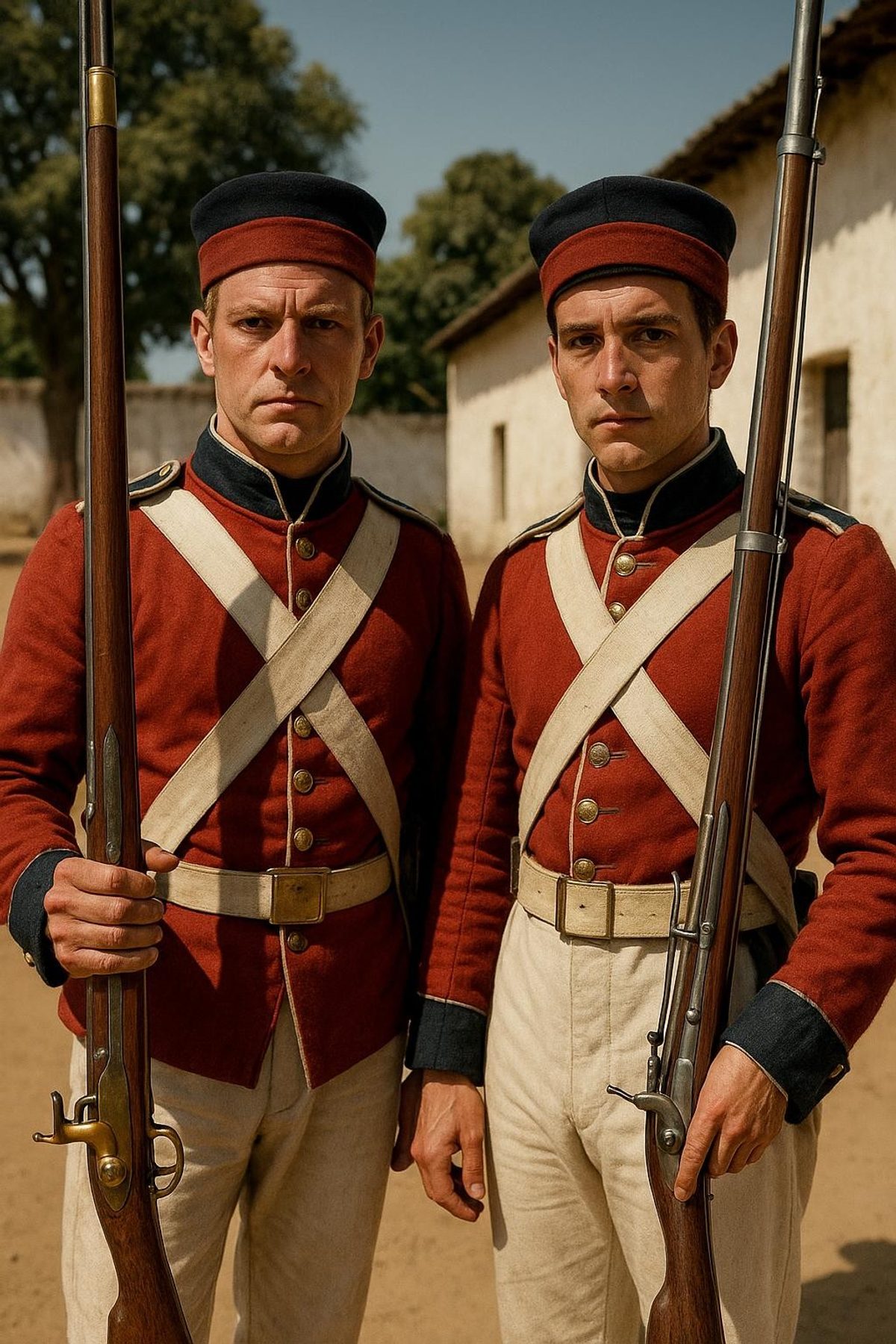
The humid air of British India hung thick and oppressive, seeping into every thread of the scarlet uniforms that dotted the landscape. Under the relentless Indian sun, the sound of a thousand boots stomping on dry, dusty earth echoed through the regimental grounds. Trees offered scant shade, their branches restless in a light breeze that barely stirred the sweat-soaked tunics of the soldiers. It was 1853, and here, in the searing heart of an empire that spanned continents, two rifles were poised to change the course of history.
For a century, the British Empire had relied on the flintlock musket, affectionately known as the "Brown Bess." Its sturdy wooden stock and metal barrel had been a companion to many a soldier over its lifespan. The crack of its discharge was familiar, its firing mechanism simple and robust. On the battlefield, the Brown Bess was a trusted comrade—quick to load, releasing its broad spray of musket ball with deadly efficiency at short range. In the heat of combat, speed was essential, and the Brown Bess discharged its unsophisticated payload with alarming rapidity. But friendships forged in battle were fraught with limitations, and as the echoes of musket fire reverberated across the lush plains, accuracy told another story.
Enter the newcomer—the 1853 Pattern Enfield rifled musket. A marvel of precision engineering, it boasted a feature that would recalibrate strategies and redraw battle lines: rifling. The grooved barrel impelled its musketball to spin, cutting through air with precision hitherto unseen. At 500 yards, where the Brown Bess floundered, the Enfield delivered its message with lethal exactitude. With this technological leap, a soldier need not wait for the oppressor to surge within spitting distance. Instead, his aim could pierce the horizon and find its target half a mile away. A revolution in rifle crafting, the Enfield was more than an upgrade; it was an ethos shift in warfare.
However, with progress came peril. The new ammunition that powered the Enfield's prowess—greased cartridges designed to seamlessly glide into the barrel—carried a secret that threatened the very backbone of the British Empire's forces in India. These cartridges, one heard in whispers that grew louder with each passing day, were rumored to be greased with the fat of cows and pigs. In an army where Hindu and Muslim soldiers stood shoulder to shoulder, this was no trivial matter. The mere thought of such an affront was sacrilege to the sepoys, whose faith dictated dietary sanctity. Emergencies conspired with sensibilities, and loading rifles could now mean straddling a chasm between duty to empire and soul.
Read next: Brown Bess vs the Baker Rifle — Which Would You Choose?
The fire of dissent sparked and spread like wildfire—long before a trigger could orchestrate finality. The choice between the reliable flintlock and the sophisticated rifled musket was fraught with more than the immediate practicalities. Would you favor the swiftness of nine shots per minute to keep the enemy at bay, though the ammunition might falter at range? Or would you dare reach far with a musket whose very preparation might summon the storm of mutiny?
As whispers transmuted into crescenting cries, the murmurings of rebellion quickened to reality. In the garrisons and parades of vast Indian territories, soldiers weighed their convictions against command, lineage against loyalty. Both the Brown Bess and the Enfield musket lay on the table, but with each passing moment, the debate about weaponry unspooled into a question of the Empire's fate. The ripples did not merely disturb tranquil waters; they promised a maelstrom.
What followed—the outbreak of mutiny in 1857—was a conflagration that altered the empire's course, shaking the subcontinent at its very foundations. The rebellion was a cacophony of battles, an orchestrated symphony that saw the ceaseless clangor of weapons bearing different legacies clash amidst fevered cries for independence and cries of loyalty to the Crown. Fields once painted only with the colors of conflict found resonance in the deeper hues of history's epochs—of past fears and future revelations.
Read next: When the First Gurkha Recruits Earned Their Cap Badge, 1816
So which rifle would you choose, standing at the crux of empire and insurrection? To the world at large, the Enfield's sleek promise of precision seemed an obvious choice. But delving back into the heart of those sun-drenched lands, the past shines in more colored hues. For it was not just accuracies and mechanics at play, but the lives and loyalties that these rifles shouldered, the frenetic dance of culture and colonizer, tradition and transformation.
The ripple effects of these martial choices were monumental, reshaping military doctrine and colonial governance alike. The unrest evoked by the new cartridges amplified tensions which surged through the channels of British India, ultimately leading to sweeping policy reforms and the reorganization of imperial rule. The choice between rifles thus became a parable illustrating the fragility of power when confronting the inveterate and intangible bonds tethering life's manifold actors.
A century and a half has passed, and the musketry discharged on those sepia-toned fields might merely echo in the annals of history. Yet, the precipice upon which soldiers once stood, beset with choices between the old world and the new, echoes still in the corridors of power. It serves as a prescient reminder that threads of modernization often weave through tapestries of tumult—a tale untold in textbooks but endless in its resonant reflections.