The Second World War was a time of legendary valor. Yet, among the tales of heroism and strategy, the quiet courage of a chaplain at a Belgian clearing station is often overlooked. In October 1944, as the leaves turned a deep golden hue, the No. 35 Casualty Clearing Station was a sanctuary and a crucible. The brutal symphony of war echoed around this place where surgeons worked tirelessly under canvas roofs, desperately patching up the broken soldiers ferried back from the front lines. But as spartan as the instruments were, there was another surgeon of souls at work.
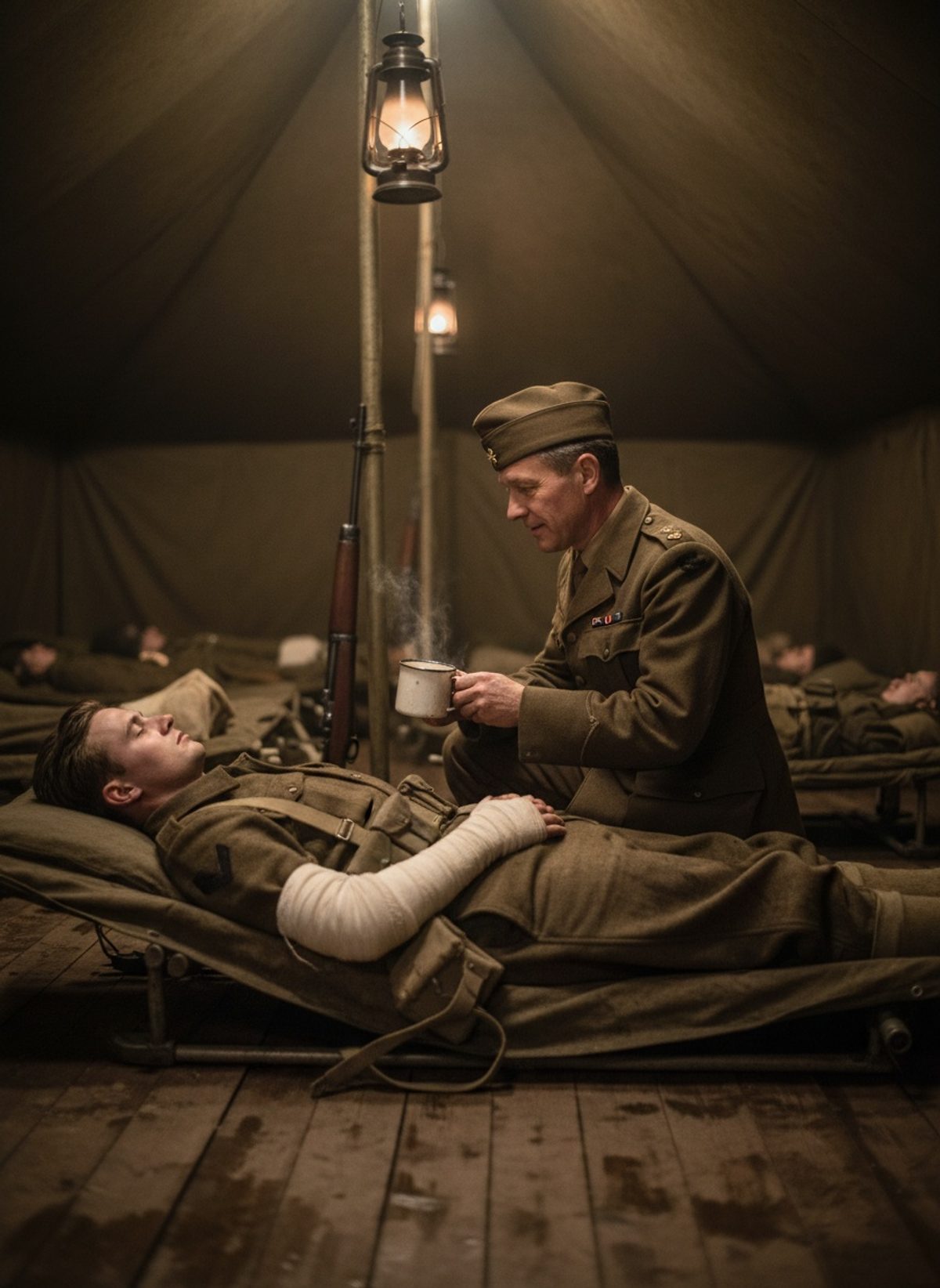
Amidst the acrid smell of antiseptic and the quiet hum of haunting medicinal efficiency, Padre walked with a humble stature and an unwavering resolve. Though he wore the uniform of a British Army chaplain, he carried no arms and commanded no men. His requisites were simple: a battered tin mug filled with hot tea and the blessings of solace and prayer. Some might have called his work inconsequential against the grand theater of war, yet to the bedridden soldiers awaiting their fates, he was as vital as the air in their lungs.
The Belgian autumn held a chill that seeped into bones already wearied from the frost of hardship. Yet once he stepped into a tent, the cold seemed an afterthought. Men of all ages and ranks, those who despite their bravery had found themselves unable to dodge the drift of war’s dice, found in him not just a clergyman but a confidant. His presence was a quiet miracle amidst the clamor, where the stretcher-bearers moved with grim determination and the medical staff bustled as the stars against the darkness of war.
In a makeshift ward fashioned from humble canvas, Padre knew that beyond the physical wounds, many men bore unseen scars. Some chatted with him about home, conjuring images of places far and peaceful. Others found comfort in his silent listen. His rituals were simple: a cheerful word here, a scripture shared quietly there, a prayer whispered into the ether. But most of all, it was his tea that worked wonders, its warmth sealing companionship and faith.
Read next: When the Women of the ATS Rearmed a Desperate Nation, 1942
Each cup offered was a brief respite, a bridge between the past and a future uncertain. The soldiers knew that the warfront was a cruel mistress, unpredictable and impartial. Yet in that tent filled with makeshift beds, the clinking of the mug against a blanket was a reminder that they were seen not as numbers or statistics, but as cherished souls worthy of care.
Padre’s journey through the tents was a ritual of hope. He navigated conversations with deft kindness, knowing that at times words were a balm, and other times presence was enough. His dedication transcended the limits of duty; it was compassion in motion against the backdrop of conflict. Many soldiers, staring up through the canopy of the tents at night, would later describe him as a light in so much darkness.
Some soldiers were steady in their stoicism, reflecting silence through the hollow gaze of those who had seen too much and spoken too little about it. Even then, his mere presence was a salve against the relentless mental noise of war. A cup of tea, shared over glances and unspoken understanding, did what medicine could not — it grounded them, rooted them in a semblance of normalcy.
Ultimately, Padre did not judge their silence or tears. He welcomed both as equal dispensations of the soul facing mortality. In his ministry, the rites of passage were sacred rituals, a descendant echo of each man’s journey to the front. For those whose wounds bore the weight of life beyond repair, the last rites he gave became whispers of courage, helping carry their brave spirits across an eternal battlefield where peace prevailed.
Read next: When H Jones Charged the Gully at Goose Green, 1982
On cold nights under the Belgian sky, with the war’s relentless inferno dividing the heavens, the men huddled in the warmth of companionship rekindled by a tin mug. The notion of a chaplain as a wartime hero seemed foreign to traditional notions of gallantry. Still, those soldiers knew that sometimes courage wears no badge. It is found in quiet offerings, in the space between spoken words, where fears are dispelled with understanding and presence.
It is often the unspoken acts of humanity in wartime that ripple across history, gathering significance as they go. In those makeshift wards, where every man lay fighting his own war within, Padre’s visit was more than pastoral duty. It was an intervention of humanity amid chaos, a reminder of the enduring spirit of brotherhood and peace. His legacy did not march through streets festooned with accolades. Instead, it etched onto the hearts of men who lived to tell tales, of a kind padre who offered warmth, prayer, and a sacred respite, one cup of tea at a time.
What echoes from these stories is more profound than any record of tactical genius. In the complexities of a world defined by conflict, here is a lesson that morality does not wield weaponry, nor does it dominate headlines. It thrives quietly in the compassionate acts of individuals. The memories of the No. 35 Casualty Clearing Station at Belgium whisper to us today not just of war’s ache but of the myriad ways humanity peaks through the gnarled branches of suffering, offering solace and hope in seams of steel.