July 1940. The sun beat down on the North African desert with a relentless fury.
Ghosts in the Desert
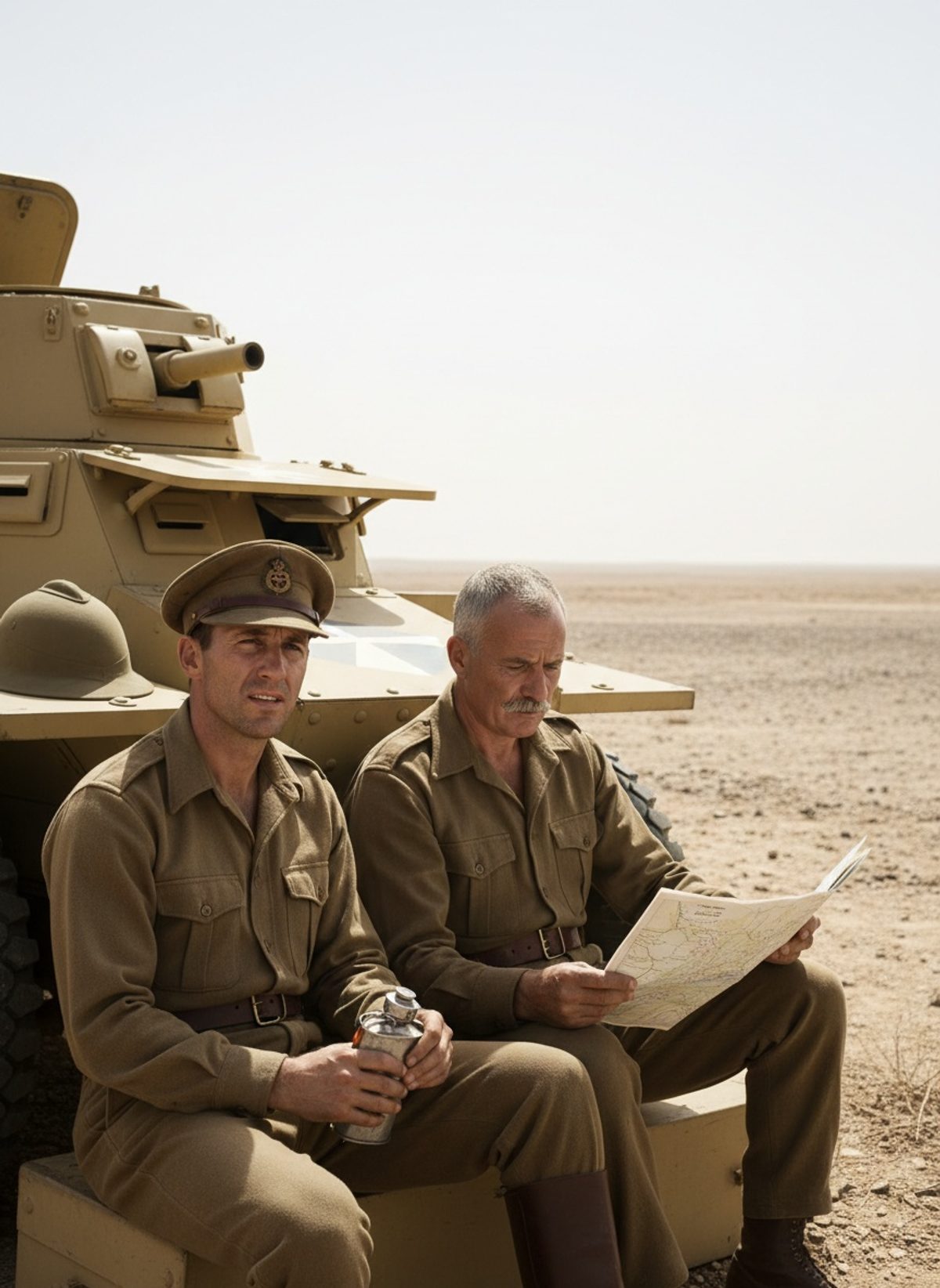
The opening weeks of the Western Desert campaign found the 11th Hussars, Britain's elite cavalry regiment, facing the unforgiving Libyan frontier. Miles of barren dunes stretched out under an oppressive July sun, where the horizon wavered like molten glass. Amidst this natural furnace, a small band of officers sought refuge in the minimal shade offered by a bulky Morris armoured car. These men were pathfinders in a theater of war yet to be etched in history books, navigating an arid no man's land between British-held Egypt and Italian-controlled Libya.
The desert itself was as much a foe as any human adversary. Temperatures soared to unbearable highs, surpassing what ordinary thermometers at the time could measure accurately. The granular sand found its way into every part of their equipment, weaponry, and skin. For the men of the 11th Hussars, this wasn't merely a test of arms but a battle against nature's ultimate challenge. Water, more precious than gold, became a binding element between survival and collapse. Each sip was a carefully measured necessity.
Their patrols were probing expeditions, directed by reconnaissance duties to unveil Axis movements in the unyielding silence of the wilderness. Every mile covered could be one less panic-prepared ambush engineered by seasoned Italian troops. However, these sorties often revealed more about the maddening vastness of the Sahara than enemy activity. Broken terrain camouflaged by shimmering heat tendrils taunted them with illusions of armies that weren't there or oases that never existed.
Read next: The Last Man to Die in the Zulu War, 1879
This period of waiting — more strained vigil than engagement — tested men's resolve in ways untold by conventional battle accounts. They rehearsed routines, maintained their Morris armoured cars like cherished steeds, and slept in shifts as the engines cooled in the desert night. Yet, even in such loneliness, camaraderie and perseverance thrived, quietly breeding the discipline that would later become a hallmark of British armored tactics.
A Silent Tactical Dance
At this infancy stage of the African campaign, the military strategy played out in subtler shades than the later large-scale battles. These early days were marked by probing thrusts and cautious feints; the 11th Hussars were often the tip of the spear, tasked with gathering intelligence and stirring uncertainty among the Italian outposts dotting Libya's frontier. The officers, men of diverse backgrounds and seasoned by years of imperial service, found themselves indulging in an unspoken game of patience.
The landscape's silence, disrupted only by the occasional mechanical growl from their Morris armoured cars, was often the sole source of drama. Radios crackled sporadically with commands and updates from headquarters, but much of the communication happened through hand signals, mutual understanding, and a shared intuition honed over years of service. Their lone watch was the harbinger of the coming battles of Sidi Barrani, Beda Fomm, and eventually El Alamein, adding quiet weight to their present task.
The desert's intimidating landscape continued to test them at every turn. Sandstorms, fierce and sudden, enshrouded their position with blinding clouds that scraped the polished surfaces of their vehicles, clogging intricate machinery and stifling their breathing. During such tempests, the waiting turned frenzied, transforming the arid desolation into a claustrophobic prison of sand. And still, when the storms subsided, and the sun set with its painted desert hues, the waiting resumed in ordered calm.
The men formed a psychic map of the terrain absorbed into their bones, detecting nuances in the shifting sands that signaled trails long faded. Such intuition was invaluable, guiding the motor-driven cavalry over deceptive expanses where one misjudged ridge could spell catastrophe. Though the situation often spiraled into mundanity, the presence of danger maintained a constant edge, ensuring their vigilance never dulled.
Read next: When the Women of the ATS Rearmed a Desperate Nation, 1942
The Unseen Frontline
While future historians would debate the pivotal moments of World War II's North Africa campaign, the unsung role of units like the 11th Hussars often passed without acknowledgment. The officers waiting under the glaring desert sun laid the groundwork upon which more celebrated victories were built. Here, at the heat-forged coalface of World War II, the courage to endure typified a different kind of heroism.
In this dusty cathedral of patience, the language of war evolved. The 11th Hussars redefined combat's potential beyond the conventional engagements, illustrating how meticulous watches and strategic resilience shaped larger campaigns. Although devoid of the medals awarded in larger skirmishes, each day surviving the Libyan heat was a testament to strategic foresight and unyielding morale.
As their Morris armoured cars glinted with faded paint amid a sea of sand, they etched an important, albeit transient, narrative of resilience and adaptation. Their narratives from these unsung days revealed a truth about human endurance and an empire wielding its global might under what appeared to be insurmountable odds.
In remembering these vanguard figures, we honor more than military achievements. We acknowledge a narrative of resolve, where the art of waiting quietly sculpted the future landscape of not only battles but also the towering story of empires. Each uneventful hour they spent in that parched cauldron laid silent claim to victory that was not just about land or foes but humanity's eternal tussle with the extremes of its world.