He was twenty-three years old. He was not meant to be there at all.
The Unlikely Warrior
When we think of Winston Churchill, our minds often wander to the stoic wartime leader who inspired a nation during its darkest hours with speeches seasoned by the rolling cadence of his voice. But few know of Churchill, the young man, thirsting for adventure and glory in the distant deserts of Sudan in 1898. It was here, amidst the swirling sands and skies of a faraway land, that he would etch his name into history despite being an unlikely warrior.
Thrown into a milieu that was as foreign as it was brutal, Churchill defied the odds just to be there. His right shoulder, a key element for any cavalry officer, had been severely compromised two years earlier, casting doubt on his ability to wield a sword effectively—a crucial requirement for survival in the rapid chaos of cavalry warfare. Nonetheless, by lobbying relentlessly, he maneuvered his way into the British cavalry regiment bound for Omdurman, defying not just physical limitations but the explicit wishes of his commander-in-chief, who would have preferred he remain at a safe distance. Yet, there he was, hurtling toward destiny on the back of his horse with an unusable sword arm as his regiment galloped headlong into the last great ambush of their campaign.
The Trap: 2,000 Hidden Foes
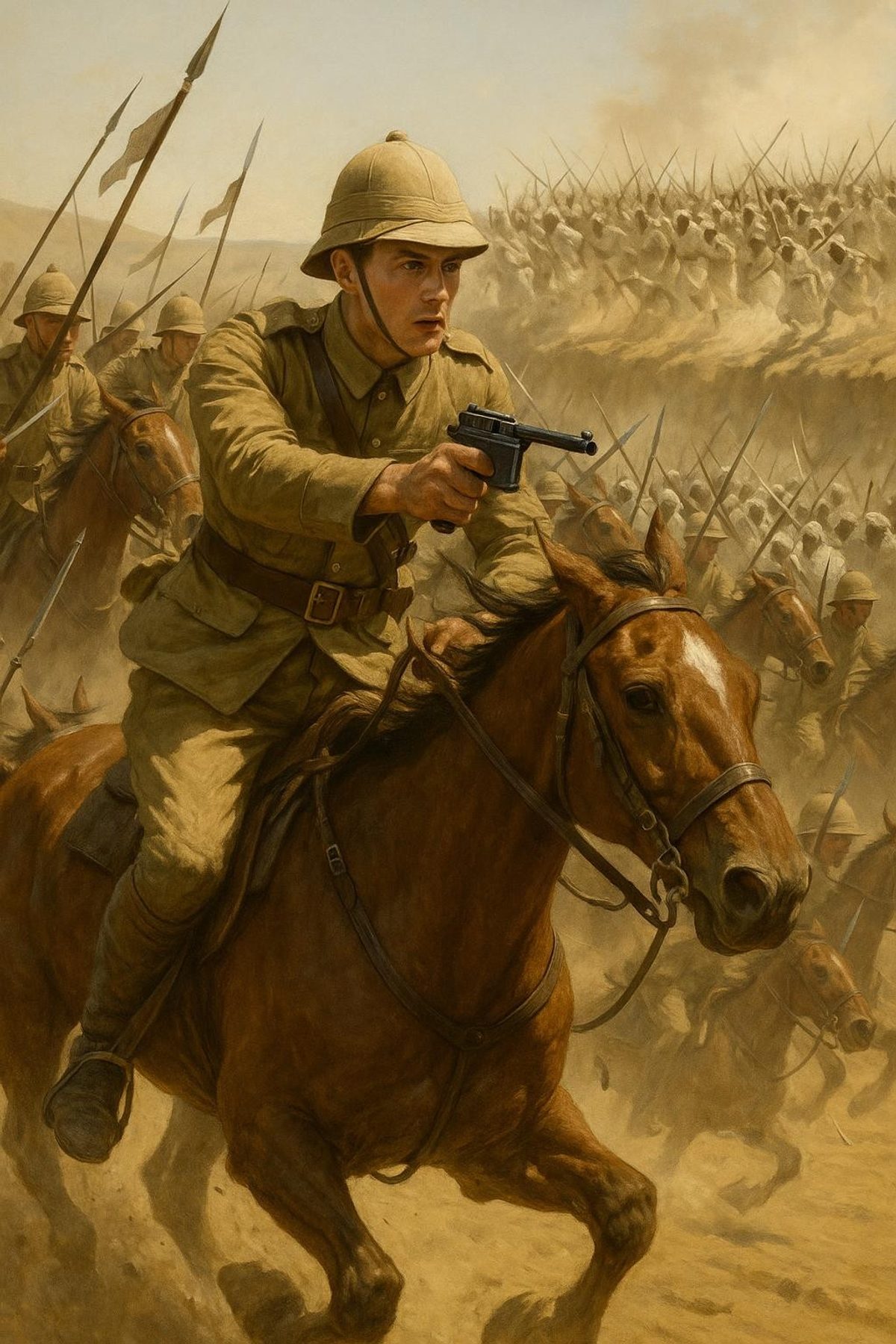
The campaign against the Dervish forces in Sudan was supposed to be the final curtain in a drama of colonial conquest. Confidence surged through the British lines. Armed with gunboats and the latest in military technology, they arrived prepared to stamp their mark upon a distant land. But nature and misjudgments often conspire in ways that technology cannot foresee. As Churchill's regiment pressed forward on the morning of September 2, 1898, the ground deceived their eyes, opening into an unexpected dry riverbed which concealed 2,000 Dervish warriors, ready with spears yearning for crimson triumph.
Read next: The Day a Surgeon's Son Chose Death Over Silence
Instantly, the trap was sprung. The cavalry found themselves ensnared within a vice of chaos and death. The morning sun bore witness to an ambush so sudden, so horrifyingly effective, that in mere minutes the sandy ground was carpeted with the forms of 21 of Churchill's comrades, their lives violently extinguished. As hooves drummed furiously against the earth with urgency and fear, the young Churchill had only his Mauser pistol and ten bullets standing between him and oblivion. The clash reverberated with ferocity—a calamitous melee fit for the pages of a gripping novel.
Survival Against All Odds
Churchill's ingenuity and improvisational prowess took center stage as his Mauser pistol barked into action, the solitary comfort amid a maelstrom of spears and turmoil. The seconds stretched into an eternity, the world reduced to the rhythmic concussions of gunfire and the cries of life and death interwoven. He maintained a steady hand, firing rounds at point-blank range, each shot a rebuttal to fate's taunting specter.
It was more than just physical conflict. Each pull of the trigger was an assertion of will, an act of defiance against the misfortune of circumstances. Where strength of arm was deprived, courage took the reins. This was a young man forging his identity amidst the crucible of war, where ideas of honor, duty, and survival converged. In that barren riverbed, amidst the tidal forces of enemies and allies, Churchill found himself not only in the physical sense but in spirit, growing into the leader he would one day become.
A Campaign of Consequence
The Battle of Omdurman would mark a significant point in both Churchill's personal and the British Empire's narratives. It was a triumph that showcased the might of military modernization, yet also a stark reminder of the volatility courted when nature and human tenacity intertwine. For Churchill, the experience was transformative. Emerging from the dust and din, he carried not only the scars and memories of combat but a wealth of experience and perspective that would inform much of his future, particularly his views on warfare and colonialism.
Read next: The Day a Chimney Sweep's Son Shamed a Whole Parliament
Back home, the events at Omdurman were hailed as a resounding success. Yet in quieter circles, debates churned, questions surfaced. Was this victory a prelude to darker days of imperialism's twilight? Would the echoes of gunfire heard in Omdurman reverberate through the years, presaging the conflicts and confrontations of the 20th century?
The Unseen Threads of History
In reflecting on such a pivotal episode, one must ask why it holds significance even today. As contemporary society navigates its turbulent landscape, tales of young men like Churchill, drawn into the vortex of distant battles, remind us of the intricate strands connecting past to present. His story is a microcosm of the broader human story—how individuals shape and are shaped by their times, how resilience and resolve can rise above the tumultuous sweep of history, and how seemingly predestined roles can be rewritten through sheer force of will.
The boy soldier who charged into the last great ambush of his youth would later become a venerable statesman navigating a world at war once more. He, like so many others, faced the unknown with determination, teaching us that even the most unassuming figures can leave an indelible mark on the timeline of history, much as the young officer did under the African sun in 1898.