April 11, 1812. The scent of damp earth rose as sunlight broke through the trees in southern Spain.
General John Le Marchant sat atop his horse, his mind ablaze with anticipation. The morning’s chill had begun to recede, casting a golden hue on the landscape. He knew this day could indeed be pivotal, not just for the Peninsular War but for his dedicated life's work. Here, amidst the quiet, the culmination of years spent reforming British cavalry hung in the balance. Initially, he wasn’t even supposed to be leading the charge. Typically, this role was reserved for others—those tactical heroes adorned in medallions—but fate had placed him here, at the forefront of a battle destined for the annals of history.
Le Marchant was no ordinary cavalryman. In the previous decade, he had dedicated his life to reshaping Britain's mounted arm. He was the architect behind the cavalry sabre, designing a weapon that combined strength with dexterity, allowing soldiers to engage enemies effectively in melee combat. But a weapon alone could not transform an army. Le Marchant penned the cavalry manual that became the gospel for training, preaching technique and discipline over brute force and chaos. And as if that weren't enough, he laid the foundations of the Royal Military College, the progenitor of today’s Sandhurst, where future tactical minds would be honed.
Yet, for all his intellectual contributions, Le Marchant craved the baptism of battle. The chance to translate theory into practice, to blend intellect with instinct. On this fateful day in April, he would do just that—prove his mettle not only as a strategist but as a warrior.
Read next: The Day a Surgeon Walked Into a Prison and Freed a Madman
The Battle of Salamanca would be his canvas. Arrayed against the French forces under Marshal Auguste Marmont, the British and their allies sought to deliver a crushing blow. The terrain itself seemed a perfect stage for Le Marchant's tutelage. Rolling fields dotted with treelines and gentle hills offered both concealment and high ground—factors crucial to cavalry warfare, enhancing surprise and heightening the impact of their charge.
As the battle commenced, the British infantry engaged ferociously, pinning French forces down, their red coats glinting as musket fire puffed around them. Le Marchant waited patiently, watching the turmoil unfold, inspecting for signs of weakness—a break in the French line where his cavalry might exploit.
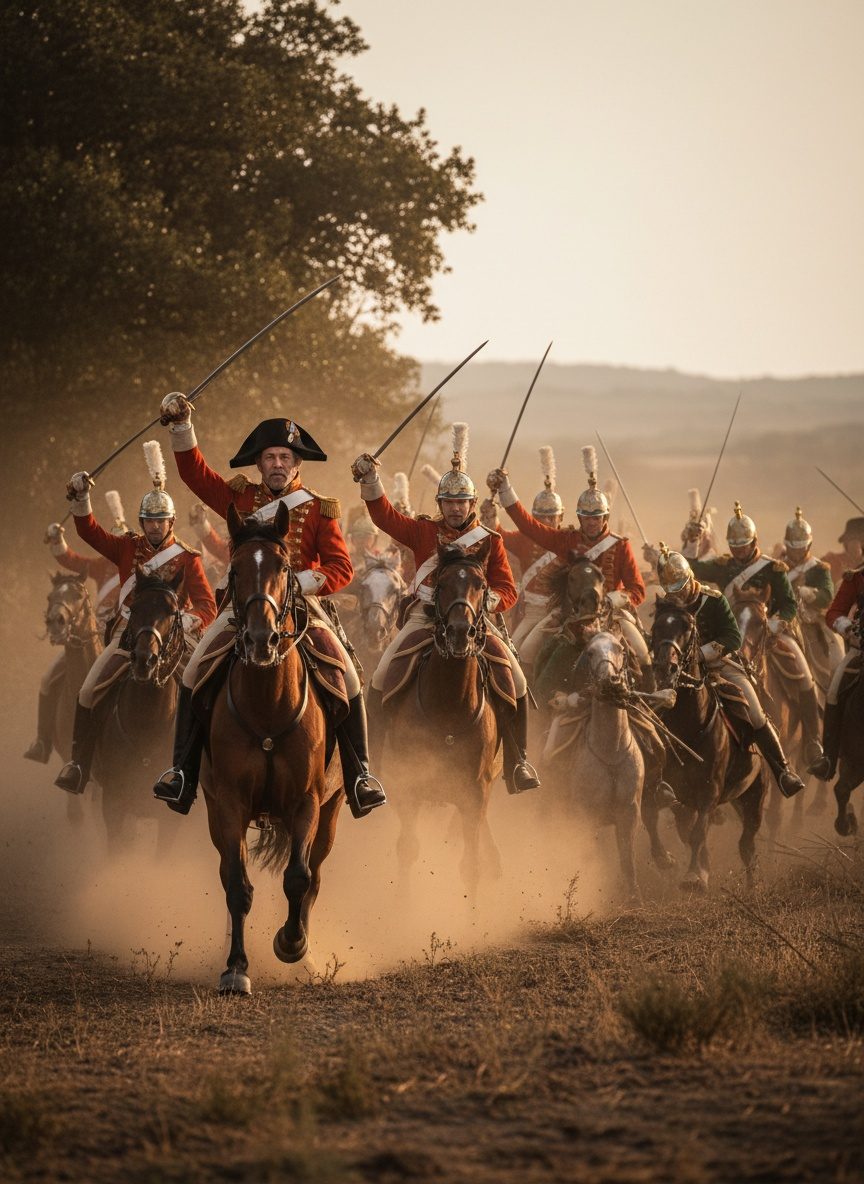
And then, opportunity. Marmont was wounded, the French lines began to waver slightly under the unrelenting pressure. Le Marchant saw his moment. His sabre gleamed as he raised it, the signal every cavalry trooper awaited. With a visceral yell that cut through the din, he led his men forward, their hooves drumming the earth in a thunderous symphony of war. This was the charge destined to become legend.
The French did not stand a chance. Le Marchant's rigorous training had instilled a discipline that synchronized the man and horse into a singular entity—swift, decisive, and fearsome. The enemy faltered as his brigade collided with them, sabres flashing with deadly precision. Stories of the charge that day would speak of its ruthless efficiency, a triumph stemming from years of meticulous preparation by a man who understood the soul of cavalry warfare like few others.
With every strike, Le Marchant's teachings lived. His men executed drills with clockwork fidelity, the likes of which the French had not anticipated. Here lay the physical manifestation of doctrines he had preached; it was as though the battlefield itself testified to his life's mission. Yet, destiny holds no certitudes. For all its initial success, war remains a merciless arbiter.
Just three months later, in the sultry July of 1812, the artful swordsman would meet his terminus at Salamanca. Once again, the cavalry charge heralded as a tactical marvel by contemporaries, became as much his demise as it was his moment of grandeur. Le Marchant fell during the fervor of battle, his body lifeless and cold on the same earth he had earlier traversed with vitality. This, moments after delivering one of the most pivotal charges in British military history.
The irony was keen; his life extinguished just as the cavalry, and indeed the army, were starting to realize the full potential of his innovations. A sword, a manual, an academy; these were his legacies. While British forces rejoiced in victory, those who knew him mourned a loss that went beyond the personal—it was a void in the future of British military prowess.
To this day, the charge at Salamanca highlights the profound yet tragic duality of armed conflict. Le Marchant’s story symbolizes the intersection of intellect, spirit, and circumstance. His vision forever reshaped the British cavalry, and his legacy outlived him in every sabre's arc and every thundering charge thereafter. This far-reaching impact encourages an appreciation of the often unsung architects behind the warriors. While victory tales often favor dramatic heroics, sometimes it is the unassuming strategist, with a steady hand and innovative mind, who orchestrates the victories that shape history.