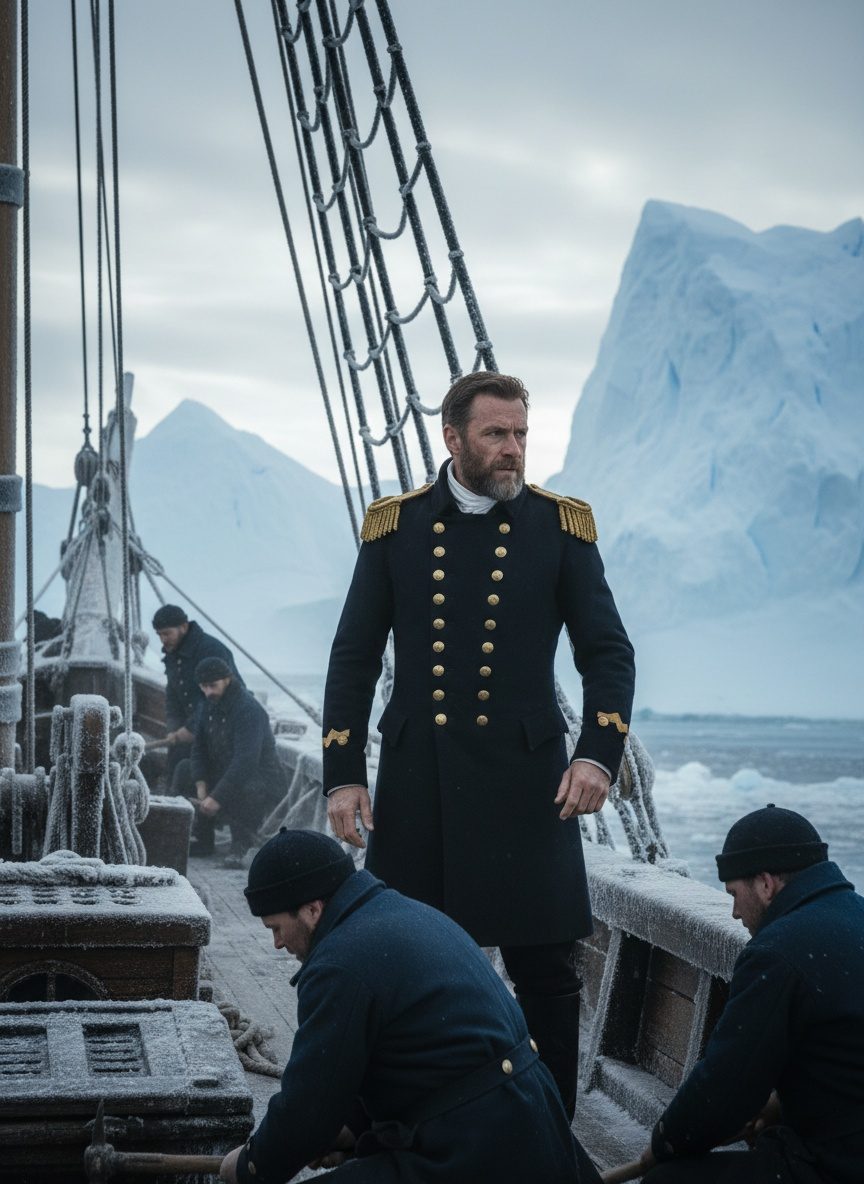
June 1, 1839. The breath of the Antarctic winds battered the stout hulls of HMS Erebus and HMS Terror, the wooden ships that dared to defy the very edges of the world.
Their journey had begun in the distant waters of England, propelled by the daring resolve of a Royal Navy captain whose name remains a footnote in history. What drove this man, the son of a humble blacksmith, to lead an expedition into the uncharted and merciless seas of the Antarctic? It was an era when the Earth seemed endless, its mysteries waiting to be unfurled — but it was also an era that mercilessly demanded the courage to conquer such secrets without modern conveniences or certainties.
This voyage into the unknown commenced not in the warmth of summer, when the southern ice might offer lenience, but in the bitter clutch of winter, when the sun relinquished its hold to the creeping shadows of endless night. The wooden vessels, far from the ironclad behemoths that would come after them, creaked under the strain of the pack ice, a frigid mass woven so thick and unyielding it might crush the ships as if they were mere playthings.
The Royal Navy captain at the helm of this audacious journey was charting seas that had swallowed whole the ambitions of many before him. With no existing charts to guide him, he placed his trust in the ingenuity of his crew and the sturdiness of his sails. Outfitted for brutal cold, they were resolute as their small fleet advanced beyond the known limits of nautical expeditions.
Read next: The Day a Surgeon's Son Chose Death Over Silence
Day by day, the harshness of the Antarctic unfolded in an endless panorama of glittering icebergs and frozen seas. The brutal beauty of this untouched world must have struck a mix of awe and dread in those mariners’ hearts. They fought not just the elements, but the loneliness of a place so isolated it seemed to stand outside time itself. Every gust of ice-laden wind, every creak of timber was a reminder of how far they were from home, from civilization, from safety.
History often glosses over these voyages of perilous discovery, as layers of events and achievements gradually cover past ventures. However, the Antarctic expedition of 1839 to 1843 was a defining moment; it was a journey of defiance against nature’s seemingly invincible barriers. The team returned with detailed accounts of the vast Ice Continent that lay beyond the shimmering edge of civilization. A land that appeared otherworldly, where the luminous glow of rare atmospheric phenomena cast surreal displays in the cold darkness of the southern skies.
Months later, when the outlines of this icy frontier were committed to paper, a new chapter of the world was penned. This remarkable feat, achieved without modern gadgets or satellite guidance, shed light on an enigmatic region many believed unreachable. The absent fame of such a pivotal expedition might be attributed to the fact that the era was one of great enterprise and massive undertakings; individual sacrifices often melded into the larger narrative of burgeoning empires.
Read next: The Day a Chimney Sweep's Son Shamed a Whole Parliament
The daring captain and his crew ventured southward amidst tales of monsters prowling the depths, an allegory for the constant human attempt to grapple with the unknown. The maps they brought back were not just navigational charts but the key to later scientific explorations. They boldly traced coastlines, pierced the heart of impenetrable ice barriers, and elucidated the mysteries of a realm shrouded in eternal frost.
We may question what drove these men to risk everything when the odds seemed so exorbitantly stacked against them. Was it the lure of fame, the promise of rich accolades, or the unyielding spirit of human curiosity that propelled them into those freezing waters? Their journey goes far beyond the constraints of ambition; it reflects a profound pursuit of knowledge, the ultimate quest to conquer the incomprehensible vastness of our planet.
Today, while satellites and submarines provide us with views of Antarctica unimaginable to the expeditioners of 1839, the raw courage behind their journey resonates still. The maps we scroll past on digital screens were first drawn by hands numb from cold, guided by eyes strained by constant blizzards, lit by flickering lanterns below decks. To remember their voyage is to honor not just their discovery, but their undying curiosity and insatiable will to expand the boundaries of human understanding.