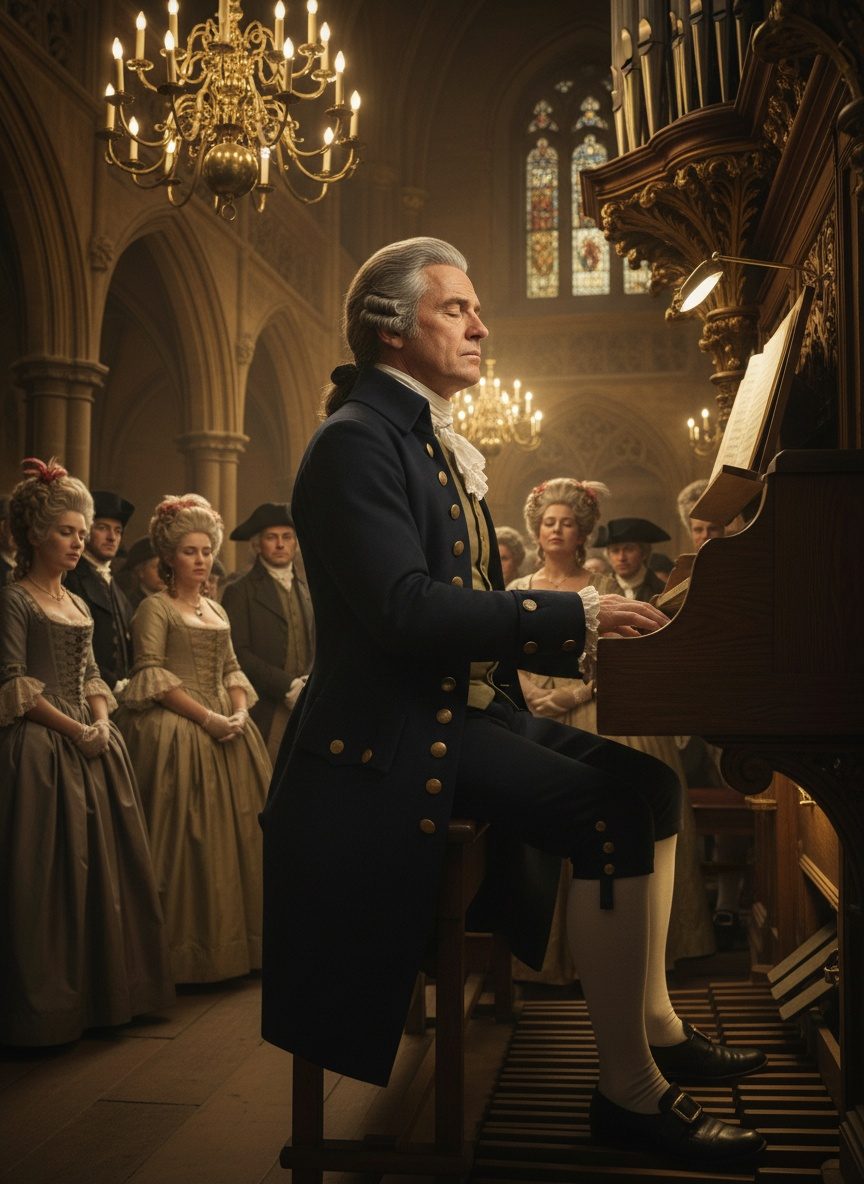
He was blind by the age of two. Yet he would mesmerize the music halls of London with the precision of a sighted virtuoso.
In the heart of 18th-century London, where the air hummed with the energy of a burgeoning city and the elegance of the Georgian era, the curious gathered to witness a musical spectacle unlike any they had ever experienced. John Stanley, a name whispered with intrigue among London's cultural elite, was about to perform. Though he had never once seen the delicate black lines of musical notation, Stanley's fingers would soon glide across the organ keys with an ethereal mastery that defied traditional learning.
Blinded by a tragic accident at the tender age of two, young Stanley faced a world shrouded in darkness. Yet his spirit possessed an almost supernatural light. Music became his seeing eye, his guide through a world where others stumbled in the dim absence of sound. Despite his visual impairment, Stanley's inherently musical family recognized his innate talent early on and nurtured his passion for music. They surely felt a sense of wonderment as Stanley, by touch alone, mastered not just the simple tunes of childhood but the complex harmonies that would later leave countless listeners spellbound.
London in 1758 was a city of music and art, a city that danced to the lively rhythm of social and political transformation. It was here, amid the bustling streets and candlelit concert halls, that Stanley carved his path. The theater had become his sanctuary, filled nightly with ladies in billowing silk dresses and gentlemen adjusting powdered wigs. They came to raise a glass of claret and whisper about the day's affairs but stayed silent with awe when Stanley set his hands upon the keys.
Read next: The Day a Black Sailor Walked Into Court and Freed Himself
The Stirling sense of anticipation was palpable as the audience awaited his performance. Benjamin Franklin had been a guest at Assembly Rooms Ogilvie Hall, where the city's cultural architects often gathered to glimpse the latest musical sensation. The chatter of the crowd faded as Stanley was led to the organ. With a quiet dignity, surprisingly assured for one who could not see his stage, he composed himself. Then, with a delicate touch, he began to play.
Many in the hall had come eagerly seeking excellence, yet none could predict the rapture awaiting them. Stanley's performance was not merely an execution of skill; it was an expression of profound emotion and understanding that transcended the barriers of sight. As his hands danced over the keys, the organ became an extension of his spirit. The notes trembled, soared, and danced in unison with the softly flickering candles, as though illuminated by the music itself.
The power of his artistry was enough to hush the cynical critics. Indeed, even George Frideric Handel, the grand maestro himself, was said to have marveled at Stanley's extraordinary talent. The kinship between these two musical titans, notwithstanding the gulf of experience and sight, was forged in a profound mutual respect. Legend holds that Handel, himself no stranger to the challenges of visual impairment, declared Stanley's performances extraordinary. This did more than secure Stanley's place in the public's admiration; it echoed far beyond, into the legacy of genius and innovation.
Stanley's artistry did not arise solely from practice but seemed to emanate from a deep well within, a reservoir of musical understanding nourished without the aid of his eyes. Every note was learned and memorized by touch, an achievement mind-boggling to audiences who had never seen such memorization outside the pages of fiction. Those present spoke of an energy in the room, something past the sound and in the vibrations on which a blind man would uniquely rely. The audience was left entranced, the music haunting their journey home.
Read next: The Day a London Clerk Walked Into Court for a Dying Slave
But what did it mean to be a musician regarded as legendary in urban Georgian London? For Stanley, the path was neither simple nor ordained. He navigated a world never crafted for the blind, proving that physical limitations could be transcended through determination and an indomitable spirit. His ability to move listeners, to elicit tears with nothing more than an organ and the music flowing from his soul, remains unparalleled in an era so richly populated with artists.
The performance in 1758 was more than a singular event of musical triumph; it was a revelation. It challenged perceptions and stirred a deep admiration for human potential found shining from under conditions of adversity. Stanley's story wasn't merely one of overcoming disability; it was a testament to the intrinsic power of music to convey emotions that hold a candle to the capacity of sight. In recognizing his talent, society was asked to reconsider its biases and redefine its understanding of ability itself.
Today, as tales of his legendary performances pass from one generation to the next, John Stanley resides in the pantheon of great musicians. Not for sheer proficiency, but for the untouchable art of evoking the profound and the moving, the transient magic that music alone can bring. His legacy is more than the notes and melodies; it speaks to a visceral connection reaching across time, inadvertently nudging the foreseen coordinates towards inclusivity and admiration for capabilities beyond tradition. In the end, the true sight Stanley gifted to the world illuminated more than the music sheets he never viewed.