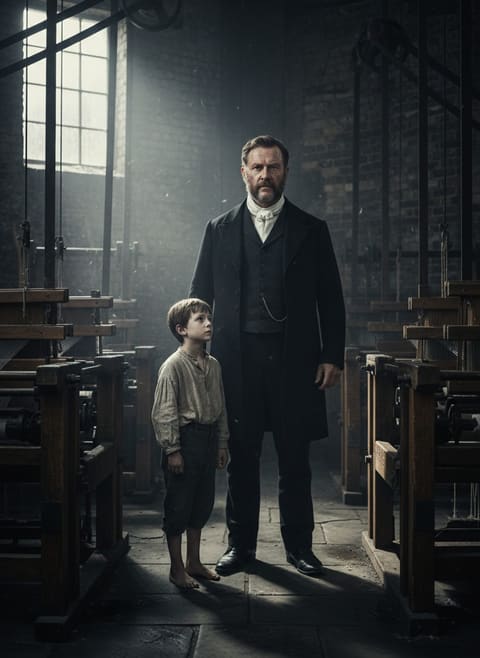
June 10, 1833. Dust hung thick in the air like a looming ghost.
A Child's Memory of Darkness and Dust
The room was oppressive and dim, its walls echoing with tales best left untold, yet today the silence was broken by the earnest words of a small, fragile figure. As the Commissioners settled into their chairs, the air tingled with anticipation. They had come to Huddersfield to hear an account that had, over time, become tragically routine among the mill towns—children broken before they had a chance to grow. Yet nothing quite prepared them for the quiet storm brewing in this child's testimony.
His name was not recorded, but his resolve was unforgettable. At only ten, the child bore the weight of an ancient, weary soul. He stood with difficulty, a sobering testament to the brutalities of a life spent in manufacturing. The crooked angle of his spine told stories of endless hours hunched over machines, while his bowed legs whispered of weariness rooted deep in his bones. Yet his voice, though soft, held a clarity that sliced through the haze of indifference that had long shrouded the issue.
He painted a vivid picture: rows of machines whirring incessantly, their hum a relentless symphony of toil. His days began at dawn, with the sun only a distant promise outside the darkened walls. For years, he’d been swallowed whole by the mill, echoes of its machinery punctuating every sunset that came too slowly. "We start before the cock crows," he said softly, "and we leave as the stars begin to wake." This was the world into which he had unwillingly been born, a world where scraps of childhood had been sacrificed on the altar of industrial progress.
Read next: The Day a Weaver's Son Lit Britain's First Public Railway
Confronting Britain's Handiwork
In the 1830s, Britain was racing headlong towards modernization, leaving a trail of human debris in its wake. The Royal Commission's investigators faced difficult truths in their inspectorial pursuit, finding the glistening peaks of industrial achievement resting on the steep, sordid inclines of human misery. Not only the child's testimony but those of many like him cast a harsh light on the costs of Britain's ambition. They were witnesses to a silent suffering seldom acknowledged by the society that should have nurtured them.
These children were the cogs in the great machine of industrial advancement, turned as ruthlessly as the gears they operated. From Manchester to the mill towns of Yorkshire, the evidence unfolded like a grim tapestry. Even though child labor was common knowledge, the intricacy of its cruelty had been elusive, hidden among the loom reeds and carding machines.
The investigators listened as if awakened from a long slumber. They took notes as he recounted his function in the mill—cleaning under the machines, collecting the stray threads, all while the very devices of his labor threatened his frail limbs. The extent of negligence, the abject destitution, and the raw perseverance it extracted left the Commission with little pause to question the need for reform.
The Nations' Pulse Quickens
As news of the Commission's findings spread, it resonated like a clarion call for change throughout Britain. People narrated the boy’s resolve with incredulity. Here was a testament not just to resilience, but to an entire society's coming of age. Was this not a reflection of humanity's remarkable ability to penetrate the fog of its own apathy?
The testimonies delivered by children cut through layers of political posturing and societal ignorance. Suddenly, the abstract was made personal. Suddenly, the conversation at Parliament was not centered around productivity charts or economic forecasts, but about the spine of a boy who could hardly stand. This stark virality, echoing through drawing rooms and broadsheets, fomented a shift towards legislative action.
Read next: The Day a Mill Owner Walked Into Court and Freed His Rivals' Children
The time had come for voices long ignored to find their place amidst the seats of power. The urgency of the Factory Act emerged not from the revelations of economic scholars, but from the undeterred will of children bound to forward their survival. That same year, their collective cries forged a legislative landmark, the passage of the 1833 Factory Act, setting limits and, for many, offering a truce in their battle against relentless exploitation.
Lessons of Dust and Perseverance
The child returned to the shadowed tenements of Huddersfield, vanishing as quietly as he had arrived. Yet his words stirred an undeniable truth within each who heard them. As children's laughter became an unfamiliar melody in the once muted warehouses, a new perspective took root amidst Britain's hayloft and hearth. The Act meticulously sought to end the nightmarish rite of passage endured by generations, though enforcement would remain fraught with challenges.
Today, in an age where such testimony might emerge through screens instead of before Commissioners, the echoes of that June day carry a timeless significance. It implores us to lend an earnest ear to those who historically have whispered from the shadows. The challenges are vastly different but to heed the voices ensnared within systems of progress remains the moral heritage imparted by that boy.
As we consider the balance between advancement and ethical integrity, the story reminds us that progress without conscience leaves us bereft of our humanity. That small, crooked messenger from 1833 still walks beside us, urging society toward a new dawn, just beyond the dust of an industrial past.