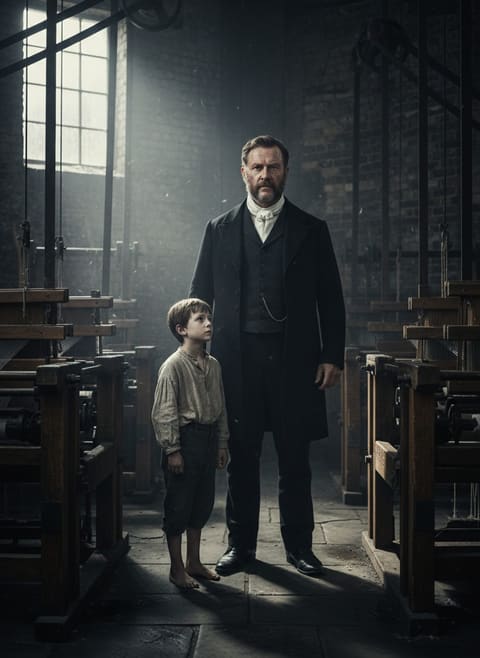
He was seven years old. He had been sold like property.
The Shadows of Early Childhood
In the dim and daunting halls of St. Pancras Workhouse, Robert Blincoe's life began as one obscured by poverty and abandonment. Born into an institution that defined the bleak realities of destitution in 1792, Blincoe was no stranger to hardship. By the tender age of seven, his prospects seemed irreversibly darkened when he was "apprenticed"—a genteel term that glazed over the brutal fact—sold into the grinding depths of the Industrial Revolution. Removed from the workhouse that had first contained him, he was sent to the harrowing cotton mills of Lowdham, Nottinghamshire. There, among the roar of machines and the stifling haze of cotton dust, Blincoe's resilience began to form, forged by years of relentless labor and harsh discipline.
The Harrowing Reality of Mill Life
The early 1800s in Britain were marked by industrial advance but masked a shadowy underbelly of suffering amongst the youngest and most vulnerable citizens. Sent to John Birch's cotton mill, Blincoe entered a world where childhood innocence was stripped away by the unforgiving rhythm of factory life. Working conditions in these mills were nothing short of a Dickensian nightmare. Children, frail and malnourished, toiled for up to 14 hours a day, squeezed into cramped workspaces where danger lurked with every turn of the machine.
For Blincoe, even simple errors were met with severe repercussions—beatings with straps or being hung from the rafters by his wrists. Such brutal discipline was masked as character-building, but in reality, it was a method of maintaining the rigid hierarchy that fed the machines of industry with child labor. Yet, even amid aflicted bones and perpetual hunger, Blincoe managed to persevere. How he endured remains a testament to human tenacity but also a chilling reflection of the times.
Read next: The Day a Weaver's Son Lit Britain's First Public Railway
The Courage to Tell the Truth
Robert Blincoe was not simply a silent sufferer; he was a witness. His inner resolve was coupled with a courageous voice that would eventually rise above the clamor of oppression. After enduring years in the mills, Blincoe saw an opportunity to escape when his apprenticeship ended. With experience etched into every scar, he navigated a world that had little regard for children like him and sought to tell his story.
In a revolutionary act of defiance in 1832, as Parliament's first inquiry into child labor began to gain momentum, Blincoe’s voice finally found a platform. Called upon to testify, Blincoe strode into Westminster, not as the defeated victim his masters had hoped to forge, but as a man armed with the truth of his experiences. His testimony was a harrowing account of life within the mills, punctuated by his chilling recollections of brutal treatment, unsanitary conditions, and the perils faced daily by child workers.
Awakening the Conscience of a Nation
Robert Blincoe’s testimony before Parliament was more than a personal catharsis; it was a catalyst for change. In a society largely indifferent to the plight of factory children, hearing such firsthand accounts was a rude awakening. The public response rippled outwards, reaching lawmakers and reformers alike who had previously turned blind eyes to the abuses that fueled Britain’s rapid industrial progression.
Read next: The Day a Mill Owner Walked Into Court and Freed His Rivals' Children
While Blincoe's testimony alone was not enough to immediately reshape the legislative landscape, it helped lay the groundwork for subsequent debates and reforms. The evidence he provided, along with other similar testimonies, was instrumental in forming new waves of activism that would eventually lead to the Factory Acts. These laws, although gradual and not initially comprehensive, began to regulate child labor and set a new course towards a more humane industrial environment.
A Legacy Written in Stone
Robert Blincoe’s story, once faded beneath the wheel of progress, demands to be remembered not just for its harrowing details, but for the indomitable spirit it reveals. In stepping forward, Blincoe challenged the very foundations of an industrial society willing to exploit the weakest. His brave act of advocacy served as a clarion call and helped light the way for future reformers who would continue to fight for social justice.
The story of this factory boy walked into court and spoke reminds us that even in times of rampant injustice, there remain those individuals whose voices, when finally heard, can alter the course of history. Through Robert Blincoe, we are reminded that any society must be judged by how it treats its most vulnerable, and in that judgment lies the true blueprint for moral progress.