January 30, 1649, marked the end of Charles I's kingship. It was also the day when royalty met the realm's judgment in a manner that stunned observers then and continues to fascinate historians.
As the sun crept over the horizon on that chilly morning, London was awash with anticipation. The city was tense, not from the cold that pervaded its streets, but from the unthinkable events about to unfold. One might have expected Charles Stuart, the man who was mere moments away from becoming the first and only English monarch to be publicly executed, to tremble at his fate. Yet, Charles was resolved to face his destiny with dignity befitting his royal stature. He had dressed with meticulous care, donning two layers of shirts. The winter air was biting, but he was determined that any shivers would not be mistaken for fear.
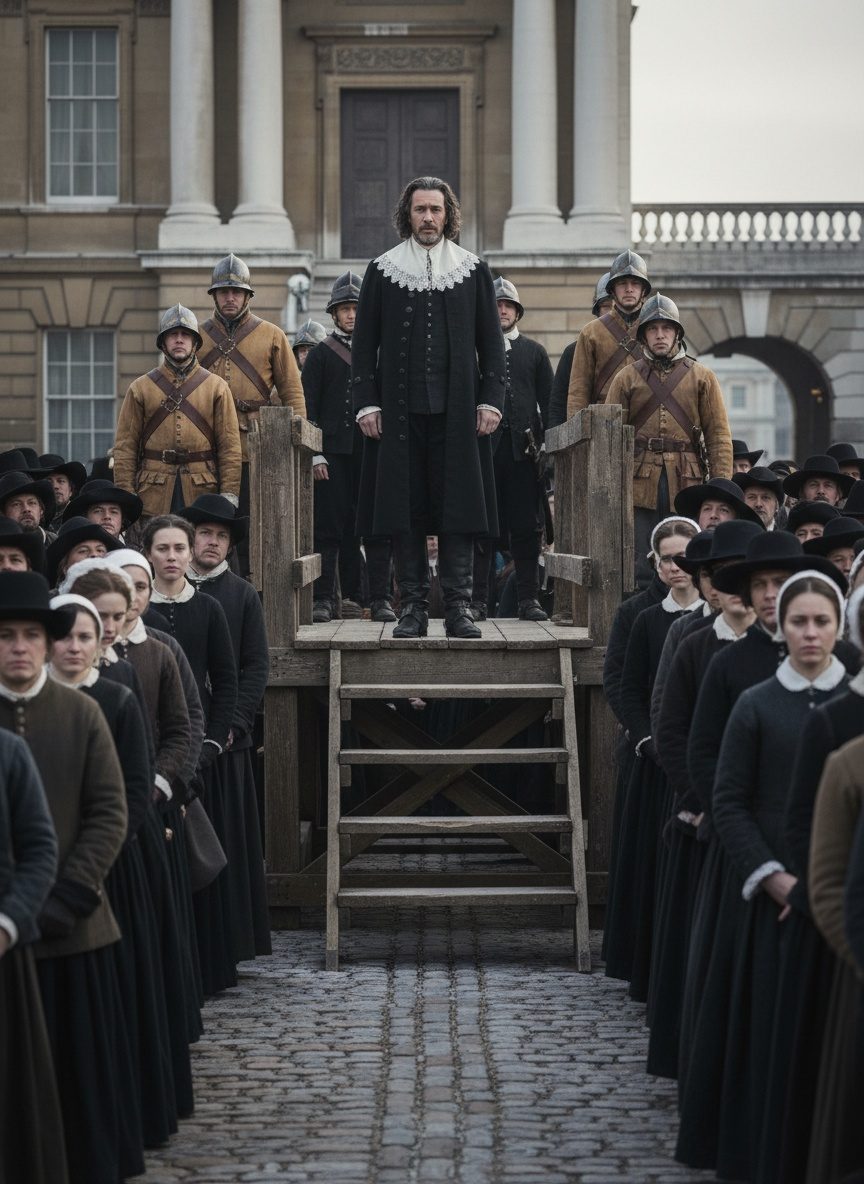
Through prior arrangement, Charles stepped carefully through a window of Banqueting House onto the scaffold erected in Whitehall. An estimated crowd of ten thousand formed a dense sea of faces — a mix of loyalists and curious onlookers, as well as those who had wished for this very moment. His demeanor was unrepentant and regal, and his gestures slow and deliberate. To those who watched, here was a king whose physical appearance on this final day bespoke not just composure, but a calm belief in the righteousness of his actions and choices that had led him here.
This was the culmination of years of conflict—an intractable clash between the king's divine right and the Parliament's authority. As heads turned eagerly, a hushed ripple of disbelief and awe spread through the crowd. The king's voice was unexpectedly steady when he addressed his executor and the gathered spectators. His final words were poised, reflecting upon the principles he had believed to the end: "I have a good cause, and I have a gracious God; I will say no more."
Read next: The Day a Young Prince Knelt and Refused a Crown
The events leading to this moment were steeped in both tragedy and complexity. The English Civil War, stretching from 1642 to 1649, had rent the country into factions. The king's staunch belief in his divinely ordained right to govern clashed with the growing demands for parliamentary sovereignty. It was a collision of old-world autocracy with emerging democratic ideals. To understand why Charles I's walk to the scaffold resonated so profoundly, one must recall the echoes of Cannonball and musketry that had for years dictated the rhythm of English life.
Charles' trial for high treason had been a perfunctory affair, orchestrated by those who had resolved upon the drastic necessity of regicide. He stood silent and unyielding during much of the proceedings, refusing to recognize the legitimacy of the court that judged him. Behind the court's verdict lay a republic's embryonic demand for accountability, marking a radical departure from history. Never before had a ruling monarch been forcibly brought to account by a tribunal not of his making.
As he ascended the scaffold's wooden steps, each creak was a testament to the weight of history pressing against the old doctrines of monarchy's inviolability. Charles kneeling was, to some, a final act of submission, but to others, it was the ultimate assertion of a belief system overrun by the relentless tide of change. The scaffold, for all its starkness, became an altar; and in that singular, irrevocable act, a monarchy was suspended between divine right and man-made justice.
Read next: The Day a Queen Rode Alone Into a Mutinous Army
When the executioner, clad in anonymity to forestall retribution, struck the fatal blow, it was quick and efficient. For those present, the moment was surreal. Onlookers could not help but digest the archaic contract between ruler and subject that dissolved with each gossamer drop of royal blood absorbed by the straw-covered boards.
The death of Charles I not only closed a chapter on Stuart absolutism but opened dialogues that would persist in the annals of British history. His execution reverberated far beyond Whitehall, influencing political thought and debate for generations to come. With the monarchy temporarily abolished, England would experiment with republicanism under Oliver Cromwell's leadership. Yet, the restoration was inevitable, as monarchy soon returned with Charles II in 1660, albeit not unchanged. The illusions of divine privilege were forever shattered, leading to a transformed relationship between ruler and ruled.
Indeed, Charles I’s somber procession to the scaffold offers a poignant meditation on governance and the perceived divine rights of rulers. Such a defiant end asks us to reconsider the balances of power and governance, pondering the sometimes unbearably human cost of political evolution. The chill of January 1649 has long since faded into the annals of history, but Charles I's walk, unsteady only in retrospect, stands as a pivotal pivot from a past of autocratic splendor to modern constitutional monarchies and ultimately, a testament to the ceaseless march of human progress, compelled forward by the need for representation and shared power.