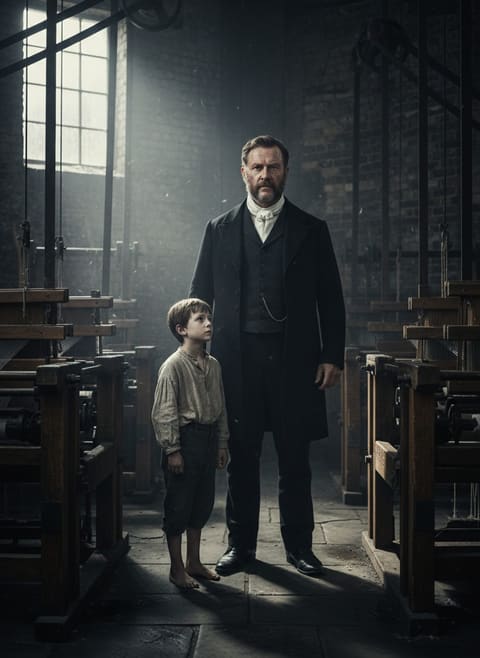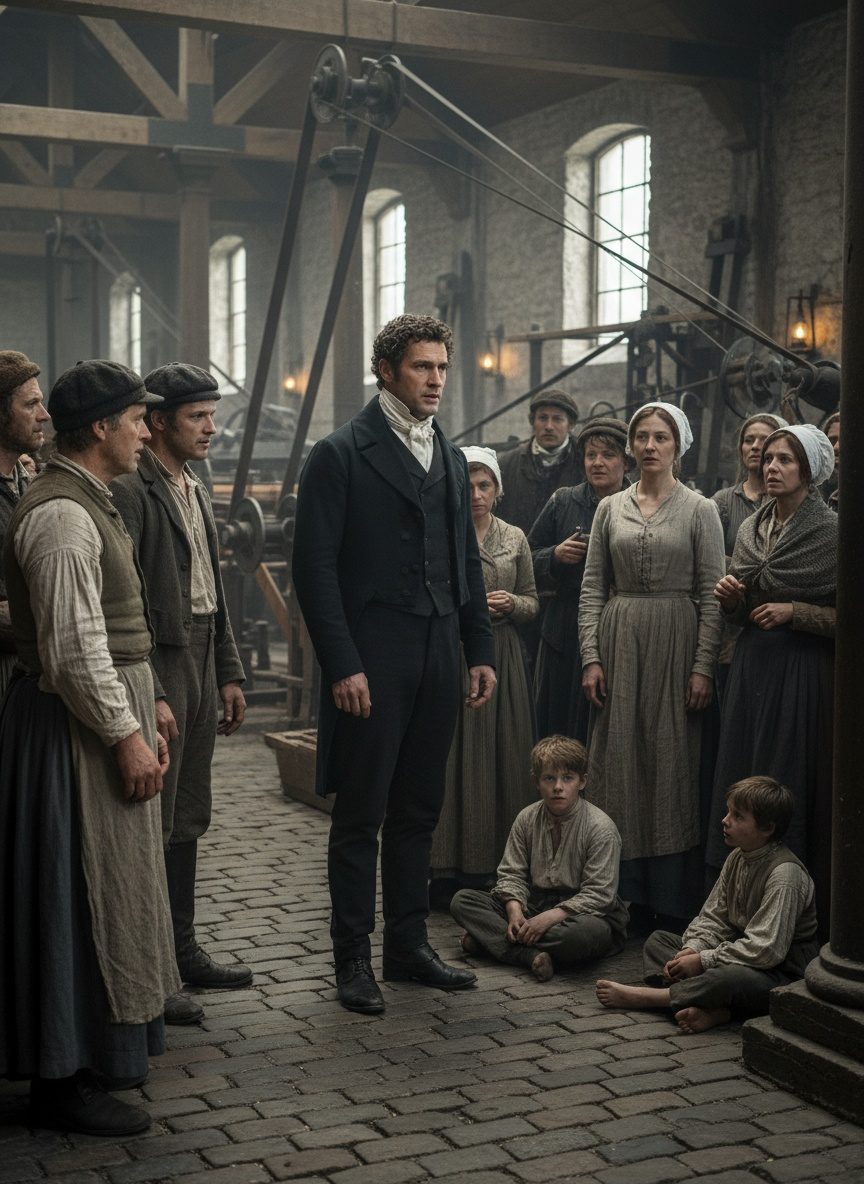
He was a mill owner, but he wore no grand top hat nor wielded a silver-tipped walking stick. Instead, Robert Owen of New Lanark was a revolutionary in spirit, armed with ideas that made factory owners gasp and laborers weep.
In the heart of the Industrial Revolution, where smoke-choked skies and the relentless clatter of machinery defined modern life, Sunday was a luxury neither time nor bosses afforded. In Lancashire, 1816, the industrial behemoth demanded its pound of flesh and did not grant repose. Factories were unforgiving monoliths of industry, their wheels grinding seven days a week, unceasing, uncompromising. Robert Owen, however, dared to imagine a world with an unsanctioned pause—a day owed to humanity rather than the machine. That day, he said, was Sunday.
It might have seemed madness in an age where production was god and profit its hallowed church. Owen’s peers scoffed, labeling him a romantic, an improvident fool ensnared by his own benevolence. Yet, Owen’s ambitious vision reached beyond mere financial gain. Staring at the ashen faces of his workers, the weariness etched into their bones, he was driven by conviction. He paid them full wages for six days of toil and gifted them a reprieve every seventh. In a sea of mechanical drudgery, he sought to remind them of their humanity.
The world surrounding Owen’s mills at New Lanark buzzed with constant activity, a visceral symphony of hammering, spinning, and the rhythmic hiss of steam. Children as young as seven years old navigated perilous machinery while mothers trudged through long shifts, losing the fight against fatigue under dim lamps. Sunday, for most, promised quietude only in dreams. But Owen’s surprising generosity opened the door to unexpected leisure. For some workers, it was the first time they felt the sun’s warmth on their skin on a day unrelated to work, a small grace that tasted of freedom.
Read next: The Day a Weaver's Son Lit Britain's First Public Railway
Robert Owen’s remarkable decision was steeped in radical philosophy long before he took New Lanark under his stewardship. He yearned for an equitable society, one nursed by the milk of human kindness. A successful textile owner, Owen believed that the very nature of a business was intertwined with moral responsibility. His peers, embroiled in short-sighted avarice, failed to entertain such notions. They saw flesh as machines, rivaling steel in the race for efficiency, a race Owen chose not to run. Instead, he meticulously kept note of his mettle: proving prosperity needn’t ride the backs of broken humans.
Owen invested in schools, imagining children studious in classrooms rather than nimble among factory gears. He built their minds with education, believing that a learned person was a richer person, not in coins but in spirit and wisdom. New Lanark’s children attended institutions, many for the first time ever, their eager young minds absorbing the world beyond factory walls—indelibly empowered, unconsciously liberated.
In time, Owen’s mills thrived under principles considered by some as dangerously unconventional. With productivity up and absenteeism down, New Lanark’s profit margins soared. Workers, now rejuvenated by their artificial Sabbath, produced more with heart and vigor, creating fidelity not just from duty, but from gratitude. It was a symbiotic advancement in which both owner and worker benefitted, more a dance than a trudge through the smoke and coal.
Read next: The Day a Mill Owner Walked Into Court and Freed His Rivals' Children
Beyond financial metrics, something bigger was quietly being born: a nascent awareness among the workers that they mattered. Instead of fearfully bowing to whips of economic threat, they stood encouraged by the employment of compassion as reward rather than brute force. Out of one man’s revolutionary approach, an entire generation came to rethink the intersections of work, kindness, and profitability.
Owen’s foresight proved that community welfare could harmonize with industry, painting a new tableau where industrial success was both benevolent and bountiful. While others doubled down on exploitation, Owen ventured into paternalism, not as a patronizing burden, but as a nurturing guide. The mills were quieter on Sundays now, a rare peace punctuating the symphony of progress.
His rivals glanced through spectacles of doubt, stubborn in acceptance of a truth that was dissolving the grist of traditional thought. Robert Owen's example highlighted that humanity and industry could flourish in concert, not opposition. His story reflects the power inherent in audacious ideas to shape society afresh. In a world often missing the harmony between power and kindness, Robert Owen’s life rings like a bell tolling across time, bidding us to remember the soul within the mechanism and the prosperity brought forth by treating people as ends rather than means.