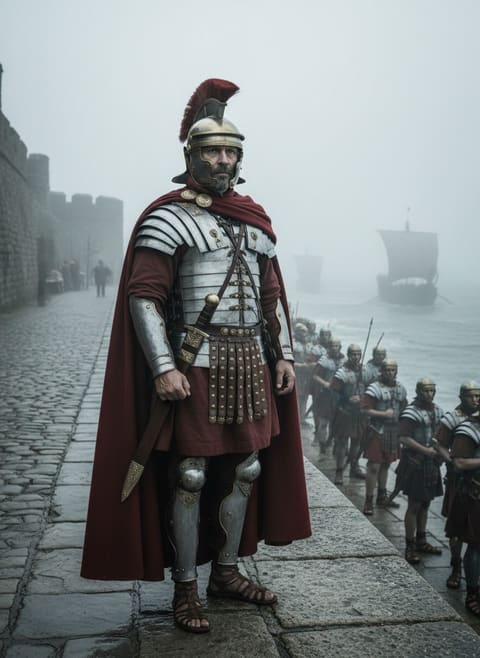
71 AD. The northern winds carried a chill across the rolling hills of the Brigantes' lands.
Pawns and Queens
In the vast tapestry of Roman Britain, few figures stood as captivating as Cartimandua, the embattled Queen of the Brigantes. The year 71 AD marked a pivotal moment in her life, as she was driven from her throne by forces within her own people. For over a decade, she maintained the delicate balance between loyalty to Rome and leadership over the largest tribe in Britain. A skilled diplomat and a shrewd leader, she played both sides in a game where the stakes were continually life and death.
Cartimandua's early success was notably marked by her role in capturing Caratacus, a king of the Catuvellauni tribe, who had resisted Roman expansion. In an act that defined her reign, she handed him over to Rome. This bold move secured her status as a crucial ally to the Romans, earning the protection of the empire she needed to rule her people. Yet, it also sowed the seeds of dissent among some Brigantes who viewed her loyalties with suspicion.
The central problem for Cartimandua was her dependency on an empire with interests that only aligned with hers as long as she remained useful. Her ambitious political maneuvers soon met with a domestic crisis. Venutius, once her consort, emerged as a formidable opponent. His rising influence and opposition to Roman rule resonated with many Brigantes, leading to a civil conflict that threatened to consume the tribe.
Read next: The Day a Roman Slave Left a Message That Outlasted an Empire
In this theatre of intrigue, rebellion reverberated through the valleys. The internal strife peaked with Venutius leading a revolt that forced Cartimandua into a precarious position. As her power crumbled, she faced not just loss of her throne, but the bleak prospect of falling from grace completely. Her plea to Rome was an uncertain gamble, reliant on the grace of her imperial patrons, embodied by their governor Petillius Cerialis.
The Cavalry's Arrive
Petillius Cerialis, newly appointed to his position, faced a critical decision. Known for his decisive nature and hard-fought experiences, Cerialis had a reputation for effective and sometimes ruthless strategies. However, the situation with Cartimandua required a touch of political finesse. Unlike military campaigns where brute force and tactical brilliance won the day, the choice he faced was steeped in nuance.
For Cerialis, rescuing Cartimandua was a calculated risk. On one hand, she was a time-tested ally whose aid had advanced Rome's foothold in Britain. On the other, investing Roman resources to assist in internal tribal conflicts might be deemed unnecessary, especially with the pressing concern of maintaining control over the region's volatile frontiers.
The governor, facing this tempestuous landscape, surprised many by opting to aid the beleaguered queen. He dispatched Roman cavalry to intervene, showcasing his strategic acumen that prioritized long-term stability over short-term gains. This intervention wasn't merely an act of mercy; it was a demonstration of Roman might and commitment to those who stood by the empire.
Read next: The Day a Roman Officer Freed His Captive and Walked Away
The sight of Roman cavalry, gleaming under the dim British sky, racing through the undulating terrain to rescue Cartimandua must have been formidable. These forces closed in, intercepting her captors and securing her safety. The act reinforced the message — Rome would not abandon its allies. Cerialis's gamble ensured a semblance of stability, although the drama was far from over for the Brigantes.
The Subtlety of Power
Cartimandua's deliverance from imminent peril was more than an episode of imperial intervention. It sparked a ripple of possibilities and consequences. Though she never regained her throne, her safe passage to Roman protection marked the last known chapter of her documented life. The rescue elucidated the intricate web of alliances that Roman governors had to navigate, balancing authority with optics in a land fraught with rebellion and unrest.
The significance of Cerialis's decision on that crucial day goes beyond the immediate relief of a dethroned queen. It represents a microcosm of Roman Britain's broader diplomatic tapestry, one where the concept of loyalty was permanently tied to an intricate dance between the conqueror and the subjugated. Cartimandua's story highlighted the delicate nature of power — how it could shift with the tides of fortune and favor.
As the years rolled on, the legacy of Cartimandua and the governor's decisive rescue effort resonated through the annals of history. It wasn't just a story of military might; it underscored the importance of political alliances and the occasional benevolence that history affords to those who play their cards right. Her tale, though now a mere whisper in the grand narrative of Roman Britain, prompts us to consider the ever-relevant themes of power, loyalty, and the human instinct for survival against all odds.