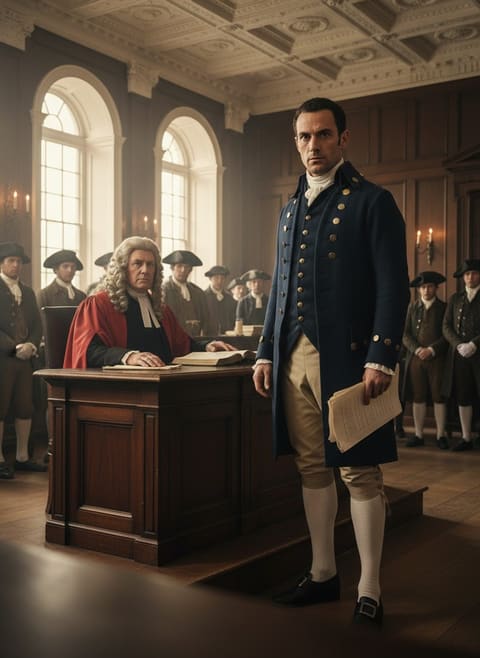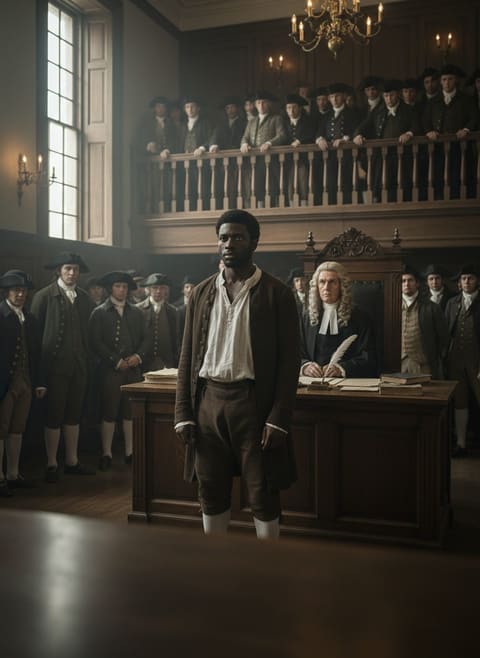
The air was brisk, dancing with the crispness of early autumn in London, 1771. The sun peeked shyly through the muted greyness that hung over the labyrinth of cobblestone streets, casting a pale light upon the bustling life below. The city seemed always in motion, with the cacophony of street vendors calling their wares and carriage wheels rattling over stones mingling with the constant chatter of hurried passersby. It was against this backdrop that a quiet, determined figure stood resolute, poised to alter the course of his own life and nudge the law itself toward change.
Jonathan Strong was a young black man who had been pushed to the brink of death by the brutality of enslavement. For Strong, the streets of London were more than just thoroughfares of commerce; they were avenues of survival, a place where his fate could pivot. He had been severely beaten by his master, left crumpled and broken in alleyway shadows. Here, amidst the everyday hustle, his life intersected with a stroke of humanity that would lead him down an unexpected path.
It was a surgeon, whose name history almost let slip into obscurity, who first spotted Jonathan slumped and battered. This moment of recognition was more than a simple charitable gesture—it was an act of compassion that carried the seeds of justice. Taking Strong in, the surgeon tended to his wounds, not just those visible upon his skin but those carved deeper by the shackles of oppression. With time, this act of kindness restored more than the man’s physical health; it reinvigorated his spirit and his sense of possibility.
As the autumn leaves turned and fell, Strong regained strength. He began to piece together a semblance of life away from the brutal grasp of his former master. Yet, like the inexorable tide, the specter of enslavement had not fully receded from his life. The very man who once claimed ownership over his being sought to exert that right anew. His former master discovered Strong’s whereabouts, and the shadow of slavery stretched threateningly over his newfound freedom.
Read next: The Day a Black Sailor Walked Into Court and Freed Himself
When Strong’s master demanded his return, it was not just a question of ownership but a glaring confrontation between the entrenched traditions of the past and the whisper of emancipation on the horizon. On that fateful day, Jonathan Strong stood at the threshold of the surgeon's door—a line in the societal sand—and refused to cross into bondage once more. His refusal was more than personal defiance; it was a challenge to the very boundaries of law.
The legal odyssey that ensued reached into the heart of Georgian England, unearthing the legal ambiguities surrounding slavery. Strong’s situation became pivotal in the maze of judicial halls. The case drew attention not just from the courts but from the public consciousness, inflaming debates that simmered in parliamentary chambers and private salons alike. The question at hand was whether a man who had walked free on English soil could be claimed as property. It asked how a society that prided itself on liberty could engage in principles that fundamentally contradicted its own ideals.
Read next: The Day a London Clerk Walked Into Court for a Dying Slave
With each step in the legal process, Strong’s case garnered allies, notably from emerging abolitionists whose ideas were bubbling against the tides of tradition. Each courtroom battle brought not just personal stakes for Strong but broader implications for an entire network of lives entangled in the chains they longed to break free from. The sights and sounds of the court, the scratch of quills and murmur of legal proceedings, marked a front line in a war of ideology.
The outcome was far from absolute. Legal victories in Georgian England were as elusive as they were transformative. The case of Jonathan Strong did not end slavery, nor did it instantly rewrite the statutes. It did, however, eke open a window through which the winds of change could blow. English law, encumbered by centuries of precedent, felt the tug of moral obligation, urging lawmakers and citizens alike to reflect upon the hypocrisies ingrained within their society.
Jonathan Strong's stand on that doorstep, far from being an isolated incident, sparked ripples that touched other lives. It added momentum to an abolitionist movement that would continue to gather force through the following decades, culminating in eventual legal reform. His unwavering refusal signified more than the rejection of a master; it was a profound assertion of human dignity.
In the grand tapestry of history, few threads are as resilient or impactful as the acts of quiet strength performed by individuals like Jonathan Strong. His story is a testament to the power of personal agency and the inherent challenge within oppression: the possibility of change. In an era punctuated by disparity and injustice, it is both remarkable and hopeful to consider that sometimes a gentle refusal—a single act, a simple decision—can begin to unravel the very fabric of institutionalized wrongs. This tale of resilience and courage reminds us that the gears of history often turn on the hinge of everyday valor.