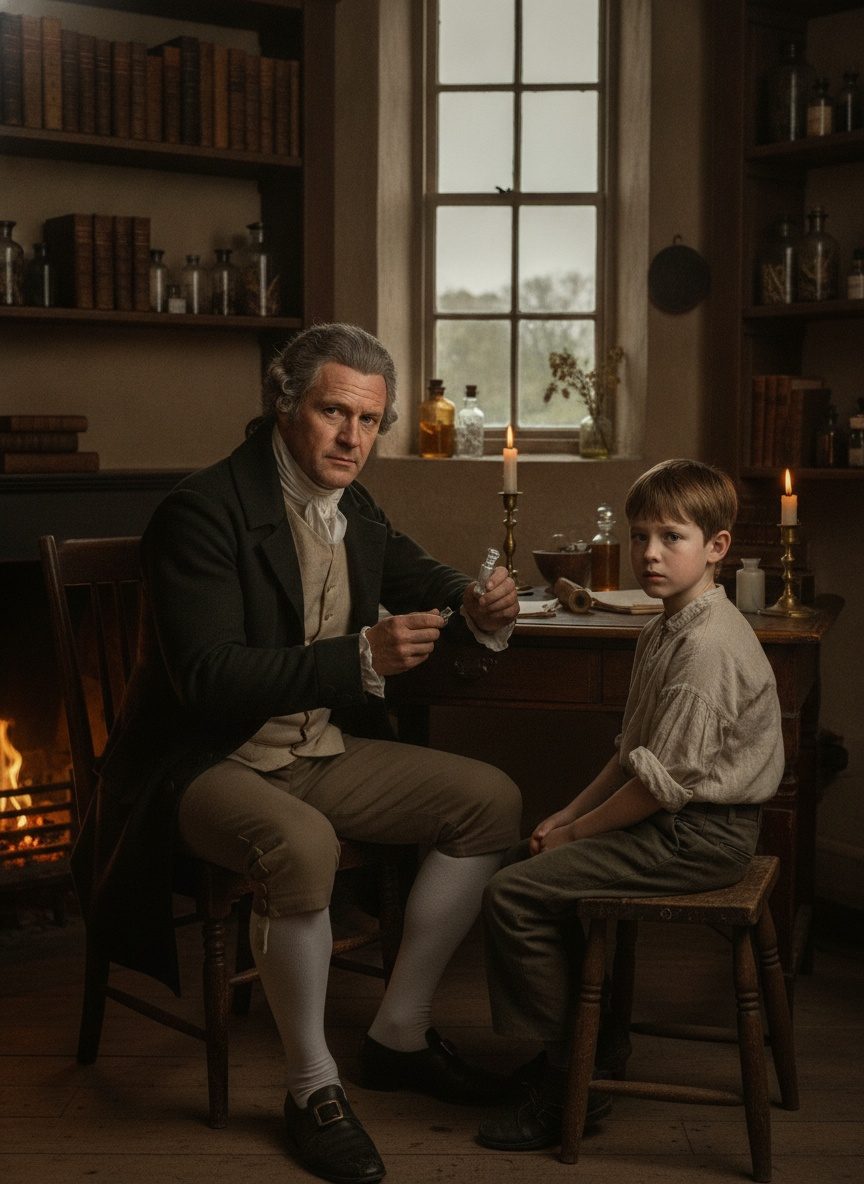
The biting chill of the early Gloucestershire morning was punctuated by the soft, insistent bleating of cattle. The landscape was a patchwork of rolling hills and quiet farms, where a lone figure moved with purpose. Dr. Edward Jenner, standing at the edge of a small barn, drew in a deep breath. In his hands, he cradled a small, rudimentary syringe, the weight of its promise and peril pressing heavily upon him. Inside the barn, a young milkmaid, Sarah Nelmes, gently soothed a cow named Blossom. Unbeknownst to her, the small, fluid-filled pustule on her hand held the secret to saving thousands.
The Unthinkable Experiment
Edward Jenner was no stranger to the fear that smallpox invoked. It was a disease that ravaged populations indiscriminately, marking its survivors with scars, and often, blindness. Despite the threat it posed, Jenner dared to challenge the accepted wisdom of his time. The notion that exposure to cowpox could protect against smallpox was a whisper of rural folklore, dismissed by many learned men. Yet, Jenner saw a pattern—a glimmer of hope—in the anecdotes of milkmaids boasting flawless complexions, untouched by the pox.
At the center of this audacious experiment was James Phipps, a mere eight-year-old boy from the village of Berkeley. With the consent of his father, Jenner was poised to make medical history. Gently, he scraped a small amount of pus from the lesion on Sarah's hand, a mere stain on a white cloth. Hours of contemplation crystallized into action as he inserted the needle into the boy's arm. This was no ordinary injection; it was a calculated gamble, a step into the unknown.
For days, James watched as a mild fever and slight discomfort replaced fear, then faded entirely. Weeks later, with a mixture of hope and anxiety, Jenner exposed the boy to smallpox. The world held its breath. When no disease followed, Jenner’s heart soared. He had cracked an unyielding code of nature, turning a humble cow into a formidable ally against the deadliest scourge known to man.
Read next: The Day a Black Sailor Walked Into Court and Freed Himself
The Ripples of Discovery
Word of Jenner’s breakthrough spread quietly at first, carried by the whispers of those who had witnessed its success. From the outskirts of Gloucestershire, ripples turned into waves, reaching the ears of the skeptical and the hopeful alike. Jenner meticulously documented each case, arming himself with incontrovertible evidence before presenting it to the Royal Society in London. But the esteemed assembly of wise men scoffed at his findings, demanding further proof.
Undeterred, Jenner expanded his trials, convinced that his discovery was not just a fluke. He vaccinated more children, including his own son, each successful case emboldening him further. His persistence paid off when, in 1798, he published An Inquiry into the Causes and Effects of the Variolae Vaccinae, laying bare his findings to the world. The manuscript landed like a thunderbolt within the medical community, garnering both fervent support and fierce opposition.
Among the common folk, optimism blossomed. For centuries, they had lived in dread of the red fever, knowing all too well the devastation it wrought. Vaccination clinics cropped up nationwide, small rooms filled with anxious mothers and children. Quills dipped in cowpox were used to scratch arms, and the air buzzed with cautious hope.
A Royal Endorsement
Jenner’s efforts to eradicate smallpox would soon find an unexpected champion. Across the sea in Denmark, smallpox claimed the life of Queen Caroline Mathilde, leaving her family bereft. In Hanover, Germany, King George III, moved by the tragedy, considered the rumblings of a miraculous prevention method emanating from England. With the blessing of a physician royal, Prince Octavius, the King's son, was vaccinated. To the relief of his family and court, the young prince suffered no ill effects and remained untouched by the pox.
Read next: The Day a London Clerk Walked Into Court for a Dying Slave
The King's endorsement served as a powerful catalyst, breaking the remaining resistance among the European courts. Faced with the evidence of his son’s safety, King George’s decree echoed through the cobblestone streets of cities far and wide. Other monarchs followed suit, ordering vaccinations for their heirs, cementing Jenner’s legacy.
The clergy and ruling classes—once vehemently opposed—began to encourage their subjects to receive the ‘vaccine’. It was said that even in the shadow of Napoleonic Wars, the needle bridged divides. Enemies on the battlefield were united by a common thread: the shared desire for immunity against a merciless foe.
The Unseen Revolution
By the dawn of the 19th century, thousands had been vaccinated; the disease that once held a nation hostage began its slow retreat. The tales of pockmarked faces and funerals for the young grew distant, increasingly replaced by the laughter of children unscarred by the disease's cruel touch. Jenner’s work transcended borders, crossing oceans to reach the new world. His vaccine was carried by missionaries, traders, and doctors, sowing seeds of health wherever it was received.
The story of Edward Jenner and his triumph is a lesson in courage and the relentless pursuit of truth against the backdrop of doubt and fear. In a time when a whisper could spark hysteria, Jenner whispered hope instead. The legacy of that fateful day in 1796 is more than a mere historical footnote; it serves as a beacon, illuminating the path forward in the darkest of times. It reminds us that from the most humble origins—be it a barn or a blister—can emerge salvation, transforming a nation's destiny and redefining humanity's potential to conquer the plagues of the world.