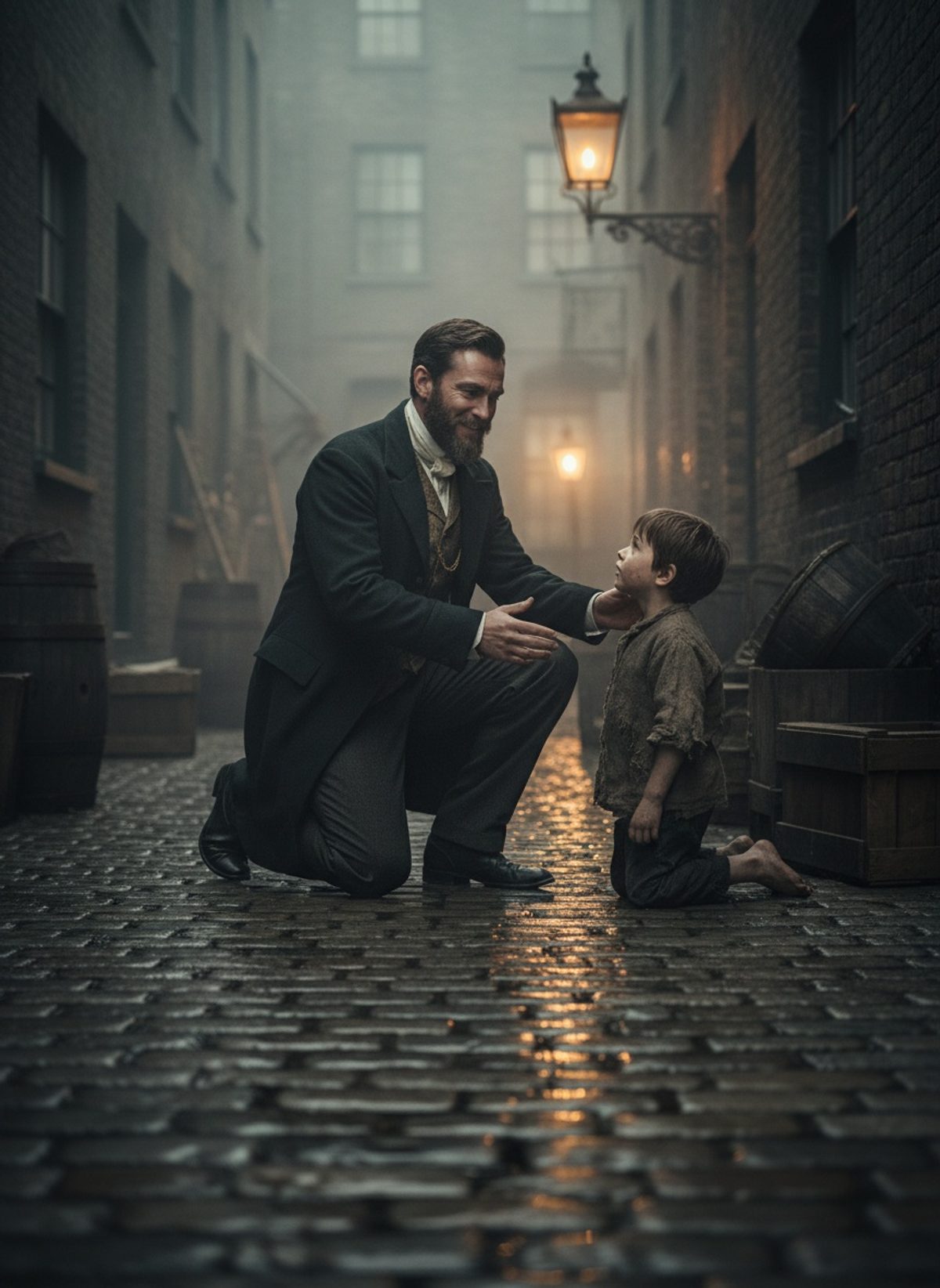
A biting wind scours the narrow cobbled streets of Victorian London, where fog clings stubbornly to the night like a shroud. The dim glow of gas lamps flickers, casting ghostly shadows that dance across the weathered bricks of the East End. It's 1884, and the heart of the city beats to the cries of the impoverished. Beneath this oppressive grey sky, where the soot of industry veils the stars, thousands of children find refuge only amidst refuse and doorways. The disquieting chorus of their plight reverberates through every alley. Amongst the destitute, one child's life, snuffed out by despair and the chill of an unforgiving winter, changes everything. His death becomes a catalyst for a promise, sown in compassion and destined to echo far beyond the murky confines of London's underbelly.
Thomas Barnardo, the son of Irish immigrants, was no stranger to adversity, yet he had a compassion that transcended the era's pervasive apathy. As a medical student and the son of a surgeon, Barnardo had the societal opportunity to embrace a respectable career. Instead, he chose the path less trodden, driven not by prestige but by purpose. It was a path illuminated by unintended discovery, as one evening he stumbled upon a boy, alone in the embrace of icy death in a filthy gutter. The boy’s name was John Somers, remembered by the nickname "Carrots," for the flaming shock of red hair that framed his young face. His demise, marked by anonymity and neglect, struck a piercing chord in Barnardo’s heart. He vowed that no child would endure the same fate, orphaned by circumstance and forgotten by society.
The streets of London's East End sprawl like a labyrinth, where poverty and disease intertwine with the cobwebs of neglect. In this world, children are both omnipresent and invisible. Their faces, etched by hunger and despair, paint a grim portrait the city seems content to overlook. Industrialization had turned the great city into a cauldron of wealth and inequality, and within its boiling core lay an underclass struggling to be heard. Barnardo, armed only with determination and a singular compassion, sought to provide more than just shelter; he aimed to restore voices that had been silenced by the cacophony of indifference.
In 1867, Barnardo opened the first of his now-famous homes for destitute children. He dared to do the unthinkable in Victorian society: he provided refuge without discrimination or prior selection, adopting a policy that none should ever be turned away. His approach was radical; rather than reproach the children for their circumstances or impose rigid criteria for entrance, he accepted them unconditionally. This policy eventually became the hallmark of Barnardo’s legacy. With each child who entered the warmth of his haven, he set a precedent of inclusivity, challenging the societal norms of class segregation and rigid moral judgments.
Read next: The Day a Surgeon's Son Freed a City's Children From the Dark
The interior of these homes was a stark contrast to the squalor outside. They were places infused with warmth and care—new foundations upon which the children could rebuild their lives. Barnardo understood that nourishment wasn’t solely about feeding hungry mouths but also about nurturing lost hopes. These safe havens focused on equipping children with skills that would empower them for a future beyond survival. Education, trades training, and moral instruction—tools that would arm them against the persistent shadow of poverty—were central tenets of this noble experiment.
The operation of these homes wasn’t without critics. In a society where charity was often meted with judgment, Barnardo’s altruistic endeavors were seen by some as overly idealistic, even reckless. Critics contended that by providing refuge to anyone, he encouraged vagrancy and laziness. Despite the harsh scrutiny, Barnardo persisted, galvanized by the belief that every life was an unwritten page and that he had the power to influence a better narrative. His homes continued to rise amidst skepticism, expounding a moral argument that was as much about conscience as it was about charity.
Read next: The Day a Surgeon's Son Stopped a City Poisoning Its Poor
The list of Barnardo’s homes expanded rapidly, each becoming a sanctuary where children could find stability amidst chaos. As the network grew, so did the stories of transformed lives. Young souls, once bound to the streets by chains of circumstance, were now apprentices learning trades, young women gaining skills for dignified employment. Barnardo understood that true charity reshaped destinies; it was not just an act of kindness but a profound commitment to forge futures.
In a time when the social structure of Victorian England was rigidly stratified, Barnardo’s legacy is not only in the homes he built but in the belief he instilled—of children valued beyond their birthright, poverty-stricken or not. By challenging the established order of things, Barnardo gave a voice to the weary echoes that once drifted lost among the fog-laden streets of London’s underworld. The children, their futures ignited anew, crafted stories of potential once thought inconceivable.
Thomas Barnardo’s work did not just provide shelter; it inspired an ideological shift. He awakened a societal recognition that each child, irrespective of their circumstance, possessed the potential to rise above with the right support. A century later, his personal promise to a boy found dying in the gutter has heralded a sentinel of universal philanthropy. His legacy compels us to reflect on how compassion can indeed reshape the marrow of society, offering life, dignity, and opportunity to those swept aside by the relentless tide of progress. In the shadows of a city that once dismissed them, the children of his homes found their place, ensuring Barnardo's vision remains indelibly woven into the fabric of history.