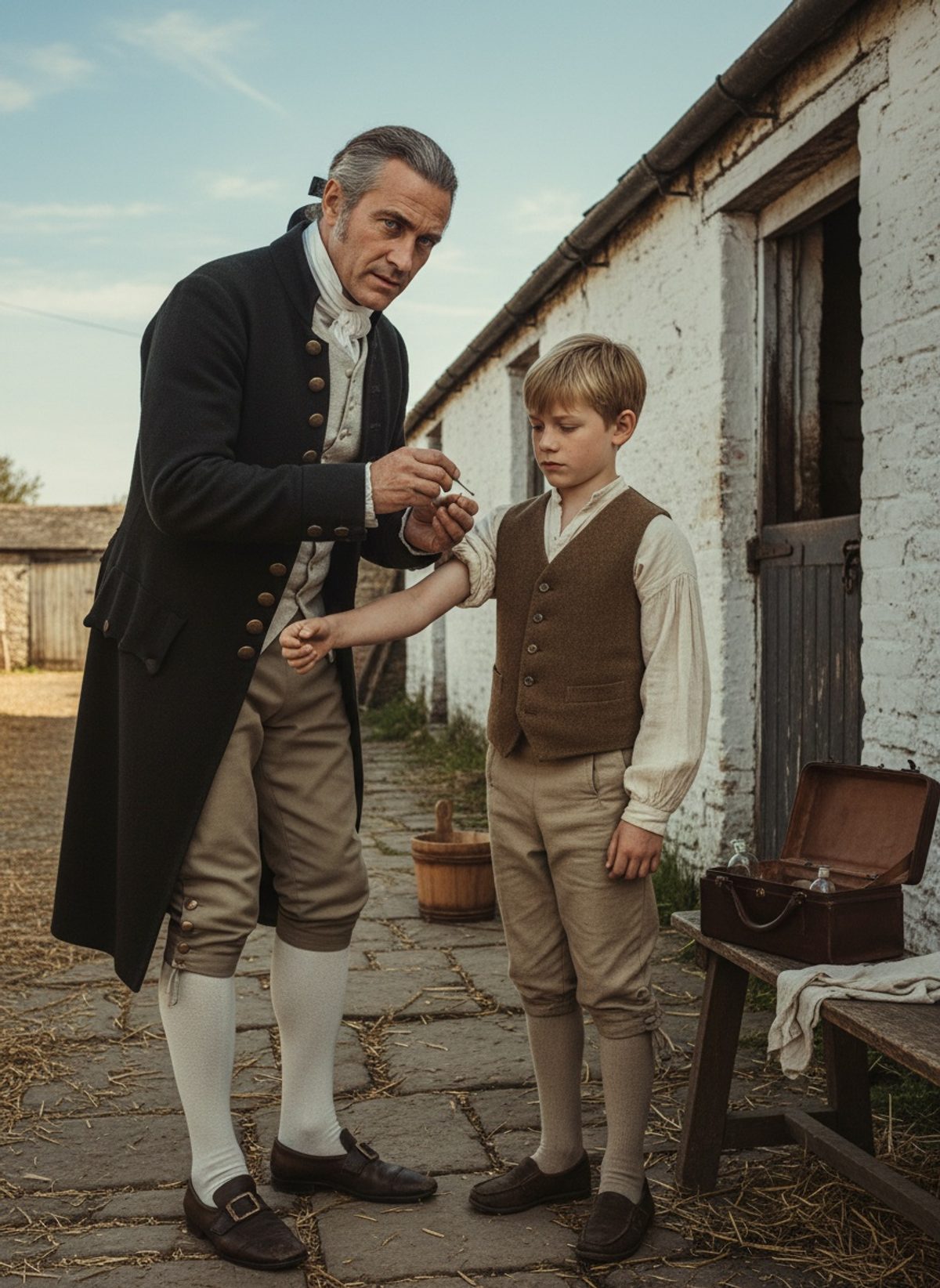
The morning sky in May of 1796 was a pale, washed-out blue over the Gloucestershire countryside, as a gentle sun cast its light upon dew-laden fields. The air was crisp, filled with the scent of grass and the distant sound of cows lowing. In a farmyard bathed in this serene morning light, a country doctor stood with a calm determination, holding a small, sharp lancet. This was no ordinary day, for this ordinary farm was about to become the stage for a medical revolution.
That doctor was Edward Jenner, the son of a tanner, standing resolutely before an eight-year-old boy named James Phipps. This seemingly modest gathering held the weight of countless lives yet to come, poised at the brink of an extraordinary breakthrough. Jenner had spent years observing and pondering, driven by an observation made by those who toiled in the dairies: milkmaids, often exposed to cowpox, seemed immune to the dreaded smallpox that ravaged populations indiscriminately.
Smallpox was a scourge, its mere mention invoking visions of pustules and fever, of death, misery, and irreversible change. The disease tolerated no social boundaries, afflicting both paupers and princes with equal brutality. Jenner, known among neighbors as a thoughtful physician with a penchant for observation, had often pondered the significance of the milkmaids' apparent protection. In a world where physicians still bled patients with leeches and diseases were not entirely understood, such a hypothesis was radical yet tantalizing, promising relief from suffering.
With the lancet keenly poised, Jenner approached young Phipps, the boy's presence there a testament to his father's trust in Jenner's careful reasoning. On the surface of the child's arm, Jenner made two small incisions and carefully introduced material from a cowpox sore he had collected from a local milkmaid named Sarah Nelmes. The deed was simple—a slight scratch, the introduction of a pathogen that was closely related to smallpox but thankfully far less harmful.
Read next: The Day a Blacksmith's Son Mapped the Blood Inside Us
The days that followed must have felt interminable, with every feverish moment dragging at the edges of hope and dread. Could cowpox truly render a person immune to smallpox? And if so, would this boy be protected? In those moments, the vibrant green of the surrounding pastures was untouched by the human drama unfolding within, timeless in its growth and oblivious to the unfolding potential of history.
A farmyard might seem a humble place for the birth of a medical miracle, but great ideas often flourish in the most unlikely of soils. As weeks passed, Phipps exhibited signs of a mild illness but harsh smallpox symptoms failed to appear. To definitively prove his theory, Jenner later exposed Phipps to actual smallpox, a risky endeavor that asked more of a father's faith than many would have been willing to give. Yet, the boy remained unaffected; his body unbowed by the specter of smallpox.
This small but significant pilot test of what came to be known as vaccination heralded an era where humans began to gain ground against one of their oldest enemies. Although Jenner’s work initially drew skepticism from some quarters, it also elicited wonder and hope. Here was a natural solution, elegant in its simplicity, deriving strength from the very disease it sought to prevent. With time, the scientific community began to accept Jenner’s findings, and the practice of vaccination spread beyond the confines of that Gloucestershire farmyard, carried by the whispers of hope it inspired.
Read next: The Day a Clockmaker's Son Tamed the Tides of Time
Yet, it is too simplistic to regard Jenner as an isolated genius. He was a man deeply enmeshed within his community, part of an intricate web of folklore, practical knowledge, and careful intellectual scrutiny. His insights were born from a synthesis of country wisdom and methodical inquiry—a rare amalgam that nurtured the seed of discovery. In this sense, the story of vaccination is also a story of rural life and its insightful, if sometimes unnoticed, contributions to science.
Today, Jenner's little experiment under the quiet British sky is often heralded as the starting point of modern immunology. It is a reminder that the path to understanding need not always follow the conventional course. Sometimes, it takes the courage to cut against the grain—to trust a milkmaid's tale about an immunity born from bovine interactions. What was once a single bold act in a bucolic English village ultimately evolved into a global campaign that would see smallpox eradicated from the face of the earth by the late 20th century.
Our history is replete with tales of heroism and innovation, of extraordinary leaps made during the most grounded moments. Jenner's development of the vaccine invites us to consider how many opportunities for such innovation surround us today, waiting for a curious eye and a steady hand. As we confront diseases new and old, Jenner's legacy serves both as a testament to the power of humble insight and a clarion call to remain vigilant, ever curious, and ever ready to question, to cut, and to change the world.